IMP, UNAI Sign Collaboration Agreement on Energy Transition
 By Perla Velasco | Journalist & Industry Analyst -
Fri, 06/05/2026 - 12:43
IMP and UNAI signed a General Collaboration Agreement on June 3, establishing a formal framework for joint energy research, technology transfer, and specialized talent formation. The partnership combines IMP's extensive industrial testing and laboratory capabilities with UNAI's network of engineering professionals and official UN climate change credentials.
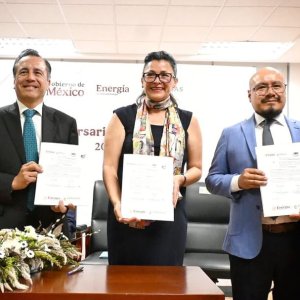
The Mexican Petroleum Institute (IMP) and the National Engineer Associations Unit (UNAI) signed a General Collaboration Agreement on June 3, formalizing a framework for joint action across research, technology development, talent formation, and the promotion of strategic projects for Mexico's energy sector. The agreement was signed by Elizabeth Mar, Director General, IMP, and Pedro Sánchez, President, UNAI.
Mar stated that the alliance represents an opportunity to identify strengths, complement capabilities, and build new collaboration routes in the face of the challenges confronting Mexico's energy sector, noting that the energy market is in transformation and that meeting today's opportunities requires joining forces across institutions, academia, industry, and professional organizations.
Sánchez described it as an honor to formalize the collaboration with an institution he characterized as one of worldwide prestige and determinant in the development of Mexico's oil industry, and highlighted that UNAI brings together talent, experience, and commitment to sustainable development, climate change, and the promotion of high-impact projects for Mexico.
What the Agreement Covers
The agreement contemplates collaboration in research, scientific and technological development; specialized training and talent formation; technology transfer, scaling, industrialization, and commercialization; exchange of scientific and technological information; development of innovation ecosystems and sectoral linkages; and the promotion of strategic projects for the energy industry.
The breadth of that scope reflects IMP's dual positioning in 2026: as Mexico's principal applied energy research institution and as an increasingly active convener of cross-sector alliances that bring its laboratory and industrial services capacity into contact with external organizations, from engineering chambers and industrial associations to academic institutions and state governments. The UNAI agreement is the latest in a series of institutional partnerships IMP has formalized in recent months.
IMP's Alliance-Building Strategy
The agreement with UNAI follows a pattern of institutional outreach that IMP has accelerated under Mar’s leadership since the Sheinbaum administration took office. In September 2025, IMP and the Centro de Ingeniería y Desarrollo Industrial (CIDESI) signed a collaboration agreement to strengthen applied research, technological development, and innovation with a focus on sustainability and energy transition, covering joint project execution, technical studies and services, and specialized talent formation.
Earlier, IMP signed a collaboration agreement with the Tecnológico Nacional de México, with Mar Juárez noting that IMP has spent six decades as the technological arm of PEMEX and that it intends to remain a central actor in Mexico's energy transition, while expanding its institutional network well beyond the hydrocarbons sector.
In February 2025, IMP signed an agreement with Concanaco Servytur, covering joint technological projects oriented toward optimizing production and transformation processes in the energy sector, strategic information exchange on innovation and sustainability, training programs for companies and entrepreneurs on energy efficiency, and the promotion of sustainable business models that foster productive investment.
The UNAI agreement adds an engineering professional organization to that network, one with a specific mandate around climate change and international engagement that complements IMP's technical and industrial orientation.
What Is UNAI?
UNAI was founded in 2003 and is a legally constituted civil association that integrates organizations including engineering colleges, associations, and technical societies from all branches of Mexican engineering, with participation from non-governmental and plural civil society organizations. UNAI has participated in all Conferences of the Parties (COPs) and is accredited as a non-governmental organization by the United Nations Framework Convention on Climate Change (UNFCCC), and has organized thirteen international forums on sustainable development and climate change.
That international profile, and specifically UNAI's COP accreditation, is directly relevant to the agreement's energy transition dimension. IMP increasingly needs to translate its applied research capacity into outputs that connect with global climate commitments and international technical standards. An alliance with an organization that operates in UNFCCC spaces provides a channel for that engagement that IMP's own institutional mandate does not cover.
The Broader Technology Transfer Agenda
The agreement arrives as IMP expands its applied research portfolio beyond its historical focus on hydrocarbons. In January 2026, IMP joined PEMEX, UNAM, and INEEL in launching a joint geothermal project, with IMP's director noting that the initiative should be the beginning of many joint projects for Mexico's energy transition, and that years of isolated efforts had limited past impact, making the current collaboration model a structural improvement.
The technology transfer, scaling, industrialization, and commercialization pillar of the UNAI agreement is among the most commercially significant. IMP holds a portfolio of proprietary processes and technologies developed over six decades of petroleum research, in areas including catalysis, refining processes, heavy crude treatment, CO2 capture, and more recently hydrogen and geothermal applications, that have historically moved slowly from laboratory to industrial deployment. Agreements that create formal pathways for commercialization and scaling through partner networks are one mechanism for closing that gap.
Mar has framed IMP's collaboration strategy in explicitly cumulative terms: not a collection of isolated agreements, but an institutional network whose combined capacity positions IMP and its partners as national and international references in technological innovation, contributing to social well-being, sustainable development, and the transformation of Mexico's strategic sectors. The UNAI agreement adds one more node to that network, with a specific emphasis on the engineering profession's role in the energy transition, a framing that positions IMP's technical output within the broader professional community responsible for executing Mexico's infrastructure agenda.
You May Like



Most popular