


Mexico Sets New Rules for Slots, Oversight at Airports
 By Teresa De Alba | Jr Journalist & Industry Analyst -
Mon, 09/01/2025 - 17:12
By Teresa De Alba | Jr Journalist & Industry Analyst -
Mon, 09/01/2025 - 17:12
Mexico’s government has enacted reforms to the Airport Law Regulation, introducing new procedures for the assignment and management of landing and takeoff slots at saturated airports. Published in the Diario Oficial de la Federación on Aug. 29, the changes establish criteria for prioritizing slot distribution and the framework for oversight, following allegations by US authorities of unfair practices at Mexico City International Airport (AICM).
The updated regulation establishes a subcommittee to coordinate and supervise slot usage. This body will include representatives from airport administrators, airlines, the air navigation service provider, and a designated slot coordinator acting on behalf of the Federal Civil Aviation Agency (AFAC).
The reforms allow the Ministry of Infrastructure, Communications, and Transport (SICT), through AFAC, to declare an airport saturated during specific hours. Under such conditions, slots will be allocated in series based on general rules approved by the authority. Historical precedence is defined as a key criterion: airlines must demonstrate that they operated at least 80% of their assigned slots during the equivalent season of the previous year, with no delays attributable to them exceeding 15 minutes.
Regarding new entries, 50% of available reserve slots will be designated for new competitors. A new competitor is defined as an airline with fewer than seven scheduled slots at the airport on the day of the request. The regulation also prohibits practices such as requesting slots without intent to operate them, using slots to block competitors, operating outside assigned schedules without valid justification, and requesting slot series solely to gain future allocation advantages.
Additionally, airlines may transfer or exchange slots if they have been operated for at least one year and the involved parties have no outstanding obligations. A second subcommittee has been established to evaluate delays and cancellations. Led by terminal administration, it will assess causes and assign responsibility.
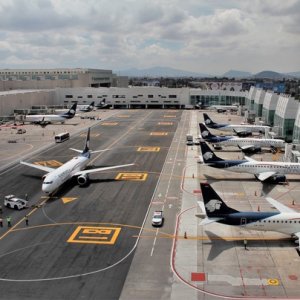
In 2023, AICM reduced its hourly operations from 61 to 43, later raising the limit to 44 in 2025. The US Department of Transportation (DOT) argued that the cuts disadvantaged US carriers while favoring Aeroméxico and Delta, warning that it could revoke antitrust immunity for the Delta–Aeroméxico joint venture.
On Aug. 18, 2025, Mexican authorities informed United Airlines, Delta Air Lines, and American Airlines that the withdrawn slots would be reinstated. United confirmed the update in a DOT filing following a call with Mexican officials, IATA, and the affected carriers. Details on slot distribution and timing have not yet been disclosed.
The original reductions were attributed to congestion and proposed infrastructure work that never materialized. US carriers argued that the measures restricted access to AICM and unfairly impacted foreign operators. The DOT later accused Mexico of violating the 2015 bilateral air agreement and responded with heightened oversight, linking the slot restoration to broader negotiations between both governments.
AFAC is required to update general slot rules within 30 business days. Subcommittees will review schedules, resolve conflicts, and propose improvements. Airport administrators may withdraw slots for non-compliance or unpaid debts. The decree includes criteria on punctuality, slot usage, and governance to ensure fair allocation.
You May Like






Most popular








