


Oil Price Plunge Knocks Helicopter Market
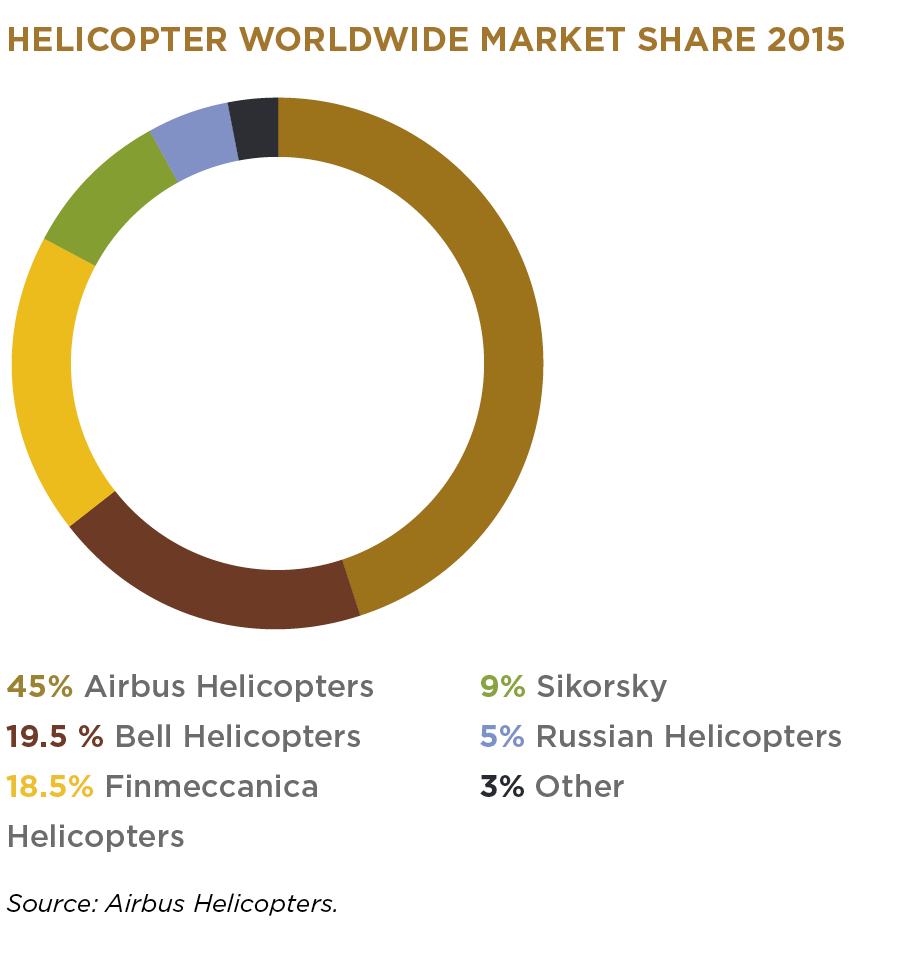
While part of the aerospace industry, helicopters operate in an entirely different fashion from aircraft and have a separate market and manufacturing chain. The global civil helicopter segment is valued at US$7.88 billion, according to Visiongain, and dominated by Airbus Helicopters. Although the OEM held 45 percent of the market in 2015, 1 percentage point up from the previous year, it faced a 16 percent reduction in deliveries to 395 from 471 between 2014 and 2015, the 2014 figure itself was a decline from 2013’s 497. Bell Helicopter, a subsidiary of Textron, is the second largest player with a 19.5 percent share. The company delivered 175 aircraft — 52 Bell 429s, 12 Bell 412s, 99 Bell 407s and 12 Bell 206L4s — in 2015, most of which went to North America. The same year, Bell Helicopters broke its own orders record for a single client with the newly launched Bell 407GXP, of which the buyer requested 200. The Italy’s Leonardo-Finmeccanica, which absorbed AgustaWestland on Dec. 31, 2015, ranks third at 18.5 percent. In fourth, with 9 percent of the market, is Sikorsky Aircraft, which was bought by Lockheed Martin in 2015 from United Technologies Corporation (UTC). Russian Helicopters stands fifth, followed by a series of smaller makers.
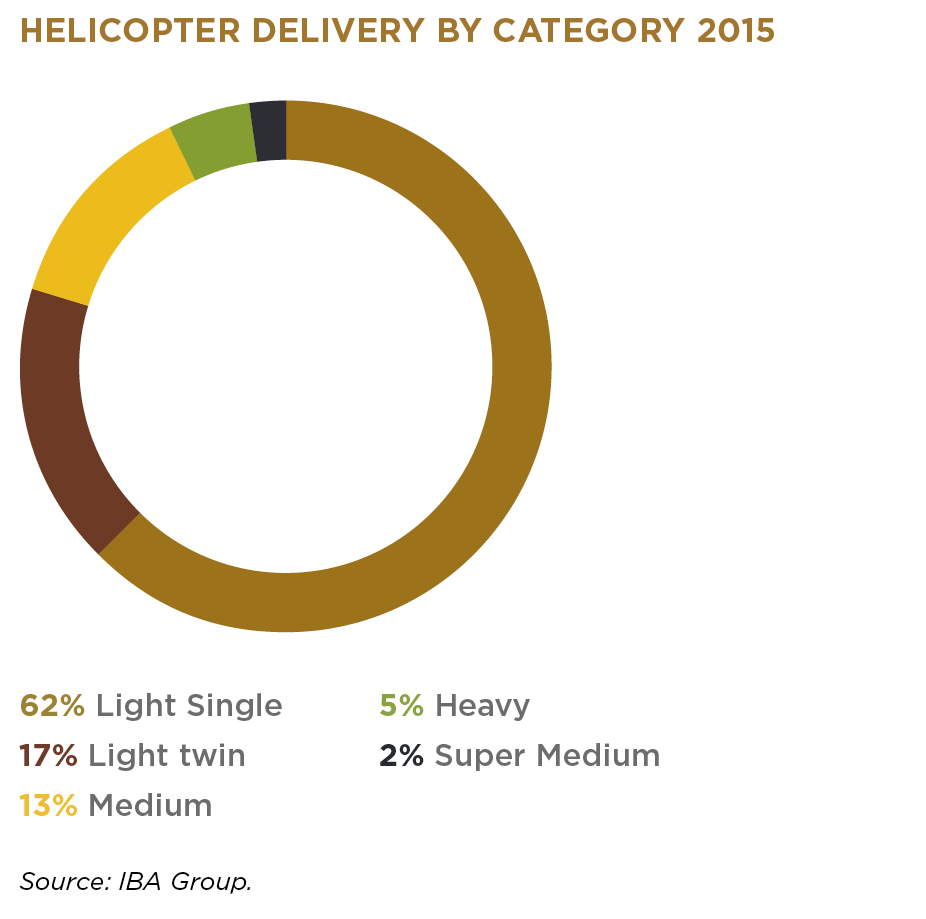
The existing helicopter market is dominated by the light single category, referring to helicopters with a single motor and capacity for one to five passengers. This segment represents 62 percent of sales, according to IBA Group. The light twin model, which has two motors but is otherwise similar to its single-engine cousin, holds a 17 percent share. Medium models, with a capacity of seven to nine passengers, and heavy helicopters, which can carry over 15 passengers, follow with 13 and 5 percent, respectively. In the middle of those weights is an emerging category, the “super-medium.” These models, of which the Airbus H175 and AgustaWestland AW189 stand out, are designed to meet the needs of the oil and gas industry. They mix the range and capacity of heavy helicopters — 19 passengers for the H175 and 16 for the AW189, for example — with a lower weight and thus have reduced fuel use and a smaller carbon footprint, says Aviation Week. Both the AW189 and the H175 were introduced to the market in 2014. By June 2016, 30 AW189 had been delivered, with 150 orders pending. Orders for the H175 exceeded 100 by mid-2016. The first H175 delivered to the Americas belongs to Mexico’s Transportes Aereos Pegaso and arrived on Aug. 29, 2016.
OIL TROUBLE
Heavily dependent on the oil and gas industry, the helicopter market has faced headwinds since last year when the price
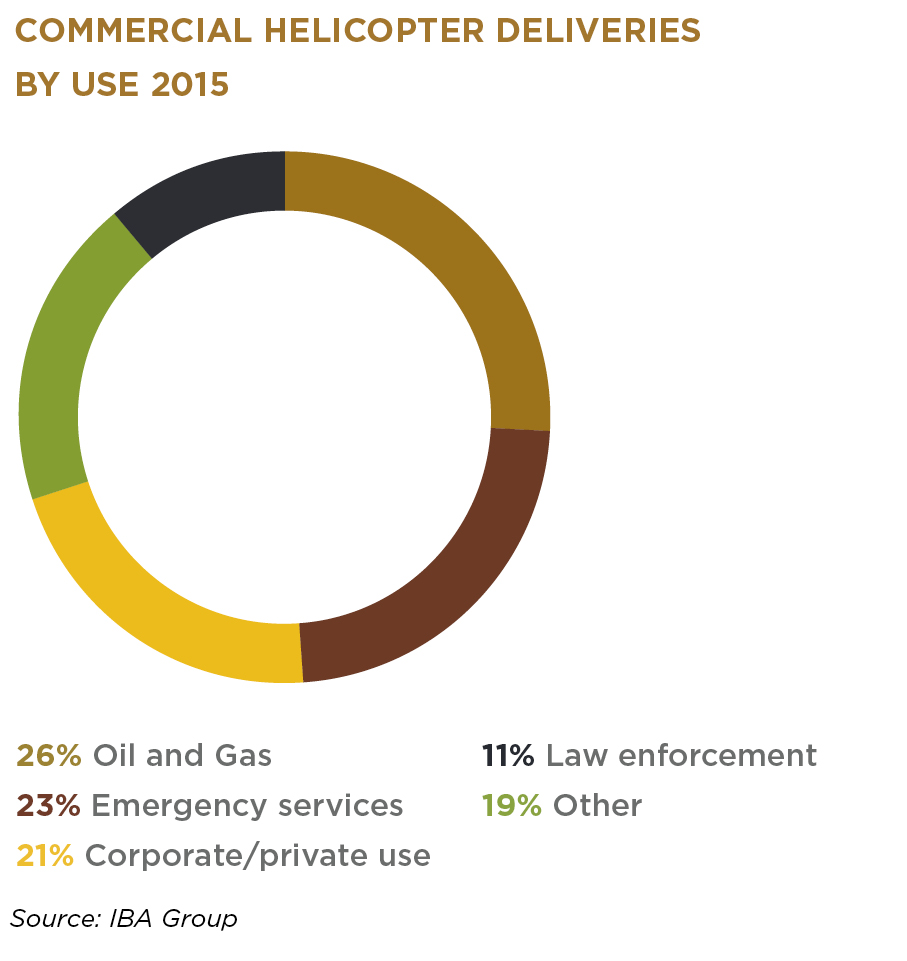
of oil went into a prolonged tailspin. From its heady days above the US$100 mark in 2014, the price of a barrel of crude now rests in the US$50 range. The knock-on effect has been explicit. The oil and gas industry is a main market for commercial helicopters, representing 26 percent, according to AgustaWestland. They are used to transport workers to and from oil platforms, a process that would be too time consuming in a boat, and to monitor remote locations. When exploration and monitoring is reduced, so is helicopter use and as the O&G industry fell back, helicopters sales took the hit. Manufacturers also suffered as deliveries dropped. In the first quarter of 2014, when oil prices were over US$100, 580 helicopters were delivered. The following year, when oil prices fluctuated between US$50 and US$60, only 448 were delivered, according to Flight Global. This year, Honeywell decreased its projection for total helicopter deliveries between 2016-20 by 400 helicopters.
MEXICAN MANUFACTURERS
The difficulties in the sector have helped make Mexico a more attractive location as manufacturers look to save on costs. Airbus Helicopters invested US$100 million to build a 12,000m2 plant in Queretaro. A prime location, quality human capital and a number of manufacturers already operating in the state factored into the decision, says Francisco Navarro, Director General of Airbus Helicopters in Mexico. The location holds potential for the company. “Our plant in Queretaro is still growing and can increase its capacity by four or five times,” says Navarro.
In Chihuahua, Bell Helicopter makes cabins and harnesses and does subassemblies for the Bell 206L, 407, 412, and 429 and cabins for the Bell 407 and 429. Luis Azúa, General Manager of Bell Helicopter at Textron International Mexico, says the company chose the city thanks to its convenient location, the time zone and the manufacturing expertise in the state acquired from the automotive industry. While Bell Helicopter is strong in both civil and military aircraft, this plant only manufactures for civilian purposes. In October 2015, Textron opened its first administrative office in Mexico City from which Bell Helicopter will support clients in the region.
Mexico’s increasing expertise in the aerospace sector alongside its lower operating costs, mean it continues to be a cost-saving alternative for manufacturing companies across the world, despite the headwinds the industry is facing.
You May Like


Most popular








