


OECD Warns Tariffs Threaten North America’s Economic Stability
 By Adriana Alarcón | Journalist & Industry Analyst -
Tue, 03/18/2025 - 13:15
By Adriana Alarcón | Journalist & Industry Analyst -
Tue, 03/18/2025 - 13:15
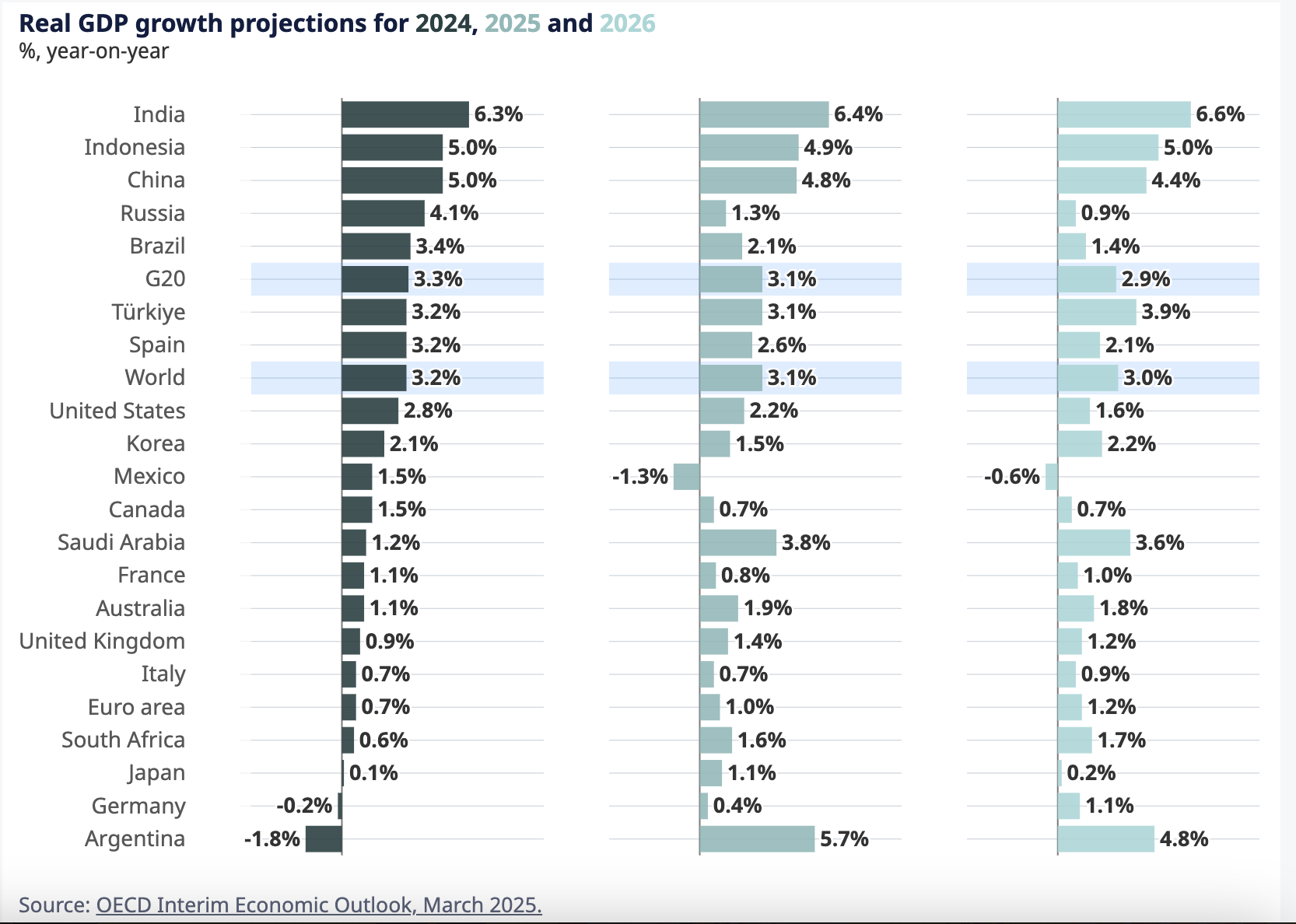
The latest OECD Economic Outlook Interim Report warns that escalating trade restrictions threaten North America’s economic stability. The United States’ recent tariff policy is set to slow growth across the region. Canada and Mexico are expected to face severe economic consequences, with Mexico potentially entering a recession in 2025. The report highlights that a more moderate tariff approach could ease economic strain, leading to higher growth and lower inflation.
A significant concern for North America's economic stability is the recent escalation of trade restrictions. The United States enforced a 25% tariff on steel and aluminum imports at midnight on March 12, affecting nearly US$150 billion worth of metal-based products, from key trade partners, including Canada, Mexico, the European Union, Japan, South Korea, the United Kingdom, Australia, Argentina, and Brazil, MBN reported. Additionally, tariff rates on all merchandise imports from Canada and Mexico to the United States are assumed to rise by an additional 25%, except for lower tariffs on potash and energy products. Canada has already retaliated with selective tariff increases, while Mexico has expressed intentions to respond if these tariff hikes materialize in April 2, 2025, when reciprocal tariffs are set to be imposed.
As tariff increases take effect, growth in the United States, Canada, and Mexico is projected to slow, with particularly severe impacts in Canada and Mexico due to their greater trade openness and strong economic ties with the United States. These negative effects will only be partially offset by potential monetary policy easing. Real GDP growth in the United States is expected to decelerate from 2.8% in 2024 to 2.2% in 2025 and 1.6% in 2026. In Canada, growth is projected to slow from 1.5% in 2024 to 0.7% in both 2025 and 2026. Meanwhile, Mexico is expected to enter a recession, with output declining by 1.3% in 2025 and 0.6% in 2026.
A lighter tariff scenario, where the United States maintains exemptions for imports from Canada and Mexico under the USMCA beyond April 2025, would lead to stronger economic growth. Under this scenario, Canada’s growth is projected at 1.3% in both 2025 and 2026, while Mexico’s economy would see modest growth of 0.1% in 2025 and 0.8% in 2026. US growth would also be slightly stronger, reaching 1.7% in 2026.
Inflation projections have risen compared to previous estimates, as slower growth is offset by the inflationary effects of tariffs. Headline inflation in the G20 is expected to decline from 5.3% in 2024 to 3.8% in 2025 and 3.2% in 2026, with core inflation in advanced G20 economies remaining above central bank targets in over half of these countries, including the United States. In Mexico, the inflationary impact of tariffs in 2025 is expected to subside in 2026 as economic growth weakens.
In the lighter tariff scenario, inflation would be lower in Mexico, Canada, and the United States. Mexico’s headline inflation is projected to be 3.7% in 2025 and 3.2% in 2026, while Canada’s would be 2.6% in 2025 and 2.5% in 2026, and the United States would see inflation at 2.7% in 2025 and 2.5% in 2026. These lower inflation projections would also lead to slightly lower policy interest rates in all three countries.
Upside risks to the forecasts remain, particularly if tariff restrictions are reversed or trade barriers are lowered, which could boost economic growth and reduce inflation. In Mexico, monetary policy is expected to remain restrictive in both the baseline and lighter tariff scenarios, despite mild easing in nominal policy rates.
Labour Market and Wages
Despite economic headwinds, labour market conditions in Mexico and North America remain relatively strong. Unemployment rates have remained low, although employment growth slowed in the latter half of 2024. Wage growth has been steady but varies across regions, with nominal wages outpacing pre-pandemic levels in the United States and Canada but lagging in some sectors in Mexico. The imposition of tariffs and subsequent price increases could lead to higher wage demands, adding to inflationary pressures.
Banamex Remains Optimistic on Mexico’s Trade Outlook Amid Market Volatility
Despite OECD’s economic outlook Banamex executives suggest that Mexico is unlikely to face prolonged high tariffs, despite recent trade uncertainty. Banamex executives argue that broad, sustained tariffs beyond the USMCA framework are unlikely, though selective tariffs may target certain sectors. It emphasizes that Mexico’s long-term economic fundamentals remain strong, benefiting from geographical proximity to the United States, trade experience, and economic complementarity. Mexico has faced economic uncertainty in the past and has consistently emerged stronger, as seen in previous trade disputes under USMCA during Trump’s first term, MBN reported.
However, in the United States, investor sentiment remains fragile, as evidenced by a sharp downturn in US stock markets. Last week, the Dow fell 890 points (-2.08%), while the Nasdaq dropped 4%, marking its worst day since September 2022. Tech stocks were hit hardest, with Tesla losing 15.4%, Nvidia down 5%, and Palantir dropping 10%. Uncertainty surrounding Trump’s tariff policies fueled the selloff, with market volatility reflected in the Cboe Volatility Index (VIX) surge, signaling heightened investor fear, as previously reported by MBN.
You May Like








Most popular








