


AICM Slot Shifts Spark Industry Concerns Over Legal Basis
 By Teresa De Alba | Jr Journalist & Industry Analyst -
Fri, 11/21/2025 - 09:19
By Teresa De Alba | Jr Journalist & Industry Analyst -
Fri, 11/21/2025 - 09:19
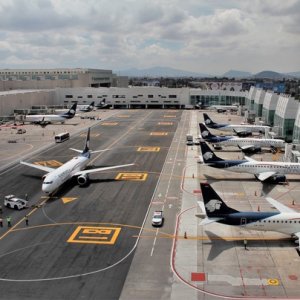
Mexico’s aviation community is questioning the federal government’s handling of recent announcements regarding slot availability at Mexico City International Airport (AICM), after President Claudia Sheinbaum stated that Mexican carriers would transfer slots to US airlines. Experts said the announcement lacked clarity, was not supported by existing bilateral agreements and contradicted established slot-allocation procedures.
María Larriva Sahd, an air traffic and operations specialist, told A21 that the statement stemmed from “misinformation provided to the President,” noting that no airline would voluntarily give up a slot—“much less to a foreign carrier”—given the economic value of those time windows. She added that such a transfer “is illegal,” as slot allocation is managed by an airport committee rather than through bilateral concessions. Larriva Sahd said AICM can handle 61 operations per hour, but operates under what she described as a “simulated capacity” of 44, a figure that excludes irregular operations such as some cargo or government flights.
The announcement followed a DOT order requiring Aeroméxico to cancel its AIFA routes to Houston and McAllen, as well as 11 additional planned flights from Aeroméxico, Volaris and Viva. The agency has also frozen new authorizations for US-bound flights from AICM and warned it may revoke permits for Mexican carriers operating mixed passenger–cargo services, adding pressure to an already strained bilateral aviation environment.
Larriva Sahd said Sheinbaum’s comments created the perception of an “open skies” scenario in which the government would “take from those with rights to give to a foreign operator.” She noted that the President later adjusted her stance, saying the government would instead work to expand AICM’s capacity. However, Larriva Sahd warned that unclear communication could expose Mexican airlines to additional US penalties, adding that the DOT “is defending the interests of its carriers,” while Mexican airlines “do not have government support.”
Pablo Casas Lías, director, National Institute of Legal-Aeronautical Research, told A21 that the announcement suggested authorities were pressuring airlines to avoid friction with the DOT. He argued that meeting US requirements would first require restoring AICM’s capacity to 61 movements per hour, as the DOT has requested, stating that “there is no technical justification for operating at reduced capacity.” He also noted that cargo operations represented only 3% of AICM traffic and occurred during off-peak hours, questioning the need to restrict them.
Casas Lías added that the government continues prioritizing passenger operations at Felipe Ángeles International Airport (AIFA), despite its limited connectivity, saying that diverting flights from AICM “strains the system” without addressing airline operational needs. Specialists say industry uncertainty will persist until the federal government clarifies its negotiating position with the United States and defines a coherent slot-management policy for AICM.
The federal government reiterated that the Suburban Rail extension from Lechería to AIFA will be completed before the 2026 World Cup, though observers note that AIFA’s connectivity challenges stem largely from delays in this project. The Transport Ministry estimates a 39-minute trip from Buenavista to AIFA once completed. Launched in 2021 and now 87% complete, the slow progress has limited AIFA’s ability to function as a fully operational passenger hub.
You May Like







Most popular








