


Is AI Becoming the Next Great Market Bubble?
 By Diego Valverde | Journalist & Industry Analyst -
Mon, 11/24/2025 - 11:30
By Diego Valverde | Journalist & Industry Analyst -
Mon, 11/24/2025 - 11:30
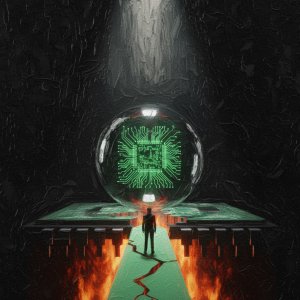
While investment in AI is rising, critics warn that an AI bubble is coming, and it could be one of the biggest and most dangerous the world has seen.
Michael Burry, Peter Thiel, and the SoftBank conglomerate, sold all their shares and dismantled their positions in top semiconductor manufacturer NVIDIA, subsequently betting against it and against the "prominent" AI market. Some investors say that these are not simply profit-taking moves, but rather a financial statement anticipating a severe structural correction, if not a crash, in a market whose valuations are supposedly no longer responding to traditional accounting logic, reports the Financial Times.
This sale of shares suggests a disconnect between their price and the operational reality of these companies, indicating that investors might have been motivated by earnings projections, gradually inflating a "bubble" that could burst at any moment. If it is real, this bubble would leave no company immune, says Sundar Pichai, CEO, Alphabet.
"Make no mistake, I think this is the biggest and most dangerous bubble the world has ever seen," says Julien Garran, Researcher and Partner, MacroStrategy Partnership.
What is Behind the "Smart Money" Movements?
Burry, known for predicting the 2008 economic crisis, says that the market is valuing AI companies based on "artificially inflated" profitability through accounting engineering, specifically in the way data center hardware is depreciated.
"The risk for the market is that it is underestimating this difference between theoretical useful life and actual useful life. And being in a new cycle of innovation, this issue raises more uncertainty around these measures," says Franco Macchiavelli, Head of Analysis, Admiral Markets Group.
Burry has placed massive put options (the right to sell a stock at a fixed price before a deadline or "insurance" against a fall in price) against NVIDIA and Palantir, totaling US$1.1 billion between both of them. His strategy is a bet that financial projections are unsustainable and that future earnings will not be able to justify price multiples.
Thiel suggests that the market is behaving as it does in the final stages of a classic bubble: investors stop evaluating fundamentals and start investing money in a sector simply because prices keep rising. In essence, he believes that AI demand is real, but not all companies will turn it into long-term profits.
"If investment in AI consolidates (we are not talking about a decline, just a slowdown and consolidation), they would have very little room for maneuver to continue beating expectations," says Macchiavelli. "A serious deterioration is not necessary; it is enough for growth expectations to stop improving at the rate that the market is already discounting."
The "Wishing Well" of the Tech Industry (2020-2025)
To understand the background to these financial decisions, it is necessary to analyze the tech stock market performance since their peak in 2020, defined by the interaction between structural demand and monetary policy.
The first phase, which took place during the pandemic, saw a convergence of forced digital adoption and unprecedented monetary stimulus. With interest rates close to zero, the market maximized the Net Present Value (NPV) of future cash flows, leading the Nasdaq-100 to an explosive return of 47.58% in 2020 alone. However, this euphoria underestimated the risk of inflation.
The cycle changed abruptly in 2022. Faced with persistent inflation, central banks adjusted rates upward, increasing the cost of capital and drastically reducing the present value of future profits for growth companies. The result was a historic correction of negative 32.97% for the Nasdaq-100. Following this crash, the market found a new structural growth boom in Generative AI starting in 2023. Despite high rates, there was a "flight to quality" toward the "Magnificent Seven," perceived as essential infrastructure.
As of November 2025, this cycle has culminated in an unprecedented concentration of power. The Nasdaq-100 is trading above 24,000 points, and the "4 Trillion Club" has been consolidated, led by NVIDIA (the only one to have surpassed this line to US$5 trillion), Microsoft, and Apple. This behavior indicates that technology investment has mutated, no longer perceived as a speculative growth bet, but rather as an investment in critical infrastructure, where dominance of AI bottlenecks theoretically guarantees an unbreakable market.
However, the situation presents metrics that, according to some macroeconomic analysts like Burry, Thiel, or Machiavelli, exceed historical precedents for overvaluation. According to Garran's data, the misallocation of capital in the United States — which currently encompasses not only AI, but also real estate, venture capital (VC), and crypto assets — is already 17 times greater than the dot-com bubble and four times greater than the 2008 real estate bubble. This accumulation of capital in risky assets suggests systemic fragility, where a correction in the technology sector could have "devastating effects on the overall economy."
The Relation with the Crash of 1929
Although there is a tendency to compare the potential AI bubble with the recent dot-com crisis and the collapse of the real estate market in 2008, it is the stock market crash of 1929, which plunged the United States into the Great Depression for 10 years, that shares similar patterns, albeit with different mechanisms.
The 1929 crash occurred because many people began buying stocks using borrowed money. That demand caused prices to rise far above their actual value. When some investors began to doubt that the stocks were worth that much and started selling them, prices fell sharply. This generated fear and massive selling, which ended up crashing the entire market.
The situation is different in the 2020s. While there is no bubble based on direct debt to buy shares, there is some indirect and systemic leverage, say analysts. In recent years, the market has seen such low rates that investors have sought returns in riskier assets compared to commodities or critical infrastructure (such as technology, crypto, or startups). This constant search for returns has made many sectors dependent on these valuations remaining high in order for the entire financial system to remain stable.
The biggest difference, and perhaps the greatest danger today according to investors, lies in the concentration of risk. While in 1929 vulnerability was spread across multiple stocks in multiple industries, today the S&P 500 is disproportionately dependent on the performance of a handful of companies, mainly technology companies.
As of Oct. 31, 2025, just 20 companies accounted for 50.8% of the S&P 500's total market value, but those companies generated only 9.1% of its total profits, reports Yahoo! Finance.
According to Garran, a crash in the "Magnificent Seven" would not be an isolated event, but a systemic failure that would drag down global index and pension funds. In addition, there is a physical vulnerability in the supply chain: dependence on a small number of semiconductor producers introduces a risk of a "whip effect," where sudden changes in demand or geopolitical tensions can paralyze entire industries.
As in the 20th century, when financial instability led to political radicalization, the risk transcends the economic sphere. Supremacy in AI is now a matter of national security. A collapse in the capital markets that finance this infrastructure, according to investors who claim the existence of a "bubble," could cede the technological advantage to rival powers, altering the global geopolitical balance.
"There are two ways I could be wrong. One is that it simply takes longer to break than I thought. Which, to be honest, has already happened," says Garran to CNN. "If this continues for another year or two because they managed to persuade someone to provide them with funding, more people will be doing things that are not going to generate profits. The future is not going to be so bright."
What Does the C-Suite Say?
Both during the Crash of 1929 and the 2008 real estate crisis, leaders in the financial and real estate industries strongly defended their markets, arguing that their stability, and even their endless growth, was more than guaranteed.
"Well, unquestionably, housing prices are up quite a bit; I think it is important to note that fundamentals are also very strong. We have got a growing economy, jobs, incomes. We have got very low mortgage rates. We have got demographics supporting housing growth. We have got restricted supply in some places. So it is certainly understandable that prices would go up some. I do not know whether prices are exactly where they should be, but I think it is fair to say that much of what has happened is supported by the strength of the economy," Ben Bernanke, then Chairman, Federal Reserve, told CNBC in 2005.
On the other hand, there is no monolithic consensus among industry leaders on the nature of this “AI bubble”. Bill Ford, Chairman and CEO, General Atlantic, and Philippe Laffont, Founder and Portfolio Manager, Coatue Management, say that valuations in the technology sector are high, but argue that market dynamics differ from the dot-com bubble.
Both point out that large public companies have unprecedented investment capacity, driven by structural advantages in scale and cash flow generation. While they acknowledge the risks associated with rapid increases in valuations, they point out that market leaders have established business models and strong balance sheets, which reduces the likelihood of a collapse similar to that of 2000 and reinforces their conviction in the continuity of the investment cycle in AI.
Mary Callahan, CEO, JP Morgan Asset & Wealth Management, categorically rejects the bubble label. She argues that AI represents an opportunity for efficiency that companies cannot ignore, suggesting that the market is simply discounting this future transformation. In contrast, Alphabet’s Pichai maintains a more cautious stance. Pichai has acknowledged elements of "irrational exuberance" in the market and warns that "no company will be immune" if the supposed bubble bursts.
Some argue that the problem might be smaller than expected. "We are not in an AI bubble, but an LLM bubble," says Clem Delangue, Co-Founder and CEO, Hugging Face. He argues that excessive investment is mistakenly focused on the belief that a single massive model will solve all problems, when the future likely belongs to specialized and efficient models.
Another problem might be physical limitations. Jason Snyder, Contributor, Forbes, argues that AI infrastructure is constrained by thermodynamics and energy supply, real factors that anchor demand to tangible assets, differentiating this cycle from the purely digital speculation of the past.

Most popular








