


Mexico Boosts Digital ID Security With Llave MX, CURP Integration
 By Diego Valverde | Journalist & Industry Analyst -
Fri, 09/26/2025 - 12:10
By Diego Valverde | Journalist & Industry Analyst -
Fri, 09/26/2025 - 12:10
Mexico is implementing a new cybersecurity shielding strategy to consolidate its national digital identity initiative. The program, which will be supported by the cybersecurity company IQSEC, is centered on the Llave MX platform and the biometric CURP. It aims to securely unify citizen interaction with the government and the private sector, marking a significant step in the country's digital transformation.
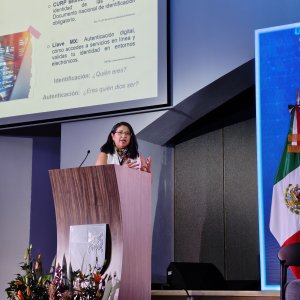
"The cybersecurity shielding for Llave MX in this digital transformation process is not an action but a necessity; it is an indispensable condition to guarantee its secure operation and protect millions of citizens," says Alicia Trejo, Legal Manager, IQSEC, during the 2nd National Cybersecurity Forum, hosted by Alianza Mexico Ciber Seguro.
Mexico's transition toward an integrated digital ecosystem responds to a tangible need for modernization and administrative efficiency. Data from the 2024 National Survey on the Availability and Use of Information Technologies in Households (ENDUTIH), conducted by Mexico's National Institute of Statistics and Geography (INEGI), indicate that the country has 100.2 million internet users. This figure represents 83.1% of the population. Among this universe, 35% of urban users and 23% of rural users already interact with government entities through digital means.
This landscape prompted the National Strategy for Simplification of Procedures. At the start of the current administration, the federal government managed over 7,000 procedures, reports IQSEC. Thanks to simplification efforts, that number has been reduced to 5,707. Considering that an average citizen performs 486 procedures throughout their life — and that 85% of them are at the state and municipal levels — the need for a unified platform becomes evident.
To support this transformation, the National Law to Eliminate Bureaucratic Procedures was enacted, establishing Llave MX as the primary authentication mechanism. The goal is to build a unified digital identity that simplifies the citizen-government relationship by standardizing access to services across all three levels of government.
Security Architecture and Governance
Consolidating a digital identity system of this magnitude demands a robust and multi-faceted security approach. The strategy Trejo describes is based on the distinction between the foundational identity (the biometric CURP as the sole source of identity) and the authentication mechanism (Llave MX, which verifies a user's claim to an identity).
The success of and trust in this ecosystem, Trejo says, depend on cybersecurity shielding based on the following technical pillars:
-
Zero Trust Architecture: This principle operates on the premise that no access is trustworthy by default. It requires strict authentication for every access request, granular authorization and continuous monitoring to detect and neutralize potential threats before they materialize.
-
Multifactor Authentication (MFA): This combines multiple verification methods, such as passwords and biometric data like facial recognition or fingerprints, to build a robust authentication process. Technologies such as liveness detection, supported by AI, are crucial to prevent impersonation attempts using videos or generated images.
-
End-to-End Encryption: This protects information both at rest (stored in databases) and in transit (during communication). Advanced algorithms are used to prevent the reading or alteration of data, even if it is intercepted. The dissociation of biometric data from demographic data adds another layer of privacy protection.
-
Active Monitoring and Incident Response: This involves implementing systems, often enhanced by AI, that analyze system behavior in real time. This allows for anomaly detection and the anticipation of attacks, ensuring an immediate response to contain any security compromise.
Governance and Multisector Collaboration
The strategy extends beyond technology. In September 2025, the Sectorial Program of the Digital Transformation Agency formally stated in its Strategy 2.5, with the objective of extending the use of digital identity to the private sector, including the validation of contracts through Llave MX.
This approach seeks to eliminate the proliferation of digital identities and the duplication of databases, which increase the risk surface. The goal is not to centralize a single "mega-database" but to interoperate securely with existing databases from entities like the Tax Administration Service (SAT), the Ministry of Foreign Affairs, and the National Electoral Institute (INE) to strengthen digital identity governance.
The first government report of the current administration cited 8.8 million registered users on Llave MX. The Digital Transformation Agency later updated this figure to 11.9 million, driven by the integration of social program beneficiaries.
Trejo says that building a cyber-secure Mexico is not a task for the government alone; a synergy among the public sector, private industry, academia, and civil society is essential. Collaborative forums are fundamental to democratize knowledge, align efforts with international standards, and adopt cutting-edge technologies. These actions lay the foundation for a digital future that is inclusive, efficient and, above all, secure.
You May Like







Most popular








