Mayan Train Derails in Izamal
 By Adriana Alarcón | Journalist & Industry Analyst -
Wed, 08/20/2025 - 11:15
By Adriana Alarcón | Journalist & Industry Analyst -
Wed, 08/20/2025 - 11:15
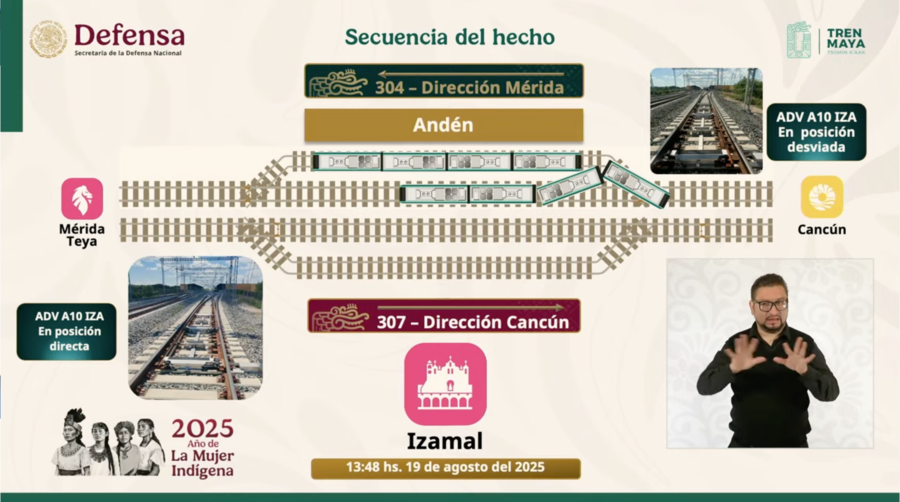
On Tuesday afternoon, the Mayan Train experienced a derailment at the Izamal station in Yucatan. Trains 304 and 307, traveling from Cancun to Merida, were maneuvering at low speed onto the station platforms when one of the cars partially derailed.
According to an official press release, security protocols were immediately activated and all passengers were unharmed. Travelers were transferred by bus to their final destinations while an evaluation committee was set up to investigate the cause of the incident.
Technical Details of the Incident
During this morning's press conference, Óscar Lozano, Director General, Mayan Train, explained that the problem occurred when train 304 took the direct railway due to a change in track positioning, while train 307 was stationed on the platform.
Lozano says that as the train advanced, a track switch system malfunction caused an unexpected movement. Although track switches are automated from the Merida control center, the system unexpectedly changed position as the third car of train 304 passed, forcing one of its bogies off the track.
“It is not a derailment, but a track incident,” says Lozano. “Out of eight bogies, only one left the track. The car leaned slightly against train 307, which was stationary, causing the visual effect of an incline.”
As a corrective measure, Lozano says that authorities will analyze the installation of mechanical fasteners (clamps) to prevent unauthorized movements of track devices and introduce a secondary verification mechanism for switch alignment.
Manual Versus Automated Systems
Despite stating that the incident was triggered by automated systems, Lozano had previously acknowledged in an interview three weeks ago with Joaquín López Doriga, that many track changes are still carried out manually by railway workers across much of the route.
“These systems are essential for trains to access stations, platforms, and passing tracks,” Lozano said at the time, recognizing that automation is still incomplete. He added that once the signaling system is fully operational, trains will be able to increase their top speed from 140 km/h to 160 km/h.
Lozano said today that he does not believe it was a human error, as this is an automated process, but it can also be an electrical problem. He adds that the cause is yet to be determined by the committee.
Previous Incidents
This is not the first incident involving the Mayan Train. On March 25, 2024, a carriage derailed near Tixkokob station, also in Yucatan, during a trip to Cancun. No injuries were reported, and only minor damage occurred, MBN reports.
At that time, the operator formed a commission to determine the cause, and on April 2, 2024, Minister of National Defense Luis Cresencio Sandoval suggested that the failure may have stemmed from improperly secured clamps in the track system.
Next Steps
Authorities stressed that safety remains a priority and that the investigation into the Izamal incident will determine specific corrective actions to prevent recurrence. “Once the causes are established, the necessary measures will be taken to guarantee the safety of passengers and operations,” Lozano says.
It is expected that the report will be ready in two weeks. The analysis will review the recordings, the orders given at the train dispatch center, at the zonal control post, the responses from the engineers, what happened during the event and what was reported, whether or not the protocols were applied, why the call was made for the track device, and whether it was due to a deficiency in the railway signaling system or if someone activated it.
You May Like








Most popular