


Sheinbaum Presents PEMEX’s New Fiscal Regime, Plan
 By Perla Velasco | Journalist & Industry Analyst -
Fri, 11/15/2024 - 10:10
By Perla Velasco | Journalist & Industry Analyst -
Fri, 11/15/2024 - 10:10
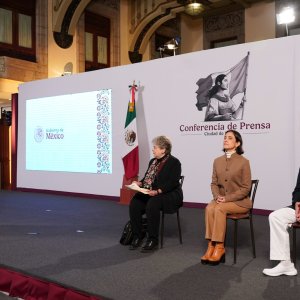
The government presented the National Strategy for the Hydrocarbons and Natural Gas Sectors, part of the upcoming National Energy Plan. Luz Elena González, Minister of Energy, and Víctor Rodríguez, PEMEX CEO presented the plan. Edgar Armando Zamora, Deputy Minister of Finance and Public Credit, presented the new financial scheme for PEMEX and its new fiscal regime. President Claudia Sheinbaum reiterated her commitment to achieving energy sovereignty and presented the new plan for PEMEX as a plan to “allow it to optimize its revenues and strengthen investment.”
PEMEX’s New Fiscal Scheme
Zamora introduced a new fiscal regime for PEMEX, named the “Oil Right for Well-Being.” This aims to simplify PEMEX’s fiscal obligations and enhance its operational efficiency. Under presidential instructions, the existing three oil contributions from five fiscal regions (Exploration, Hydrocarbon Extraction, and Shared Utility - DUC) will be consolidated into a single “Oil Right for Welfare” with two fiscal regions. This consolidation is designed to streamline taxation and leverage PEMEX’s productive capabilities.
For the new taxation model, considerations included the estimated production platform for 2025, next fiscal year oil prices, and the budgeted exchange rate. The new regime sets the tax rate at 30%, while the ‘Non-associated Gas’ fiscal regime stands at 11.63%. It was emphasized that this redesign is neutral for public finances and does not negatively impact them, while it simplifies administrative processes for PEMEX.
Additionally, new mechanisms have been established to help PEMEX meet its financial debt obligations without relying on capital markets, thus enhancing its financial stability. Sheinbaum noted that the Oil Right for Well-Being will enable PEMEX to capitalize on its revenue for operational needs while contributing to the national treasury for the country's welfare.
Rodríguez presented PEMEX’s strategic plan to support the national energy program. This includes a republican austerity plan and reintegration into a single company, aiming to reduce expenses by MX$50 billion through cost compression, elimination of redundant expenses, increased productivity, reduction of subsidiaries to only those essential, and heightened operational efficiency. The financial reinforcement provided by the new fiscal regime is expected to facilitate investment, debt repayment, and coverage of operational needs, reducing financial debt by approximately US$99 billion. Rodríguez emphasized the commitment to financial discipline and transparency, responsible use of public resources, and timely payment to suppliers, coordinated with the Ministry of Finance and Public Credit.
PEMEX’s Guidelines for This Administration
In terms of exploration, the goals for PEMEX include projecting 3P (proven, probable, and possible) reserves using new exploration techniques to cover a 10-year consumption period. For liquid hydrocarbon production, the aim is to maintain production at 1.8MMb/d, preserve strategic fields such as Zama and Trion, and promote joint projects to increase reserves and production.
In natural gas production, the goal is to increase output to 5Bcf/d to reduce import dependence, take advantage of gas reservoirs, reduce gas flaring through infrastructure modernization, maximize gas recovery and utilization in fields like Ixachi, Quesqui, and Cantarell, develop offshore fields such as Piklis, Kunah, and Lakach, and reduce fugitive methane emissions.
Refining goals include maintaining operations of the Tula coking unit, the completion and commissioning of the Salina Cruz coking unit, and the operation of the Olmeca Refinery with a capacity of 340Mb/d. The plan also aims to increase the production of gasoline, diesel, and jet fuel by 34% (to 343Mb/d) to achieve self-sufficiency, maintain positive profits at all refineries through maintenance in the National Refining System, achieve a processing level of 285Mb/d at Deer Park, and consolidate the Well-Being Gas Station System for fuel distribution.
Logistics goals involve increasing oil product storage capacity, combating fuel theft and illicit markets, and strengthening coordination between production and logistics to reduce maritime transportation costs, aiming for savings of MX$7 billion. Regarding petrochemical goals, the plan includes mixed projects that guarantee PEMEX ownership, reactivation of the Cangrejera complex under the petrochemical refinery concept (producing 40Mb/d of fuels and 330,000t per year of aromatics), and reactivating production capacity at the Morelos and Cangrejera petrochemical complexes for ethane derivatives, increasing production from 250,000 to 520,000t per year.
Fertilizer production goals aim at increasing the production of ammonia and carbon dioxide for fertilizer production to reach 2.2Mt/y, producing 1.6Mt per year of urea by 2023, and rehabilitate input and product storage and transportation systems in the fertilizer chain. Rodríguez emphasized that having a fertilizer chain will allow fertilizers to be supplied to low-income farmers.
Sustainability commitments include joint projects with CFE under social and private ownership (covering wind, cogeneration, geothermal, lithium, green hydrogen, and ammonia), a sustainability plan, reduction of emissions on land, water, and air, reduction of water consumption, water reuse, remediation of contaminated soils, and CO2 emission neutralization through nature-based solutions like reforestation, alongside social responsibility actions.
You May Like






Most popular








