


Technology, Innovation: Drivers of E&P Efficiency, Sustainability
 By Sofía Garduño | Journalist & Industry Analyst -
Wed, 09/24/2025 - 16:50
By Sofía Garduño | Journalist & Industry Analyst -
Wed, 09/24/2025 - 16:50
Technology and innovation are playing an increasingly central role in how Mexico’s upstream oil and gas sector confronts growing cost pressures, aging assets, and higher expectations for environmental performance. As PEMEX and private operators deal with budget constraints, complex geology, and tighter regulatory demands, cutting-edge tools such as autonomous drilling, AI-driven reservoir modeling, predictive analytics, digital twins, and advanced emissions monitoring are moving from experimental or pilot phases toward becoming core elements of efficiency, safety, and sustainability.
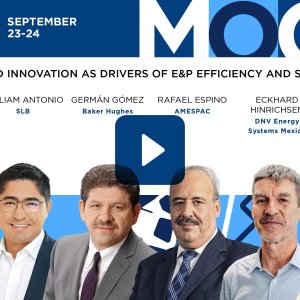
“Artificial intelligence and other emerging technologies have the potential to enhance efficiency, reduce costs, and improve safety, particularly within industries such as oil and gas," said Rafael Espino, President, AMESPAC.
Commercial technology vendors and service companies are converging on two pragmatic value propositions: reduce cost per barrel and de-risk operations. Baker Hughes is deploying integrated digital and automation suites that combine drilling automation, remote operations, and carbon management tools such as CarbonEdge and Cordant for CCUS operations, demonstrating that major vendors are packaging emissions management with conventional drilling and intervention services. Those integrated stacks allow operators to monitor energy consumption, optimize well interventions, and plan maintenance with a clearer line of sight on both opex savings and emissions reductions, an essential capability as financial and environmental performance increasingly drive capital allocation decisions.
“We have seen the digital component integrated both in subsurface and surface operations, with no disconnection between them. We have devoted significant effort to the production area as a key focus, given its direct link to decarbonization processes,” said Germán Gómez, Corporate Director - Mexico & Central America, Baker Hughes
Mexico’s research and technical ecosystem has a critical role to play in localizing these technologies. The Mexican Oil Institute remains the country’s primary applied R&D engine for hydrocarbons, from reservoir modeling and enhanced oil recovery methods to emissions measurement protocols and material science for corrosive environments. By partnering with international vendors on pilot deployments, IMP can help adapt tools such as digital twins and AI reservoir simulators to Mexican carbonate and fractured plays, where standard models often underperform without local calibration. That combination of local validation and international technology transfer reduces operational risk and shortens the learning curve for field teams, improving the business case for investment in automation.
“It is important to discuss AI, new technologies, costs, and production within this industry. Despite the availability of these tools, they are not being utilized,” said Elizabeth Mar Juárez, Director General, IMP.
Independent engineering and environmental specialists such as INERCO Mexico are advancing the practical applications of advanced emissions monitoring and process optimization in industrial settings. INERCO’s portfolio shows a consistent focus on stack and fugitive emissions monitoring, combustion optimization, and EHS compliance systems that are directly relevant to oil and gas asset decarbonization pathways. Robust, verifiable emissions data from INERCO-style systems will be a prerequisite for operators that seek to both meet evolving regulatory requirements and demonstrate emissions intensity improvements to ESG-focused capital providers. "Technology, when properly implemented, is the best ally for meeting EHS standards without compromising business competitiveness," said Sara Landon, Executive Director, INERCO Mexico.
Standards, validation, and system integration are where classification and advisory bodies such as DNV come into play. Digital twins are emerging as a unifying architecture for real-time operations, predictive simulations, and integrity management; DNV’s work on connecting digital twins across the energy system and its guidance on safe, integrated twins provide the protocols that reduce vendor fragmentation and ensure that simulation outputs are trusted by engineers, financiers, and regulators alike. The Mexican market is already on a fast track: independent research estimates the national digital twin market at roughly US$281 million in 2024 with a projected CAGR north of 25% into the next decade, which implies a rapidly growing addressable market for integrated monitoring, predictive maintenance, and scenario testing tools. That growth trajectory will be meaningful for operators contemplating multi-year digital deployments on long-life assets.
One recent example of how innovation is being deployed in Mexico is the contract awarded to SLB for the ultra-deepwater Trion development offshore. In that contract, SLB will deliver 18 ultra-deepwater wells incorporating AI-enabled drilling capabilities, surface and downhole logging, cementing, completions fluids, and other digitally enhanced services. The use of these technologies is designed to improve well quality and reduce non-productive time in water depths up to 2,500m. This shows that even in ultra-deepwater settings, where the cost and risk are highest, operators see enough upside from automation and digital workflows to invest.
"Autonomous drilling is a reality, it is expanding, and it eliminates the risks caused by human factors," says William Antonio, Managing Director Mexico and Central America, SLB. "The dream is to have fully automated oil and gas fields," he adds.
From a deployment strategy perspective, the highest near-term returns will come from targeted applications that directly lower OPEX and extend economic life. Predictive analytics that cut unplanned downtime through condition-based maintenance, machine-learning (ML) models that optimize choke and lift settings to maximize late-life recovery, and automation of repetitive or hazardous tasks on rigs and platforms all deliver quantifiable upside.
One example of this approach comes from offshore operations. “We developed an ML model to predict the failure of a mooring line for a floating rig. The algorithm learns the rig's movements under certain environmental conditions and issues an alarm if it detects deviations,” explained Eckhard Hinrichsen , Country Manager, DNV Energy Systems Mexico.
You May Like




Most popular








