What is Next for the Oil and Gas Industry in Mexico?
 By Perla Velasco | Journalist & Industry Analyst -
Tue, 07/02/2024 - 10:07
By Perla Velasco | Journalist & Industry Analyst -
Tue, 07/02/2024 - 10:07
The Mexican oil and gas industry has undergone significant changes over the past decade, including the market’s opening and the entry of major international players, followed by the reversal of the energy reform, in addition to challenges posed by political tensions and extraordinary situations such as the pandemic. In this context, the oil and gas supply chain and service sector remain robust, expecting different challenges with the advent of a new administration.
To address these challenges, during the Mexican Petroleum Congress (CMP), OPEX organized Drill Talks, a space where industry experts discussed the most relevant topics for the industry and its players. In the session The Future of the Oil Industry in Mexico, experts addressed the exploration and production priorities of the new government, as well as the challenges the industry will face, particularly considering the decline in production and mature fields. Oil and gas leaders also discussed the role of technology in tackling increasingly challenging fields and wells, emphasizing its importance in enhancing sustainability in essential production and exploration practices amid an energy transition that demands reliable energy sources.
William Antonio, Managing Director of Mexico and Central America, SLB, identifies three main challenges that will be the top priorities for the next administration’s oil and gas strategy. In first place is the decline in production. “Drilling activity must be very intensive. The next administration will have to drill more wells and increase reserves. With the current production rate, adding new reserves will be one of the priorities,” Antonio highlighted. The second priority is related to what all major companies strive for: cost reduction, plus guaranteeing cash flow. Lastly, as sustainability has made its way into PEMEX’s agenda, its suppliers will also have to look for ways to reduce emissions.

Regarding PEMEX’s efforts to maintain production, César Granados, CEO, OPEX, considers that the services sector is understanding of the challenges identified by experts, especially the urgency of the decline in reserves and the difficulty of maintaining production objectives in this scenario. “Mexico not only needs to maintain mature fields but must develop new ones, which implies investing in exploration and production of wells. A point in Mexico's favor is that its exploration success rate is quite high compared to other countries, which can guarantee energy security,” Granados mentioned. Granados identifies that Mexico will continue investing in exploration and in the maintenance of mature fields. “The development of the 54 new fields during this administration speaks of the intention to follow this much-needed strategy, in addition to leadership to guide these efforts,” he added.
Hermes Aguirre, Country Vice President of PEMEX, Halliburton, identifies that PEMEX has followed a clear path to add reserves and accelerate production. However, he highlighted the challenge presented by reservoirs and wells with globally unique characteristics, especially the deepest wells. He noted that although technologies have demonstrated certain limitations, the great opportunities lie in how to assimilate new technological developments and the potential of artificial intelligence to better understand fields. This approach would allow drilling and optimization plans to be more efficiently incorporated to achieve the desired results. He also highlighted the scope of digitalization and technology to overcome current barriers.
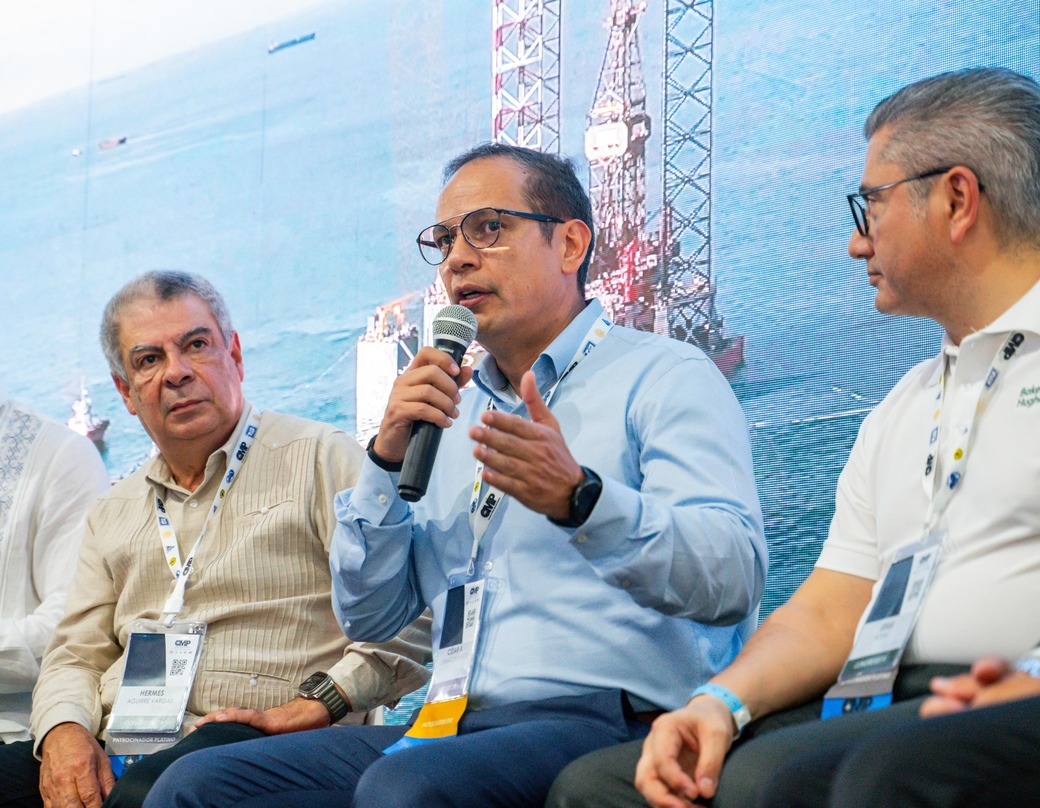
Jesús Rosas, Director of OFSE in Mexico and Central America, Baker Hughes, highlighted that the marine region continues to offer some of the best prospects for exploration in the coming years. Rosas also pointed out the possibility of exploring deep waters, a task that, although promises to change production figures, also implies facing significant technological complexities. Rosas emphasized that extreme depths present numerous technological challenges that must be addressed. In the face of these challenges, Gustavo Torres, Vice President of International Operations - Latin America, Weatherford, pointed out that the industry also has to unlearn its processes to find new and better solutions for increasingly challenging reservoirs and wells.
Regarding how new technologies can reduce the environmental impact of exploration and production activities in Mexico, Antonio believes that the industry in Mexico is not ready to pay a premium just to reduce emissions. “However, although we are far from that, there are many ways in which the service chain seeks to reduce environmental impact. The easiest way is that any technology that reduces operation time will also reduce environmental impact,” he said, identifying this as an area of opportunity for supply chain and service companies.
Regarding the changes or continuity expected from the next administration in terms of exploration and production, Granados considers that, due to the great challenges identified in the industry, service companies anticipate that activity will continue. “It is not an easy situation for PEMEX, because if reserves are not replenished, oil revenues will also fall. It is a challenge of great optimization, new technologies, and digitalization, making things better than they were done before and, hopefully, obtaining new deposits. We think that activity will be maintained; we believe that it will be so and that is why we continue investing in Mexico.”
Another challenge, no less important for the industry, is to continue captivating young talent to replenish the workforce in the sector, experts agree. For this, Mexico also presents a great opportunity: “One of the best oil engineering schools is to work in Mexico. Mexico has all types of deposits, everything imaginable in the industry from the point of view of drilling and completion of wells,” Granados mentions.

You May Like





Most popular