


Mexico Unveils Updated NDC 3.0 Commitments Ahead of COP30
 By Duncan Randall | Journalist & Industry Analyst -
Mon, 10/20/2025 - 09:56
By Duncan Randall | Journalist & Industry Analyst -
Mon, 10/20/2025 - 09:56
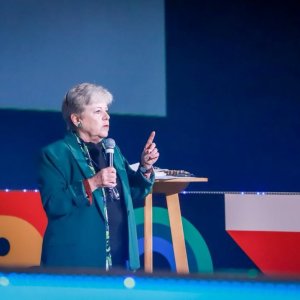
Speaking at Climate Week Mexico (México por el Clima - Semana de Acción), Minister of Environment and Natural Resources Alicia Bárcena provided new details on Mexico’s updated nationally determined contribution (NDC 3.0), which will be presented at COP30 in Belem, Brazil. The environment minister also previewed Mexico’s broader agenda and expectations for the summit, while laying out the challenges and opportunities facing Mexico in its pursuit of a more sustainable future.
With the COP30 summit only a month away, Bárcena used her keynote address to reveal key commitments and priorities that will be included in Mexico’s NDC 3.0. Noting that NDC 2.0 was structured around only two elements — mitigation and adaptation — she outlined a new structure that will add three additional elements: losses and damages; implement methods and enabling conditions, and transversal themes.
With respect to mitigation, Bárcena outlined a commitment to a 35% reduction in greenhouse gas (GHG) emissions by 2035. In contrast to NDC 2.0, which committed to a 35% reduction by 2030, NDC 3.0 will focus not just on a percentage target, but also an absolute target. Recognizing Mexico’s failure to meet its previous commitment, she noted that an absolute, realistic goal was essential to making real progress on decarbonization. According to the environment minister, Mexico will cut its GHG emissions between 564 million tons CO2 equivalent (tCO2e) to 604 million tCO2e, regardless of whether the 35% target is met. Bárcena also committed to an additional reduction of another 532 tCO2e to 569 tCO2e, provided Mexico receives climate financing from the international community. She noted that these reductions would be achieved through targeting eight key sectors, including transportation (responsible for 22% of Mexico’s GHG emissions), agriculture (15%), and heavy industry.
On adaptation, Bárcena outlined six key focus areas: impacts in population and territory; productive systems and food security; biodiversity and ecosystem services; water management with a climate focus; infrastructure and cultural heritage; safety and security with climate change. She noted that the sixth area — not included in NDC 2.0 — was added to account for climate change-induced internal migration, spurred by the erosion of coastal land, soil degradation, and natural disasters.
Losses and damages, the first of the three new elements included in NDC 3.0, will feature five priorities: humanitarian attention and emergencies; mechanisms for risk transference; resilient reconstruction; internal migration; and economic and non-economic losses. Bárcena framed the importance of these considerations by citing the example of Hurricane Otis, which devastated Acapulco 2023, killing at least 52 and causing up to US$16 billion in damages. “Are we going to build climate resilient structures, or are we going to rebuild the hotels just as they were before,” she questioned.
Implementation methods and enabling conditions, the second of the new additions to NDC 3.0, will also contain five points of focus. These include strategic planning and financing; development and technology transfers; capacity building; harmonizing of norms and institutional coordination; and open information models.
The final addition to NDC 3.0 will be transversal themes. The first of these themes will focus on a gendered perspective to climate change, human rights, the just transition, interculturality, and intergenerational equity. The second theme will give special attention to “priority populations,” including women in all of their diversity, indigenous peoples, afro-descendent communities, infants, youth, seniors, disabled people, migrants, and LGBTQ+ individuals.
Emphasizing the importance of a transparent and inclusive process, Bárcena also provided an overview of the technical groups and workshops that played an integral role in the development of NDC 3.0. According to the environment minister, the process first involved dialogues with eight key ministries, including the Ministries of Energy, Agriculture, Defense, Science and Technology, Education, and Economy. Next, multi-sectorial technical groups were formed to update the elements of the NDC focused on adaptation and mitigation. To conclude the process, fourteen workshops were conducted, covering gender; infants and youth; indigenous and afro-descendent communities; subnational and regional perspectives; human rights; civil society; academia, the private sector; financing; and industrial policy.
COP30 Agenda
In addition to NDC 3.0, Bárcena’s keynote highlighted Mexico’s agenda for the upcoming COP30 summit being held in Belem, Brazil from Nov. 10-21, 2025. Acknowledging a rise in isolationism around the world, Bárcena pointed to COP30 as an opportunity for the “simultaneous collective action and political commitment” that climate change requires.
To help stimulate this action, she explained that Mexico will bring forward an agenda aligned with seven key priorities:
-
Maintaining confidence in multilateralism and UN processes: With Latin America and the Caribbean one of the world’s most vulnerable regions to the effects of climate change, Bárcnea declared that only through a combined effort could nations of the region make progress on mitigation and adaptation.
-
Presenting an updated NDC 3.0, in line with the goals outlined in the Paris Agreement: Bárcena emphasized that just because the United States had withdrawn from the Paris Agreement, the rest of the world “must not yield: we must keep fighting for this very important accord.” She added that after 30 COPs of discussions, texts, and declarations, “the time has come to implement and act.”
-
Implementing adaptation policies: The environment minister pointed out that Mexico is particularly threatened by natural disasters, citing ongoing heavy rains and floods occurring on Mexico’s coasts. She emphasized that only through adaptation strategies will be crucial to managing these events.
-
Ensuring a just transition: Bárcena committed to consolidating a just transition that respects divergent national circumstances. She noted that the countries who contribute least to climate change are the ones who suffer the most from its effects, and urged developed nations to take on more responsibility in reducing emissions.
-
Mobilizing climate finance for developing countries: Admitting that the goal of US$1.3 trillion set aside at COP29 for adaptation in the developing world might not be reached, Bárcena urged countries across the Global South to fight for alternative financing mechanisms, such as green bonds, blue bonds, and hurricane clauses, the latter of which would place a moratorium on debt repayments while counties rebuild after natural disasters. She also pointed to Special Drawing Rights held by developed countries, which allow them to supplement their foreign exchange reserves without generating debt. She noted that these rights could be transferred to developing countries on the condition they be used for climate action.
-
Promoting the transfer of green technologies to developing countries: Calling access to technology “one of the most serious problems we face today,” Bárcena argued that if developed countries are unwilling to provide financial assistance, they must allow the developing world to access patent-protected environmental technologies.
-
Integrating the perspectives, practices, and interests of Indigenous and Afro-Descendent communities within climate negotiations: Calling these groups “guardians of our ecosystems,” Bárcena recognized their role in protecting the remaining biodiversity that exists across the continent. She noted the progress achieved on this priority at the Ministerial Meeting of Latin America and the Caribbean for the Implementation of Regional Climate Action, which gathered representatives from 22 countries across the hemisphere in Mexico City from Aug. 25-26.
Building the Green Economy
Bárcena closed her keynote address by providing her vision for a new economic system rooted in sustainability and justice. She championed the circular economic model as a viable alternative to the current “extractivist and unequal system,” calling for a paradigm shift in prevailing modes of production and consumption. To achieve this transformation, the environment minister noted that Mexico is committed to the construction of circular economy parks, including the newly established Tula Circular Economy Park in the state of Hidalgo.
Bárcena also pointed to the circular economy law being debated in the Mexican congress, which she predicted would be passed in the next legislative session. The law would create binding obligations for design, reuse, and recycling across all productive chains; introduce extended Producer Responsibility (EPR) mechanisms, requiring manufacturers to track their products well beyond the point of sale; create fiscal and financial incentives for circular innovation, particularly for startups and SMEs; harmonize the fragmented waste legislation across federal, state, and municipal levels under a unified framework; and establish public–private monitoring councils to oversee compliance, secure transparency, and align industry with community interests.
Nevertheless, Bárcena highlighted that a more sustainable economy would not be possible without collaboration with the private sector. She emphasized the importance of companies decarbonizing their operations and supply chains, while also acknowledging critical advances in green technologies and innovations that have emerged from innovative new business.
Bárcena ended her address with a quote from Barack Obama, which in her view sums up the complex web of challenges and opportunities facing the public, private, and nonprofit sectors: "We are the first generation to suffer the effects of climate change and the last that can do something about it."
Most popular








