

How Digital Teams Work to Deliver Business Results



STORY INLINE POST








This may be an oversimplification, but in essence, successful global digital companies like Amazon, Microsoft, Airbnb, and Stripe do two things very well:
-
They build a digital product (or multiple ones) that customers really love; in other words that they use and pay for because it solves a real pain, and
-
They attract many users/customers that remain loyal over a long time, which contributes to more customer lifetime value and monetization.
Importantly, over time, they build two big parts or teams of the business that work as interconnected pieces; not as silos. Those are the Product teams and the Growth/Go-to-Market teams, which we call Exploit Teams.
Product Teams
These teams are in charge of innovation and product development. At the early stages, they build the initial digital product and iterate it until they discover something that really works for customers and delivers value to the business. Over time, they continue iterating it and adding more functionalities that cater to new use cases not covered before.
They analyze data and use user research techniques to deeply understand customers, and “work backward” from the customers to build a digital solution for them. They are also in charge of defining how they are going to measure success (metrics), what is the opportunity size and the effort of building the solution, and prioritize heavily to allocate resources to the most promising activities.
They are typically measured by outcomes, such as impact on business metrics in which they are focused. For example, if they are building a feature for client engagement or retention, they will focus on impacting WAU (Weekly Active Users) or MAU (Monthly Active Users), or reducing churn or increasing NDR (Net Dollar Retention) in the case of B2B products. If they are focused on activation, it will be more related to percent conversion from sign-up to first usage or first purchase. They impact leading indicators that finally impact outputs or lagging indicators.
If the Product Pod (Squad) is focused on an entirely new product, its metrics will be related first to attracting a first set of users/customers and more importantly, ensuring that they stick with the product and retain it over time and continue paying (in the case of a paid solution).
Exploit
Exploit Teams are also named growth and operations or go-to-market teams and, they are in charge of acquiring new customers and users for the business and along with Product, are heavily focused on forming a habit in those customers and retaining them over time. If they do this well, they can increase the customer lifetime value that produces more monetization and revenue for the company.
In the case of B2C digital products (think Spotify, Netflix, or a fintech app for final consumers), they will have to impact total final growth, through the acquisition of new customers, activation into becoming customers for the first time, and finally promoting habit formation (engagement) and retention (continue using or purchasing again).
In the case of B2B digital products (think Hubspot, Zoom, or any other B2B solution), the focus of this team will also be on growth, through lead generation, deal closing through sales teams (inbound or outbound), and delivering customers value and promoting retention, which is typically handled by CS (Customer Success) and Account Management Teams.
How do these groups interact?
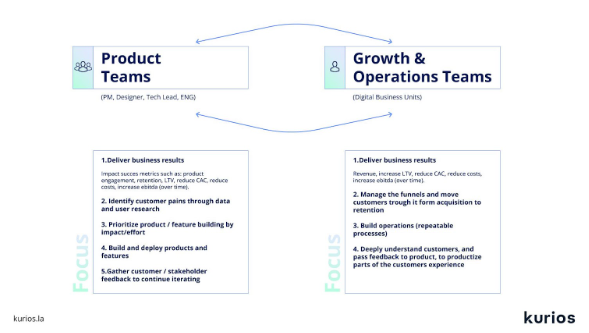
Both groups are heavily interrelated and need to coordinate closely. As you can see in the image below, product teams are in charge of building products customers love and pay for them, and also continue iterating it with customer and stakeholder feedback, and finally contribute to impact business metrics.
On the other hand, Exploit teams are in charge of attracting many customers, converting them into first customers, and retaining them over time.
Caveat: some companies have Growth Product Teams in charge of building many growth loops inside product teams. Something we would cover in a different article.
Nevertheless, something important to mention is that Product leverages exploit teams to reach more customers and supports the latter in impacting certain metrics; exploit teams also gather customer feedback and data, build business cases, and pass them over to Product, to prioritize and productize new pieces of the product and serve customers better.
Source: Kurios material. Do not reproduce without permission.
What are the key roles in each group?
Product Teams
In Product Teams, you typically have the Product Trio and more, depending on the scope of the Pod. See below an image (not fully representative. It can change depending on the situation).

Source: Kurios material. Do not reproduce without permission.
Product Manager
-
Responsibilities: A PM is responsible for overseeing the development and management of a company's product or product line. Their main responsibility is to ensure that the product meets the needs of the customer and aligns it with the overall strategy of the company.
-
Competences: A product manager must have 4 core competencies, (1) Product Insights, Vision, and Strategy. (2) Execution and Impact, deliver business results through strong execution. (3) Leadership and Soft Skills, takes on large challenges, and inspires/influences others. Acting like an owner, and with effective storytelling. Also, divide big problems into smaller chunks and act on them. (4) Technical Expertise (in some degree of software engineering and design) to collaborate effectively with highly technical counterparts.
Product Designer
-
Responsibilities: Create and design the user interface and user experience of a digital product. They’re responsible for creating designs that are both functional, and that meet the needs of the target audience.
-
Competences: Some of the main competences for a Product Designer are (1) Design thinking, the ability to approach design problems from a user-centered perspective, and develop creative and innovative solutions. (2) User research: The ability to conduct research to understand user needs. (3) information architecture: The ability to structure and organize information in a way that is logical and intuitive for users. (4) Prototyping: The ability to create prototypes to test and refine design concepts.
Tech Lead
-
Responsibilities: This person is in charge of guiding the team regarding technical solutions for the product. The primary responsibility is ensuring that the team is able to deliver high-quality software products on time and within budget.
-
Competences: The competencies can vary in order of the company or the product, Some of the main competences are (1) Technical expertise: The tech lead should have a strong technical background and expertise in the technologies and tools used by the team. (2) Architecture and design, the lead should have experience in designing and implementing software architectures. (3) Project management: this person must have experience in project management and be able to manage the project schedule, resources, and risks.
Engineer
-
Responsibilities: They apply their knowledge of science, mathematics, and engineering principles to solve problems and improve existing systems. They’re responsible for designing, building, and maintaining complex systems, structures, or processes solving.
-
Competences: The competences depend on the product, these are some of the basic competencies (1) Technical knowledge, engineers should have a strong foundation in science, mathematics, and engineering principles. (2) Problem-solving, identifying, and solving complex technical problems. (3) Analytical skills, analyze complex technical data and information, and use this information to make informed decisions.
Data Analyst
-
Responsibilities: They are responsible for analyzing user data and feedback to inform product decisions. Data Analytics is heavily focused on descriptive analytics, but can also use some predictive modeling or prescriptive analytics, something that is more used by Data Science professionals.
-
Competences: (1) Data analysis. (2) Data management. (3) Business acumen, data analysts should have a strong understanding of the business and industry they are working in. They also should be good at identifying what business levers can be pulled and perform solid storytelling to convey a strong business case.
Quality Assurance
-
Responsibilities: This area is responsible for testing the product to ensure that it is making the required quality standards
-
Competences: (1) Testing methodologies. (2) Test automation: QA engineers should be familiar with test automation tools and frameworks. (3) Attention to detail
Note: there are more roles, not covered here.
Exploit Teams
On the other hand, the structure and roles of Growth and Operations Teams (also named go-to-market teams), depends on the digital business model that surrounds the product.
Also, this can change if the product is focused on B2B or B2C customers.
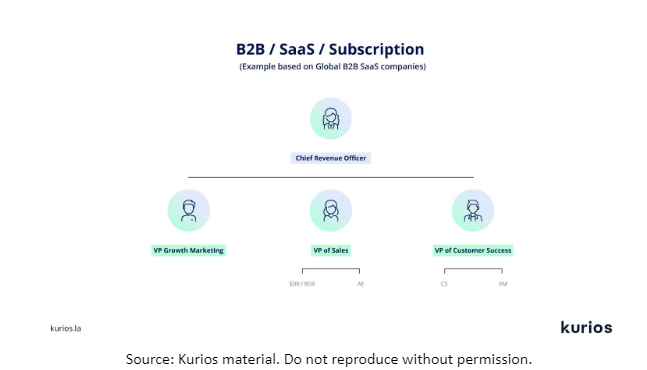
In the case of B2B customers, you typically have the figure of a CRO (Chief Revenue Officer) in charge of all things revenue, and who oversees three big functions:
-
VP of Growth Marketing or VP of Marketing: who is in charge of lead and demand generation, and who oversees teams that are responsible for brand, positioning, and performance.
-
VP of Sales: who is in charge of closing new accounts, and has teams of SDR (Sales Development Representatives) who serve and qualify potential customers that are coming inbound; and BDR (Business Development Representatives) who serve and qualify customers finding them outbound. After qualifying those people to do their word, they hand off the negotiation and final closing to Account Executives (AE) also named Hunters.
-
VP of Customer Success: who is in charge of renewals and expansion, and who oversees a team of Customer Success Managers, Customer Support, and Account Managers if necessary (typically for Enterprise Accounts).
In the case of B2C digital business models, you can have three that are very typical: e-commerce and marketplaces (of physical goods like Amazon, or services like Uber ridesharing), and transactional, which is very common in fintechs or banking and financial services products. See the images below for some examples.
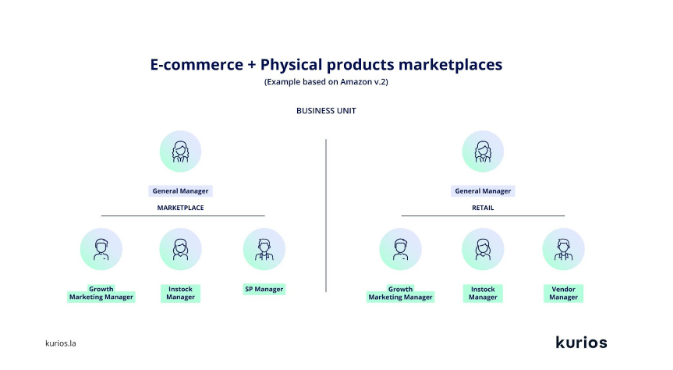
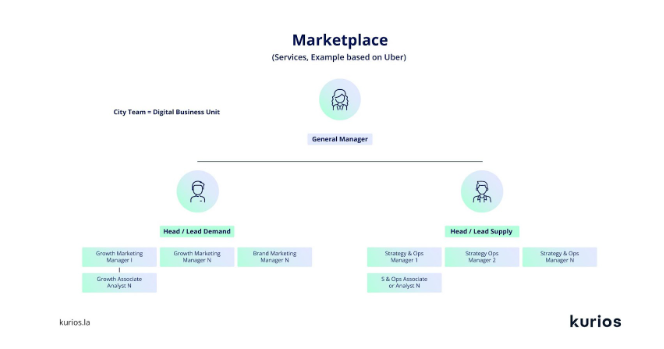
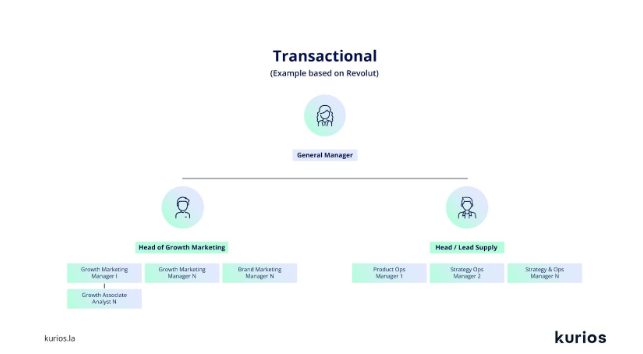
In those companies, you typically have roles such as:
General Managers
-
Responsibilities: Developing and implementing the overall strategic plan for the organization, in collaboration with other senior leaders.
-
Competences: The main competences of a GM are (1) Strategic thinking, they should be able to think strategically and develop long-term plans to achieve the organization's goals. (2) Financial Management (3) Business development, they must have strong business development skills, including the ability to identify and pursue opportunities for growth and expansion. (4) Stakeholder management, building and maintaining relationships with key stakeholders, including customers, suppliers, investors, and regulators.
Growth Marketing Managers
-
Responsibilities: This involves anything from the top of the funnel, to CRO, CRM, email marketing, SEM/SEO, Organic, and habit formation and retention, performed from marketing approaches, etc.
-
Competences: (1) Data analysis. (2) A/B testing, experience with A/B testing and other testing methodologies, and being able to use this data to improve conversion rates and other key performance indicators. (3) Customer acquisition (4) Content marketing, create and execute content marketing strategies.
In-stock Managers
-
Responsibilities: managing inventory levels to ensure that products are in stock and available to meet customer demand.
-
CompeteResponsibilitiesnces: (1) Supply Chain Management (2) Sales Forecasting, forecasting demand, and ensuring that there is enough inventory to meet customer demand while minimizing excess inventory. (3) Cross-functional Collaboration, work closely with other departments such as marketing, operations, and finance to ensure that inventory levels are aligned with business goals and objectives.
Vendor or 3P (Third Party Managers)
-
Responsibilities: The Vendor Manager evaluates, recruits, and on-boards new vendor partners (sellers) for marketplaces or e-commerces. Targeting the most relevant brands/products for customers, they aim at recruiting new vendors, making their selection available on the site, and drive their growth through joint planning of marketing and advertising.
-
Competences: (1) Growth skills to map the best approaches to onboard a diverse set of vendors. Strategy can vary depending if vendors are large enterprises or small businesses, (2) Negotiation skills to close complex deals with win-win approach, (3) analytical skills, to define pricing, and win-win structures for both the vendor and the platform.
Strategy and Operations for Supply (Uber case)
-
Responsibilities: Responsible for developing and implementing the organization's supply strategy, ensuring that it aligns with the organization's overall strategic goals.
-
Competences: (1) Supply Management - Growth to attract, convert and retain more driver partners in the marketplace (2) Strategic Planning, developing, and implementing a supply chain strategy that aligns with the goals. (3) Business Acumen, a strong understanding of business operations, finance, sales, and marketing.
Business Intelligence or Data Analytics
-
Responsibilities: This area is responsible for collecting, analyzing, and interpreting large amounts of data to identify patterns and trends that can help businesses make informed decisions.
-
Competences: (1) Strong analytical skills, analyzing large amounts of data and interpreting meaningful insights that can drive business decisions. (2) Communication skills, clearly and effectively communicate complex technical information to non-technical stakeholders. (3) Continuous learning: They should be committed to continuous learning and staying up-to-date with new technologies and trends in the BI and Data Analytics field.
How to develop these teams?
There are three options for building these kinds of teams, and every one of these has benefits and challenges. The first is hiring talent. If you choose this, you must be aware of the war on digital talent; in Latin America, digital talent is scarce, so the battlefield is made up of traditional companies, foreign enterprises, and startups. Would you like to be part of that?
What about reskilling? This option enriches the current talent of your company. It may take a few months but people will have new hard skills and the old ones will be updated, so you'll have people with new competences and knowledge of the current business.
On the other hand, upskilling takes the talent that shows the skills and the competences to the next level. People with digital business experience could have a good fit in new digital areas or projects as long as they receive the right training. These kinds of employees used to show interest in continuous learning, user obsessions, and love testing some hypotheses.
Upskilling and reskilling also provides an economical benefit, because it can be up to 5x-10x more cost efficient than hiring, and can also contribute to reducing the digital employee attrition rate.
Wherever you get the talent for teams, the approach of Kurios is: the teams who achieved their business goals always have one thing in common, good resources, good training, and the best practices of the industry, and the latest frameworks to work with.
Best teams are made of talented people and the best frameworks and practices.
KURIOS provides training, frameworks and best practices for digital teams at Latin American enterprises.
You May Like








Most popular








