

AI-Powered Drones: Revolutionizing Intelligence and Security




STORY INLINE POST





 By Marcos Rosales | CEO -
Tue, 09/23/2025 - 06:30
By Marcos Rosales | CEO -
Tue, 09/23/2025 - 06:30
In today’s world, driven by diverse needs, the use of drones for intelligence and security increasingly requires harnessing the capabilities of unmanned aerial vehicles (UAVs) for surveillance, monitoring, emergency response, and real-time analysis, especially when supported by artificial intelligence. Drones enhance safety across various fields, such as public security, infrastructure protection, and crime prevention, by detecting threats, coordinating responses, documenting evidence, and carrying out dangerous tasks without putting human personnel at risk.
For this reason, both governments and business leaders have opted to invest in these systems to strengthen, or at least monitor, the environments in which their corporate and operational activities take place.
However, given the circumstances faced across different regions regarding intelligence and security, it is important to understand how this strategy unfolds:
- Surveillance and Patrol: Enable aerial patrols in unsafe or high-crime areas, detecting suspicious activities and increasing security coverage.
- Event Management: Used to monitor crowds at concerts or demonstrations, identify risk points, and coordinate security resources.
- Search and Rescue: Equipped with thermal sensors, they can locate missing persons in natural disasters, forests, or hard-to-reach areas.
- Damage Assessment: Following disasters such as earthquakes or fires, drones assess structural damage and detect hazards to guide intervention.
- Tracking: Can discreetly follow suspects or vehicles, providing crucial intelligence to ground forces.
The Role of Artificial Intelligence in Drones
The fields covered by AI allow us to define its role in the technological and operational universe of drones, particularly in:
- Threat Identification: AI enables drones to automatically identify weapons, suspicious objects, or individuals in complex environments.
- Autonomous Decision-Making: Equips drones with the ability to perform tasks and make decisions intelligently and independently based on data analysis.
- Real-Time Analysis: Advanced sensors and software process live information, generating automatic alerts and transmitting data to control centers.
Benefits of Drone and AI Integration
The benefits of applying this technology — enhanced through AI — can be summarized as follows:
- Rapid Response: Improves response times to incidents, reducing delays in reinforcement deployment.
- Risk Reduction: Enables intelligence and surveillance operations without exposing personnel to dangerous or hazardous conditions.
- Greater Efficiency: Automation and the ability to operate in difficult environments increase overall effectiveness of security operations.
The Global Impact of AI-Powered Drones
Numerous international studies confirm the impact of AI on the development of autonomous drones. The combination of AI and drones has revolutionized multiple sectors, from agriculture to public security. Initially designed for basic reconnaissance and delivery, drones have evolved into autonomous tools capable of making real-time decisions thanks to AI. This leap has greatly expanded their professional uses and effectiveness, opening new opportunities across industries.
Organizations are adopting this technology to improve operational efficiency, automate processes, and reduce costs. The ability of drones to operate autonomously, make decisions, and adapt to changing environments is proof of AI’s transformative impact.
AI-powered drones are being used in a wide range of applications, from surveillance and monitoring to product delivery. In construction, drones can inspect job sites, identify potential issues, and optimize project planning.
In logistics, companies are leveraging drones to automate deliveries, reducing transport times and improving customer satisfaction. Microsoft, for instance, has pioneered the use of AI-equipped drones in delivery automation. Their initiative has shown how cargo drones can perform fast and accurate deliveries, particularly in densely populated urban areas.
AI has expanded the functions and capabilities of drones, enabling greater autonomy and precision in their operations. With features such as object detection, image recognition, and real-time decision-making, drones can now perform complex tasks without human intervention.
Reducing Errors and Decision-Making Time
AI not only enhances drone capabilities but also significantly reduces errors and the time needed to make decisions. AI-enabled drones can process large volumes of data in real time, allowing them to make informed choices and quickly adapt to environmental changes. This is critical in time-sensitive situations, such as rescue missions or emergency medical deliveries.
The progress in AI and drone integration is being driven by multiple technological initiatives and developments. Leading companies are investing in advanced systems that allow drones to operate autonomously and efficiently. The combination of AI and drones is already having a major impact across sectors by improving efficiency and reducing costs.
Key Industries Transformed by AI-Powered Drones
Agriculture
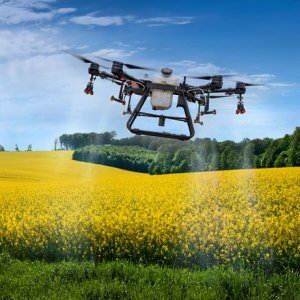
AI-equipped drones are transforming crop management. They can analyze vast farming areas, detect pests or diseases, and apply treatments precisely. This not only improves yields but also reduces resource usage, such as water and pesticides.
Construction
Techniques like photogrammetry enable drones to analyze terrain and collect critical data for construction projects. Drones can monitor infrastructure development, track project progress, identify risks, and improve site safety.
Public Security
In public security, AI-powered drones are increasingly used for surveillance and monitoring, allowing security forces to respond faster to incidents. AI enables drones to identify threats, such as weapons or suspicious individuals, and alert authorities in real time. This strengthens response capabilities while minimizing risks for security personnel.
The Future of Drones and AI
The future of AI-powered drones is highly promising. As technology advances, we will likely see greater integration of AI, delivering unprecedented levels of autonomy and efficiency.
Future developments could include drones capable of operating in even more challenging environments, making complex decisions in fractions of a second, and collaborating more effectively with other drones and autonomous systems. This evolution will not only transform entire industries but also open new opportunities in areas we have yet to imagine.
You May Like



Most popular








