


Blue Origin Marks First Spaceflight by Wheelchair User
 By Óscar Goytia | Journalist & Industry Analyst -
Tue, 12/23/2025 - 16:36
By Óscar Goytia | Journalist & Industry Analyst -
Tue, 12/23/2025 - 16:36
Blue Origin on Saturday completed its 16th crewed suborbital mission, marking the first time a wheelchair user traveled to space, as the company continues to expand its space tourism operations and reusable launch capabilities.
The flight, conducted aboard Blue Origin’s New Shepard vehicle, lifted off from the company’s launch site in West Texas at about 9:15 a.m. New York time (14:15 GMT). The capsule carrying six passengers landed roughly 11 minutes later after reaching space just above the Kármán line, the internationally recognized boundary of space.
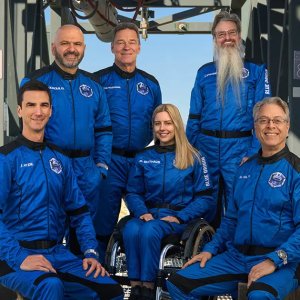
Among the crew was Michaela Benthaus, a German aerospace engineer at the European Space Agency, who became the first wheelchair user to fly into space. Benthaus sustained a spinal cord injury in a mountain biking accident in 2018. Also on board was Hans Koenigsmann, a former SpaceX executive who spent two decades at the company and served as vice president of avionics before retiring in 2021.
“This was the coolest experience. I did not only like the view and the microgravity, I also liked going up. That was so cool, every stage of going up,” Benthaus said after landing in a video released by Blue Origin.
The mission had originally been scheduled for Dec. 18 but was postponed after Blue Origin identified an unspecified issue during preflight checks, the company said.
New Shepard is a fully reusable suborbital launch system designed to carry passengers and payloads on short flights to the edge of space. The system consists of a reusable rocket booster and a crew capsule that separates during ascent and returns to Earth under parachutes. In addition to tourism, New Shepard is used for scientific research missions that require brief periods of microgravity.
Benthaus said the idea for the flight began with an online message to Koenigsmann, asking whether spaceflight was still possible for someone with her condition. “I just asked him, you worked for so long at SpaceX, do you think that people like me can be astronauts?” she said.
Koenigsmann said her determination prompted him to help organize the mission. “She basically inspired me to do this. It’s her drive that convinced me, and to experience something that I’ve seen from the outside for a long time,” he said.
Blue Origin said it made operational adjustments to accommodate Benthaus, including adding ground support equipment to assist with entering and exiting the capsule. Benthaus was able to transfer from her wheelchair into the spacecraft using a bench extending from the hatch. Koenigsmann was seated nearby during the flight in case assistance was required.
“Michi’s flight is particularly meaningful. It demonstrates that space is for everyone, and we are proud to help her achieve this dream,” said Phil Joyce, Senior Vice President, New Shepard.
Blue Origin does not disclose the price of a seat on New Shepard flights. Its main competitor in suborbital tourism, Virgin Galactic, has publicly listed ticket prices of about US$600,000. Blue Origin has carried dozens of paying and invited passengers since its first crewed flight in 2021.
The New Shepard program operates alongside Blue Origin’s larger orbital ambitions. The company is also developing and flying New Glenn, a heavy-lift orbital rocket intended to carry satellites, spacecraft and government payloads to low Earth orbit and beyond. In November, Blue Origin completed a second successful flight of New Glenn, during which the rocket deployed two NASA spacecraft bound for Mars and landed its reusable booster on a barge in the Atlantic Ocean.
You May Like




Most popular








