


Mexico Moves to Standardize Tortilla Production Amid Disputes
 By Eliza Galeana | Junior Journalist & Industry Analyst -
Fri, 11/28/2025 - 12:39
By Eliza Galeana | Junior Journalist & Industry Analyst -
Fri, 11/28/2025 - 12:39
The Mexican government is working to professionalize the tortilla-making profession through a new competency standard designed to ensure product quality and safety. However, despite these efforts significant disagreements persist across the corn–tortilla supply chain, as producers denounce low purchase prices, demand greater support, and question the effectiveness of the measures intended to balance the relationship between farmers, industry, and tortilla makers.
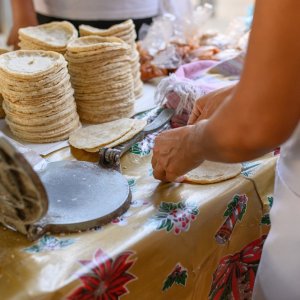
The Ministry of Public Education (SEP) and the Ministry of Agriculture and Rural Development (SADER) developed Competency Standard 1707, Production of Corn Tortillas Using a Tortilla-Making Machine. Its purpose is to serve as a reference for evaluating and certifying people who work in this activity, ensuring product quality and safety, as well as industrial safety in corn tortilla establishments.
This Competency Standard describes the essential functions that must be performed by the person responsible for operating and maintaining the tortilla-making machine: preparing the work area, preparing the dough, adjusting the equipment, monitoring production, and cleaning both the machine and the establishment. These activities are designed to ensure an efficient process and tortillas that meet the required quality standards.
Anyone who becomes certified will obtain an officially recognized document that validates the skills, knowledge, and competencies necessary to perform this job at a high level. This becomes a tool for entering the labor market. The certification does not require a professional degree, since it is aimed at operational positions within the corn tortilla industry. Tortillerias benefit by guaranteeing process efficiency, reducing risks, complying with regulations, shortening operational times, and therefore increasing productivity.
This initiative is part of the National Corn–Tortilla Agreement, one of the most representative programs of President Claudia Sheinbaum’s administration. The agreement brings together the Ministries of Agriculture, Economy, and Labor, along with PROFECO, FIRA, and the Food for Well-Being program, in an integral strategy designed to benefit all actors involved in the corn tortilla production chain. In June, the Mexican government signed the agreement with the promise of stabilizing tortilla prices by gradually reducing them by 5% over the next six months, aiming for a 10% reduction by 2030.
According to President Sheinbaum, one of the project’s main goals is to reduce the number of intermediaries between corn sellers and processors, and to promote direct agreements between producers and processors. However, this is not without challenges.
Recently, members of Amigos por el Campo, a farmers’ organization in Jalisco, denounced that producers earn only between MX$4/kg and MX$5/kg (US$0.22/kg - US$0.27/kg) of corn, while tortillas sell for between MX$25 and MX$30. “We are not asking anything from the federal government, only that they demand that the flour companies pay us a better price. What they are doing to the entire country is an injustice,” they warned.
Representatives added that to give real meaning to the phrase “without corn, there is no country,” which has become a banner of the current administration, farmers need support for machinery, planting, scalding, cultivating, fertilizing, fumigating, and paying field laborers. They also expressed discontent that the federal government only provides support to those who plant up to 5ha of corn, something that those with larger plots consider unfair. This situation has intensified mobilizations across the country.
Meanwhile, Grupo Minsa, the second-largest producer of corn flour in Mexico, reported that it pays a premium of approximately MX$1,000/t of white corn compared with the international benchmark, with the goal of supporting domestic production. This represents a 24% increase over the purchase price paid for imported yellow corn used by other industries, the company stated in a press release published Wednesday on the Mexican Stock Exchange (BMV).
The company presented this argument in light of the pressure Mexican corn producers are facing. It added that its share of national corn consumption is 1%, leaving it without the capacity to influence corn price formation. “For more than 30 years, Minsa has primarily purchased domestic corn, and only in periods of regional scarcity has it needed to import the volumes required to ensure supply,” reads the press release.
The flour processor specified that, over the past six years, it has purchased 4Mt of domestic corn, while imports totaled 69,815t, equivalent to less than 4% of its total purchases. “We remain committed to developing a domestic supply of white corn that guarantees the availability of our main input, securing direct commercial agreements with farmers in Jalisco, Michoacan, Guanajuato, Sinaloa, and Campeche,” the company emphasized.
Minsa also stressed that corn flour accounts for only 35% of the final tortilla price, while the remaining percentage corresponds to factors beyond its control. In this regard, the National Tortilla Council (CNT) revealed in August that tortilla prices have been affected by higher costs for spare parts, food-grade paper, freight, and insecurity.
Finally, the company stated that it participates in the working groups convened to create the Mexican System for Corn Market Regulation and Commercialization, with the aim of achieving a long-term solution to the crisis faced by corn producers in Mexico. This effort includes collaboration with the National Chamber of Industrialized Corn (Canami), producers, the starch industry, millers, and masa and tortilla manufacturers.
You May Like





Most popular








