


Sheinbaum to Expand Anti-Inflation Plan
 By Eliza Galeana | Junior Journalist & Industry Analyst -
Fri, 10/25/2024 - 12:47
By Eliza Galeana | Junior Journalist & Industry Analyst -
Fri, 10/25/2024 - 12:47
The new government led by President Claudia Sheinbaum will expand the Anti-Inflation and Scarcity Package (PACIC) to include more food items. As the program grows, however, industry leaders emphasize the need to manage imports carefully to protect local production and uphold health and safety standards.
Luis Fernando Haro, Director General, National Agricultural Council (CNA), highlighted that PACIC, launched by former President López Obrador, helped curb price increases in some essential food items. “In some way, it prevented prices from rising further, as there was availability of raw materials that were not in Mexico and had a tariff, like pork and other foods,” said Haro during the 21st edition of the Global Agri-Food Forum Innovating for Food Security.
The first package aimed at containing rising food prices was launched in May 2022, but it did not yield the expected results. In response, the Opening Agreement against Inflation and Scarcity (APECIC) was launched in October 2022, providing a Universal Single License that allowed signing companies to import and distribute food and inputs for food production, exempting them from all procedures, permits, and the general import tax. The Agricultural Markets Consulting Group (GCMA) reported that, although this second package managed to reduce inflation, it fell short of expectations. By April 2023, the prices of fruits and vegetables had decreased by 10.4%; grains and tortillas had risen by 6.2%; pantry items and others had dropped by 0.7%; and proteins had decreased by 1.7%.
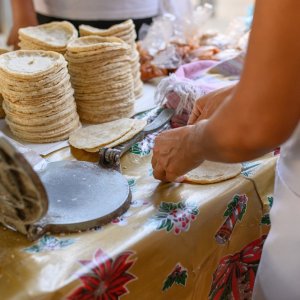
Haro emphasized the importance of analyzing potential improvements to the new anti-inflationary package. He noted that caution is needed when opening up to many countries to avoid compromising the health and safety of imported products. Currently, the only new element in this relaunch is the inclusion of tortillerias (tortilla shops), who were previously not invited to participate.
Julio Berdegué, Minister of Agriculture, clarified that the plan to lower tortilla prices involves inviting dialogue within the production chain. He stated that this part of the National Corn and Tortilla Plan will not impose a set price for tortillas but will seek an agreement between corn and tortilla producers for a fair deal that benefits the production and consumption chain. “The goal is the gradual reduction of tortilla prices throughout the administration. We will invite actors in the corn-tortilla chain to dialogue to build an agreement toward this goal. No one has talked about setting the tortilla price by decree,” he said during a press conference.
Haro noted that last Friday, representatives from the Ministry of Finance and Public Credit (SHCP) and the agroindustry met to review the new terms of the program that will be continued by the current federal administration. He stressed the importance of ensuring decisions are not unilateral but are made in consensus between the productive sector and the government, so as not to harm the national production base.
The businessman emphasized that the priority will not only be to expand PACIC but also to improve it for the benefit of the population, particularly for the most vulnerable groups, who dedicate a large part of their income to food. “It is necessary to import these products so that the population has access to affordable, nutritious foods. However, we must protect our borders to avoid unfair competition with Mexican companies,” Haro underscored.
You May Like


Most popular








