

The Risk of SMB Defaults and the Power of AI




STORY INLINE POST







 By Erez Saf | CEO & Founder -
Wed, 07/03/2024 - 08:00
By Erez Saf | CEO & Founder -
Wed, 07/03/2024 - 08:00
In the vibrant and ever-evolving landscape of Mexico’s economy, small and medium-sized businesses (SMBs) play a crucial role in driving innovation and growth. Yet, these dynamic enterprises face substantial challenges, one of the most pressing being the risk of default. Our latest data analysis offers a fascinating glimpse into how the age and size of a business influence its likelihood of default, shedding light on the financial health and resilience of these enterprises.
Before diving into the data, it's essential to understand what "default" means in a business context. Default occurs when a company fails to meet its debt obligations — this could be missing a scheduled payment, breaching a loan covenant, or being unable to repay its creditors entirely. Defaulting can severely impact a business's ability to secure future financing, harm its relationships with suppliers and customers, and ultimately lead to insolvency or bankruptcy. Therefore, understanding and mitigating the risk of default is crucial for the longevity and health of any business.
The Pulse of Mexican SMBs
Drawing insights from over 13,000 businesses across Mexico, we delved into the intricate relationship between a company’s age, its size, and its likelihood of default. Here are the compelling findings:
|
Age |
Micro |
Small |
medium |
Enterprise |
|
<5 |
12.6% |
16.7% |
15.4% |
12.7% |
|
>=5, <10 |
13.2% |
8.3% |
6.4% |
3.5% |
|
>=10, <20 |
11.1% |
12.4% |
4.4% |
1.9% |
|
>=20 |
6.7% |
7.3% |
3.5% |
1.0% |
Our analysis reveals a striking pattern: younger companies, especially those under 5 years old, are most vulnerable to default. This risk is particularly pronounced among small businesses, which face a peak default rate of 16.7%. As businesses mature, their risk of default generally diminishes, with those over 20 years old showing the lowest default rates across all categories.
Game-Changer for Risk Management
In an era where data is the new oil, AI and data analytics stand out as powerful tools for understanding and mitigating default risks. Here’s how these cutting-edge technologies can transform risk management for SMBs:
1. Predictive Analytics: AI-driven predictive models can sift through historical data to uncover patterns that precede defaults. This proactive approach allows for early intervention, offering lifelines to at-risk businesses and potentially reducing default rates.
2. Tailored Financial Solutions: By understanding the specific risks associated with different business ages and sizes, financial institutions can craft customized financial products. For instance, younger small businesses might benefit from flexible repayment plans, while older enterprises might need investments in innovation to sustain their growth.
3. Enhanced Credit Scoring: Traditional credit scoring models often fall short in capturing the unique challenges SMBs face. AI can enhance these models by incorporating a broader array of variables, such as cash flow patterns, market conditions, and even social media sentiment, providing a more holistic assessment of creditworthiness.
Diving Deeper: Insights From Our Data
The data indicates that the first five years are critical for small businesses, with a 16.7% default rate. This period, marked by high volatility and uncertainty, is when businesses are still finding their footing. During this time, external support — such as favorable credit terms, financial consulting and business development services — can be pivotal.
For businesses aged between five and 10 years, the risk of default drops significantly, particularly for small and medium-sized enterprises. This suggests that once businesses survive the initial years, they become more stable and resilient. However, micro-businesses continue to face notable challenges, with a 13.2% default rate in this age bracket.
As businesses age, the trend of decreasing default risk persists. Companies over 20 years old exhibit a remarkably low default risk: 6.7% for micro businesses and a mere 1.0% for enterprises. This long-term stability underscores the advantages of experience, established customer bases, and accumulated market knowledge.
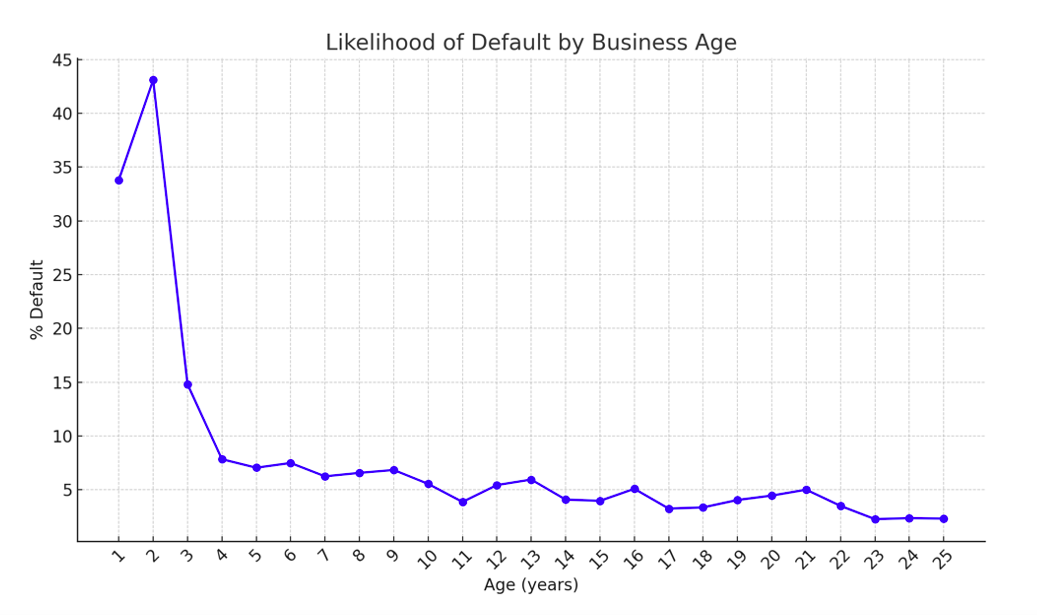
A Visual Insight: Default Likelihood by Age
To further illustrate the relationship between business age and default risk, the following graph presents the default likelihood for businesses from 1 to 25 years old (regardless of size):
Pioneering the Future of Risk Management
Integrating AI and data analytics into risk management strategies is more than a trend, it's a necessity. By harnessing the potential of these technologies, we can develop more effective risk mitigation strategies, ensuring the sustainability and growth of SMBs in Mexico.
Additional Questions to Explore
To further our understanding and support SMBs more effectively, several additional questions can be explored using our comprehensive database:
-
Sector-Specific Risks: How does default risk vary by industry? Identifying vulnerable sectors can tailor support.
-
Geographical Influences: Are there differences in default risk by location? This highlights regional economic disparities and directs resources effectively.
-
Economic Cycles: How do economic shifts affect default rates among SMBs? Understanding this helps in planning for future economic changes.
-
Leadership Practices: How do leadership styles impact default likelihood? Effective leadership insights can guide business owners.
-
Financing Sources: How do different financing sources impact default risk? This informs better financial planning for SMBs.
-
Customer Base: How does customer diversity and stability affect risk? This helps businesses focus on robust customer relationships.
-
Technological Adoption: Does adopting new technologies reduce default risk? Encouraging SMBs to invest in technology can improve resilience.
Charting the Path Forward: A Call to Action
1. Embrace AI Technologies: SMBs should invest in AI technologies to better understand their financial health and predict potential risks. Tools like CRiskCo can provide invaluable insights, helping businesses make informed decisions.
2. Support for Young Enterprises: Policymakers and financial institutions should prioritize targeted support for young businesses, especially those in their first five years. This could include access to credit, business advisory services, and mentorship programs.
3. Continuous Monitoring and Adaptation: The economic environment is in constant flux. Continuous monitoring using AI and regular adjustments to risk management strategies can help businesses stay ahead of potential challenges.
The risk of default among SMBs in Mexico is intricately linked to the age and size of the business. By leveraging AI and data analytics, we can gain deeper insights into these risks and develop strategies to support the growth and stability of these vital enterprises. The future of SMBs in Mexico hinges on our ability to understand and mitigate these risks, ensuring they can thrive in a competitive and ever-changing market.
Author Bio
Erez Saf is the CEO of CRiskCo, a leading provider of AI-driven risk management solutions, and the president of Pymes Capital, an organization dedicated to supporting the growth of small and medium-sized businesses in Mexico. With a deep understanding of financial technologies and a commitment to innovation, Erez Saf is a prominent figure in the field of business risk management.
You May Like


Most popular








