


From Kibbutz to Fields: 60 Years of Drip, Mexico’s Opportunity
 By Adriana Alarcón | Journalist & Industry Analyst -
Tue, 06/03/2025 - 09:00
By Adriana Alarcón | Journalist & Industry Analyst -
Tue, 06/03/2025 - 09:00
Despite being located in a semi-arid region, Israel has secured a reliable and sustainable water supply through strategic planning, technological innovation, and integrated resource management. Covering just 21,937 km² and with a tiny coastal area compared to Mexico’s vast coastlines, Israel has turned environmental challenges into global leadership in water management.
With over 60% desert territory, Israel’s sustainable water planning has drastically reduced freshwater overexploitation by efficiently allocating water across sectors and ecosystems. This expertise and technology, including over 60 years of drip irrigation innovation, present a unique opportunity for Mexico to enhance its agricultural productivity, conserve water, and strengthen food security through the adoption of proven sustainable water solutions.
These technological advances in water production, wastewater treatment, desalination of water and advanced resource management tools have the potential to benefit other arid regions globally — especially as climate change increases the pressure on water systems.
Key Advances in Water Management
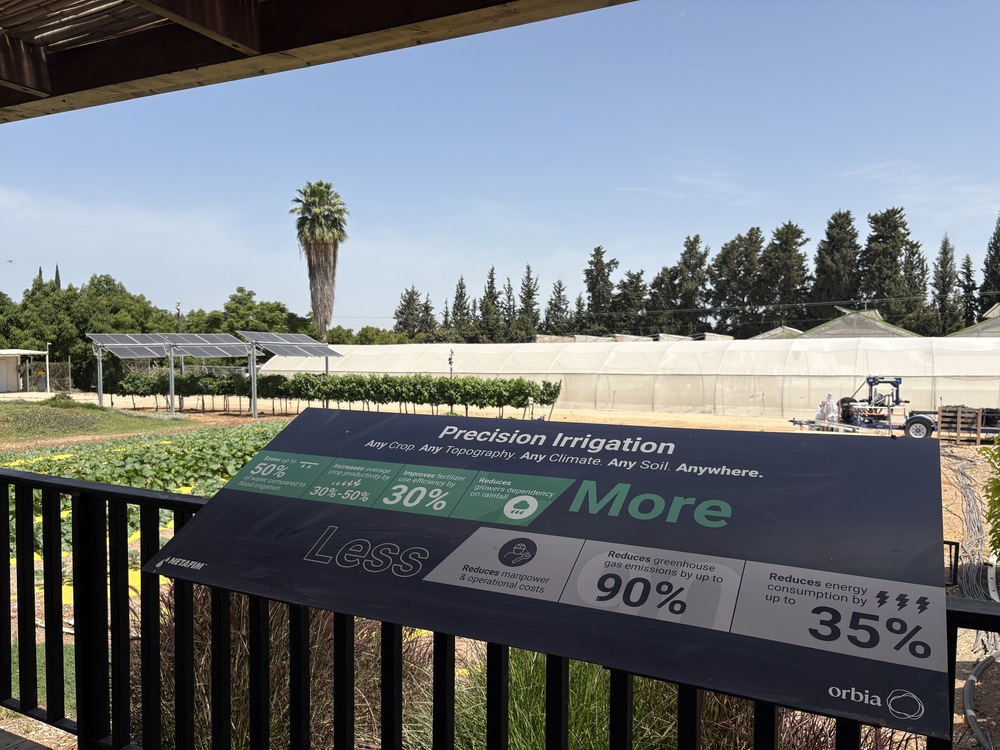
Precision irrigation maximizes crop yield while minimizing resource use by delivering water and nutrients directly to plant roots at the right time, place, and dose. As a result, farmers produce higher-quality yields more sustainably while saving significant amounts of water, fertilizers, energy, and labor. This technology brings tangible benefits to farmers: crop yields increase by 50% to 100%, water use is cut by half, and climate resilience improves. Moreover, input costs are lowered, making agriculture more profitable and predictable, according to Netafim.
Another key water management solution is drip irrigation, a technology developed in the 1960s in Kibbutz Hatzerim (a kibbutz is a collective community in Israel traditionally based on agriculture), where farmers facing extreme desert conditions invented drip irrigation. Drip irrigation allows the precise delivery of water and fertilizers, commonly known as fertigation, dramatically improving crop yield. The technology was co-invented by Israeli engineer Simcha Blass, who also co-founded Mekorot, Israel’s national water company responsible for water exploration and supply infrastructure. This combination of technology and strong institutional support has enabled Israel to build decades of expertise in sustainable water management.
In 1965, Blass and Kibbutz Hatzerim co-founded Netafim, which has since grown into a global leader in drip irrigation, operating in 110 countries with 33 subsidiaries, 19 manufacturing plants, two recycling plants, and over 5,000 employees worldwide. What began as a solution for survival has grown into a multi-billion-dollar industry, since 95% of farmers in the country use drip irrigation.
“Today, about 80% of Israel’s water is recycled, the highest rate in the world. In contrast to many countries, Israeli law dictates that water is a national resource, not private property. The state is responsible for its delivery, quality, pressure, and infrastructure. All users must pay for water, though agriculture receives a subsidized rate of US$2-US$3 p/m3. We can grow water-intensive crops like avocados, which require 10,000m3 of water p/ha per year, only because we use recycled water. Otherwise, it would not be possible. Today, 95% of Israel’s avocado production is exported to the European Union, where Israel supplies 20%-40% of total demand,” says Odeel Israelí, a member of Kibbutz Magal.
Recycled water is used for many crops, including citrus and cucumbers. However, for sensitive produce like green leafy vegetables, non-recycled water is used to ensure food safety.
“Next-generation drip irrigation systems now deliver the exact amount of water and fertilizer each plant needs, optimizing resource efficiency. Additionally, drones and AI are used to monitor and analyze agricultural fields in real time. Biotechnology has allowed for the development of more resilient seeds, capable of producing higher yields with less water and in smaller areas. Innovations are also being applied in the livestock industry to reduce water consumption in meat and dairy production. The key to success lies in the coordination of regulation, technology, and science, enabling efficient water management in agriculture and livestock farming to address water scarcity challenges,” says Einat Kranz, Israel’s Ambassador to Mexico, to MBN.

Mexico’s Untapped Agricultural Potential
Netafim has expanded its products to the European Union, the United States, Australia, and Latin America, including Mexico. Netafim entered the Mexican market in 1994. In 2017, it was acquired by Orbia, a Mexican multinational. With annual revenues of around US$1.3 billion from irrigation technologies alone, Netafim has implemented initiatives such as ReGen, a program that collects and regenerates plastic waste to produce high-quality raw materials for new irrigation products. This circular economy initiative reflects the company’s broader sustainability mission, offering tools to improve agricultural practices and protect natural resources.
Despite being one of the world’s Top 10 food-exporting countries, only one-third of Mexico’s 21 million ha of arable land is irrigated. The rest remains largely dependent on rainfall, an increasingly risky bet in the face of climate change and water scarcity.
Drip irrigation presents a sustainable, high-efficiency alternative to traditional methods, says Netafim. With the company’s support, thousands of Mexican farmers are adopting this technology to boost productivity and ensure food security. Netafim Mexico aims to modernize Mexican agriculture through innovative, sustainable, and accessible solutions for all producers.
According to the Mexican government, better water use is central to increasing food production and protecting natural resources. Studies by the Mexican Institute of Water Technology (IMTA) project that by 2050, Mexico will need 250km³ of water annually — up from 200km³ today — to feed a projected population of 150 million.
Irrigated agriculture now consumes 76.6% of the country’s extracted water to irrigate 6.9 million ha. These areas, though just 25% of the arable land, account for nearly half of Mexico’s total agricultural output. Technological advances have improved irrigation efficiency, but water access will remain a major challenge as demand grows across agricultural, urban, and industrial sectors.
“There are many investment opportunities in Mexico, particularly in water management, agriculture, healthcare, and cybersecurity. In the water and agricultural sectors, collaboration with entities like CONAGUA and local governments can bring Israel’s expertise in drip irrigation, advanced greenhouses, and fertilizers,” says Kranz.
You May Like








Most popular








