Sheinbaum Seeks Ban on Foreign Political Ads in Mexican Media
 By Adriana Alarcón | Journalist & Industry Analyst -
Wed, 04/23/2025 - 09:00
By Adriana Alarcón | Journalist & Industry Analyst -
Wed, 04/23/2025 - 09:00
President Claudia Sheinbaum has announced the submission of a bill to Congress aimed at restoring a key provision in the Federal Telecommunications and Broadcasting Law. The initiative seeks to explicitly prohibit foreign governments or entities from paying to disseminate political, ideological, or discriminatory propaganda through Mexican media.
During her morning press conference on April 21, Sheinbaum emphasized that the reform is grounded in a firm defense of Mexico’s sovereignty and aims to prevent external influence in domestic affairs. “Our sovereignty and respect for Mexico deserve to have this article reinstated in the law,” she stated.
The article in question was removed in 2014 under former President Enrique Peña Nieto’s administration. It originally barred media concessionaires and licensees from broadcasting content funded by foreign governments that could interfere in national matters. Sheinbaum has called for an investigation into how and why this clause was removed, noting that it was originally well-formulated and justified.
On April 22, Sheinbaum confirmed the formal submission of the reform to Congress and noted that the new version goes even further than the original. “We are going to change the law to explicitly prohibit foreign governments from running political or ideological propaganda in our country. It is even stronger now.”
She clarified that cultural or tourism promotion by foreign nations is acceptable, but political messaging, particularly if discriminatory, crosses a line. “They can do it in their own country, but not here. Even on social media, they will not be allowed to sponsor content targeting Mexican audiences,” says Sheinbaum.
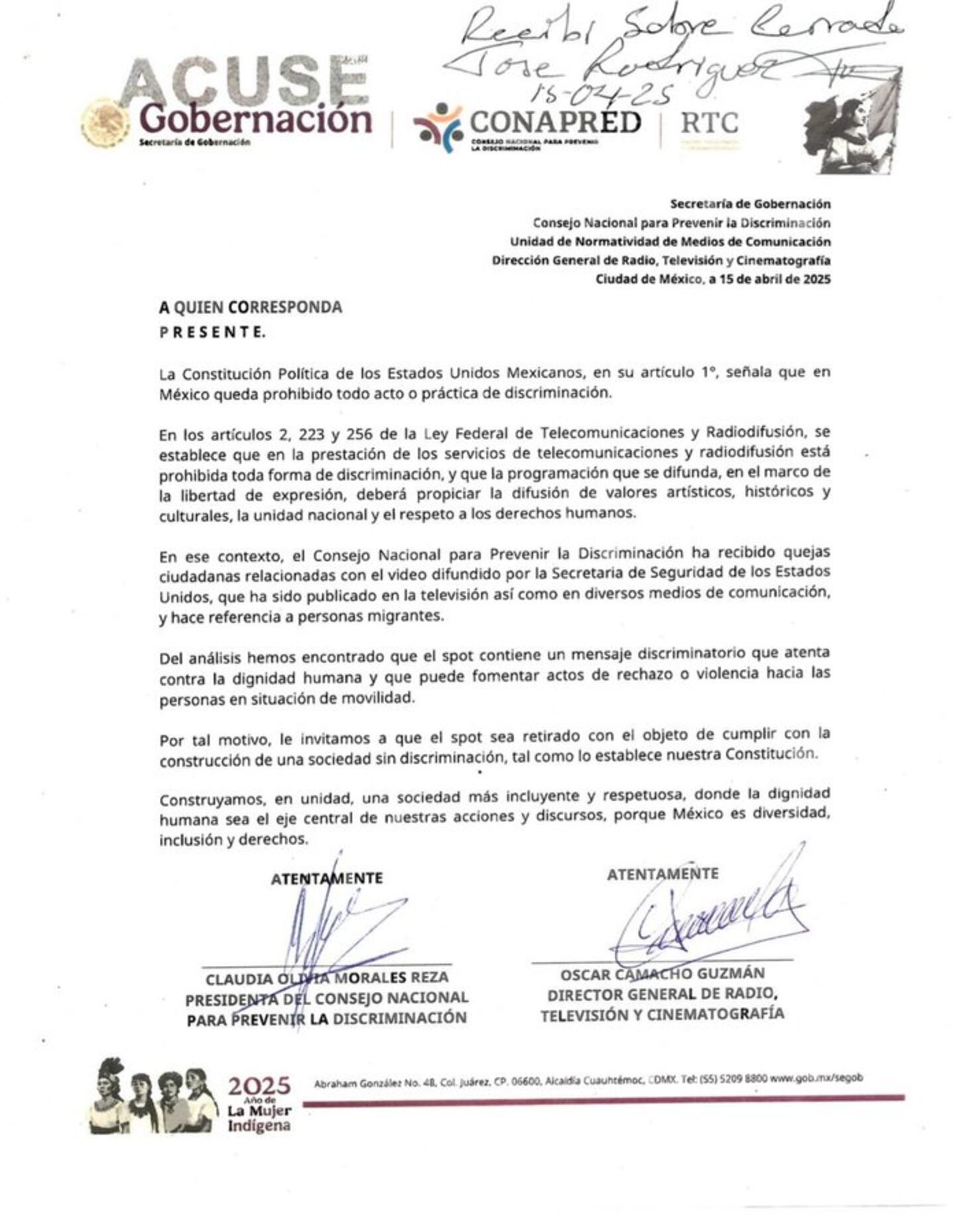
This move follows recent complaints filed with Mexico’s National Council to Prevent Discrimination (CONAPRED) regarding a US Department of Homeland Security (DHS) campaign aired on Mexican television and online platforms. The campaign, which featured Kristin Noem, Secretary, DHS, warning against undocumented migration, was deemed discriminatory by CONAPRED.
In a formal request, CONAPRED urged several broadcasters to withdraw the advertisement, citing Art. 1 of the Mexican Constitution, which prohibits all forms of discrimination. The Council also referenced Art. 2, 223, and 256 of the Telecommunications Law, which require media content to uphold human rights and promote cultural and national unity.
CONAPRED also mentioned that they found the spot contains a discriminatory message that undermines human dignity and may encourage acts of rejection or violence against people in situations of mobility.
In addition to this reform, Sheinbaum addressed the status of Mexico’s regulatory bodies. Although the Federal Telecommunications Institute (IFT) and the Federal Economic Competition Commission (COFECE) are set to be replaced by new entities, they will remain active until the transition is completed. The administration is expected to submit the accompanying legislation to restructure these regulators within the next few days.
Sheinbaum expressed hope for bipartisan support in Congress, highlighting the positive response from opposition lawmakers. “Even the opposition was outraged, good. Let us pass this unanimously,” she concluded. The proposal is part of a broader legislative agenda that the administration hopes to pass before the current congressional session ends in April.
On April 22, the Radio and Television Commission of the Chamber of Deputies, chaired by Deputy Miguel Monraz, hosted the first in a series of forums bringing together experts from the telecommunications industry, government, civil society organizations, and academia. The goal is to collaboratively develop strategies that ensure the sector’s sustainability and modernization in the digital convergence era, while contributing to a regulatory framework that balances commercial, social, and public interests in alignment with the Constitution. The discussion covered areas such as governance, development, legal certainty, freedom of expression, human rights, access to information, and the promotion of better content.
You May Like








Most popular