


China Charts Nuclear Course for Maritime Decarbonization
 By Adriana Alarcón | Journalist & Industry Analyst -
Tue, 11/11/2025 - 09:15
By Adriana Alarcón | Journalist & Industry Analyst -
Tue, 11/11/2025 - 09:15
As the International Maritime Organization (IMO) intensifies global decarbonization targets, setting net-zero goals for 2050, China’s leading ship designer is envisioning a nuclear-powered future for the world’s commercial fleet. In an October 2025 feature in Ship & Boat, members of Jiangnan Shipbuilding Group detail how fourth-generation small modular reactors (SMRs) could transform marine propulsion, positioning nuclear power as a clean, safe, and economically viable solution for deep-sea shipping.
The International Maritime Organization (IMO) back in April took a decisive step toward establishing a legally binding framework to achieve net-zero greenhouse gas (GHG) emissions from shipping by around 2050. Approved by the Marine Environment Protection Committee during its 83rd session (MEPC 83), the IMO Net-Zero Framework becomes the world’s first sector-wide regime combining mandatory emissions limits and GHG pricing, setting a precedent for all heavy-transport industries.
Under the framework, formally set for adoption in October 2025 and expected to enter into force by 2027, ships over 5,000 gross tonnage, responsible for 85% of international shipping emissions, will face binding requirements. These include a global fuel-intensity standard using a well-to-wake lifecycle calculation and a global economic mechanism requiring ships that exceed their GHG thresholds to acquire “remedial units” or contribute to the new IMO Net-Zero Fund.
China: Nuclear Propulsion for the Net-Zero Era
In the published paper in Ship & Boat, Jiangnan Shipbuilding Group’s Hu Keyi and Wang Bing argue that while fuels like green ammonia, methanol, and hydrogen will play vital roles, nuclear energy, free of lifecycle carbon emissions and capable of decade-long fuel cycles, offers unmatched endurance for large ocean-going vessels.
They note that fourth-generation SMR designs drastically enhance safety by reducing power density, enabling passive cooling, and minimizing radiation risk. The progress of these compact reactors, they write, “makes nuclear power a feasible propulsion option for large commercial vessels.”
The paper reviews three main reactor families, pressurized-water (PWR), sodium-cooled fast (SFR), and lead-bismuth cooled (LFR), before turning to molten-salt reactors (MSRs) and particularly thorium-based solid-fuel MSRs (TMSRs). These designs operate at atmospheric pressure, possess strong negative temperature coefficients, and virtually eliminate meltdown risk. Solid-fuel TMSRs combine fluoride-salt cooling with coated-particle fuel, inheriting safety traits from gas-cooled and liquid-metal reactors while achieving thermal efficiencies above 45%.
China’s Thorium Molten Salt Reactor (TMSR) program, led by the Chinese Academy of Sciences, has already achieved stable operation of its TMSR-LF1 liquid-fuel test reactor, marking the world’s only operating thorium MSR as of 2025. A companion solid-fuel design (TMSR-SF) has completed engineering design and awaits deployment.
Applications for Large Commercial Ships
Hu’s team models nuclear integration for three vessel types:
-
Suezmax oil tanker: Equipped with two 70MW lead-bismuth SMRs producing 25MWe each, designed for a ten-year refueling interval
-
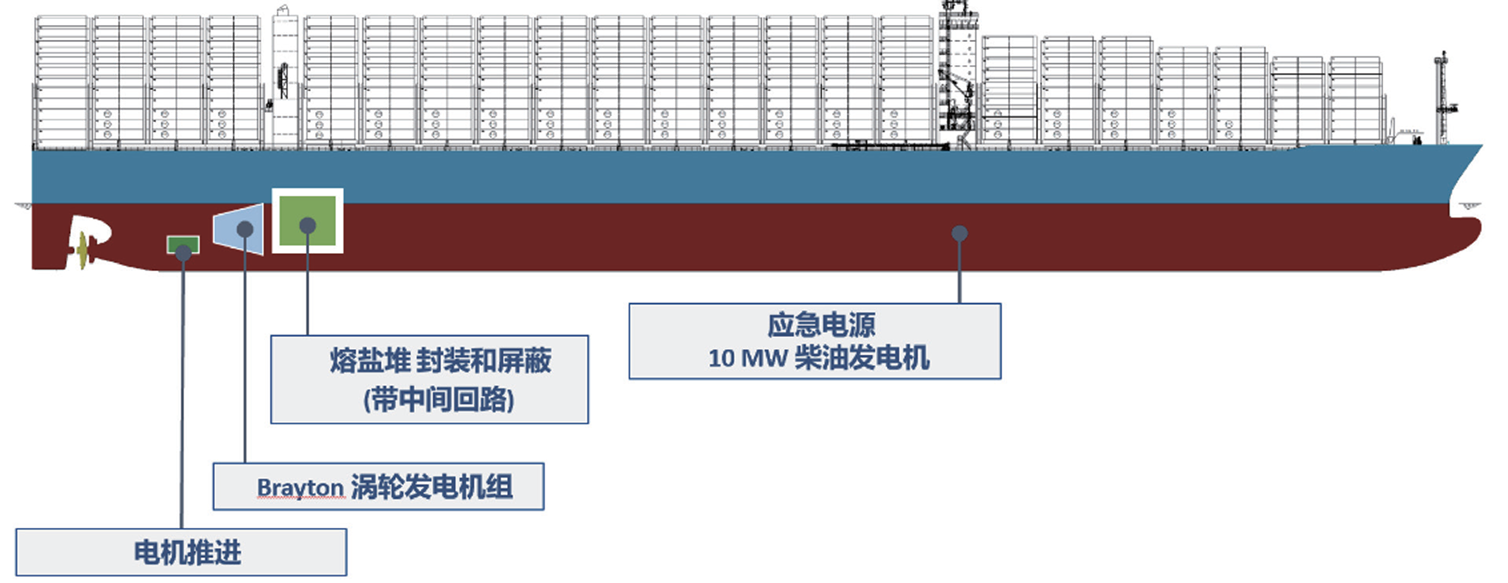
14,000TEU container ship: Powered by a 200 MW TMSR delivering ≈ 50MWe via a supercritical CO₂ Brayton cycle, offering 45-50% thermal efficiency and inherent safety through sealed modular replacement every ten years
-
Floating power platform: A 112m barge hosting four 50MW high-temperature gas-cooled reactors generating 70 MWe to supply ports or AI-driven data-center “computing platforms”
All designs emphasize modular construction, passive cooling, and robust radiation shielding, reflecting a shift from military to civilian nuclear marine systems.
While capital costs and insurance challenges remain steep, the authors argue that long-term fuel savings and government-backed financing could offset initial hurdles. Beyond commercial shipping, marine nuclear power could secure offshore energy independence, enable hydrogen production, and power deep-sea and polar operations.
As fourth-generation SMRs mature and international safety frameworks evolve, nuclear propulsion may soon underpin a new era of zero-carbon, high-endurance ocean transport, anchoring the next stage of the global blue economy.
You May Like





Most popular








