


Judicial Elections / Deported Mexicans
 By Paloma Duran | Journalist and Industry Analyst -
Fri, 02/07/2025 - 12:14
By Paloma Duran | Journalist and Industry Analyst -
Fri, 02/07/2025 - 12:14
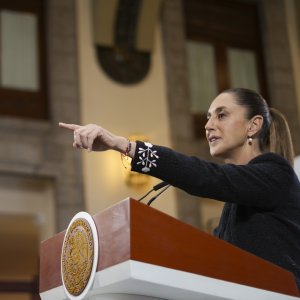
Judicial Elections. After the Supreme Court rejected the list of candidates selected by the Senate for the 2025 Judicial Power elections, President Claudia Sheinbaum stated that the judicial election will proceed as scheduled. "Many judges disagree with the judicial reform, so they turn their personal opinions into attempts to sabotage the election from within their institution. But, they are wrong. It (the election) will happen."
The Senate approved 955 candidates for various judicial roles, including district judges, circuit magistrates, and Supreme Court ministers, after the Judiciary declined to conduct its own selection process. However, Supreme Court ministers concluded that the method, which involved a lottery to select some candidates, did not ensure a proper evaluation of suitability. Following the rejection, the Senate may directly submit the results of its procedure, as recently determined by the Electoral Tribunal of the Federal Judiciary.
Mexicans Deported. Claudia Sheinbaum announced that since Donald Trump took office on Jan. 20, the United States has deported 10,964 people to Mexico, 8,425 of them Mexican nationals and 2,539 from other countries.
The Trump administration's immigration policies aim to curb illegal migration and accelerate the deportation of undocumented migrants. Juan Ramón De la Fuente, Mexican Minister of Foreign Affairs, leads the charge in migration negotiations, focusing on safeguarding the rights of Mexican nationals in the United States. He announced the strengthening of Mexico's legal team in the United States, with a force of 2,610 lawyers. De la Fuente has also been a vocal critic of the reactivation of the Remain in Mexico policy, condemning it as a unilateral move that contradicts Mexico’s humanitarian approach to migration.
Ban on GMO Corn. Claudia Sheinbaum announced that two days ago, the DOF published the ruling of a US dispute panel, which invalidated López Obrador’s decree banning the cultivation of GMO corn in Mexico. She emphasized that her administration is moving forward with a reform that seeks to protect corn by elevating the prohibition to a constitutional level. “We will meet with the Sin Maíz No Hay País group to refine the reform’s details. This meeting aims to determine whether any adjustments are needed to the reform. It is a constitutional initiative to safeguard native corn and prevent the planting of genetically modified varieties,” she stated.
The initiative aims to protect biodiversity and preserve corn as both a cultural symbol and a nutritional staple. These efforts respond to a USMCA dispute resolution panel's ruling, which concluded that López Obrador's 2020 presidential decree banning genetically modified seeds in Mexico violated USMCA and lacked scientific merit.
Spain. Following the announcement of an event at the Casa de México in Spain for International Mother Language Day, Claudia Sheinbaum reaffirmed her commitment to showcasing Mexico’s Indigenous cultures in Spain. Sheinbaum also reiterated Mexico’s request for Spain to apologize to its Indigenous peoples. “This is undoubtedly linked to that—the apology that President López Obrador once requested from the Spanish state for Indigenous communities. We uphold that request and continue to advocate for it.”
In 2019, President López Obrador read aloud the letter he sent to King Felipe VI of Spain, in which he requested an apology from Spain for the violence associated with the Conquest. He noted that no response was received. While relations between the two countries continued, there was a pause in political matters. It was previously announced that King Felipe VI was not invited to the inauguration of President Claudia Sheinbaum, and that the Spanish government decided not to participate in the ceremony at any level.
You May Like





Most popular








