


Mexico Outlines Environmental Priorities at UNAM Forum
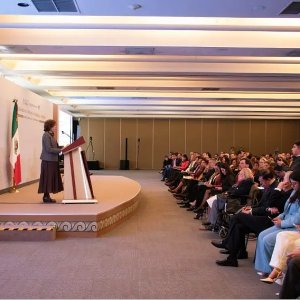
Alicia Bárcena, Minister of Environment and Natural Resources (SEMARNAT), outlined the country’s ecological policy priorities during the opening of the International Colloquium Perspectives on Ecology in Latin America, hosted by UNAM.
In her remarks, Bárcena presented the framework of Mexico’s Humanist Ecological and Environmental Policy, a federal agenda that includes multiple large-scale environmental initiatives. Among the key goals are the restoration of 50 highly degraded sites, reforestation of 100,000ha of forest and 18,000ha of mangroves, a 35% reduction in greenhouse gas emissions, and the remediation of several polluted rivers including the Sonora, Tula, Atoyac, and Lerma-Santiago.
Bárcena also announced a commitment to protect 30% of Mexico’s territory by 2030, which would expand the area under protection from 99 million ha to 153 million ha. Additional priorities include improving air quality in the Mexico City metropolitan area and Monterrey, the development of two circular economy parks, and increased support for environmental defenders and activists.
Bárcena highlighted that environmental improvement cannot exist without social justice. Moreover, she emphasized that Mexico’s new ecological policy under President Claudia Sheinbaum represents a shift toward a participatory model that integrates scientific knowledge with grassroots action. “The challenge is enormous because we must remediate, restore, and conserve, while also developing, growing and promoting equality,” she said.
Bárcena also underscored the importance of community leadership in conservation efforts, particularly those led by Indigenous and Afro-Mexican peoples. “They are the ones who have preserved our most critical ecosystems. We are recognizing these communities not just as a matter of justice, but because they hold essential ecological knowledge,” the minister noted.
You May Like





Most popular








