


BMV Supports WFE Effort to Advance Low-Carbon Finance
 By Duncan Randall | Journalist & Industry Analyst -
Tue, 12/09/2025 - 06:41
By Duncan Randall | Journalist & Industry Analyst -
Tue, 12/09/2025 - 06:41
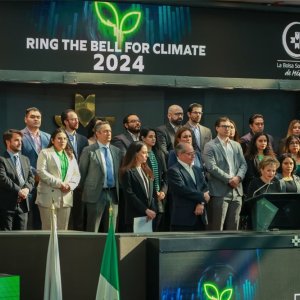
Grupo Bolsa Mexicana de Valores (Grupo BMV) has joined the World Federation of Exchanges’ global call to accelerate the transition to a low-carbon economy, urging listed companies to adopt emissions-reduction strategies, measure climate risks and strengthen their sustainability commitments. The announcement was made during the Ring the Bell for Climate event.
“Climate change represents one of the greatest global challenges of our time. At Grupo Bolsa Mexicana de Valores, we are committed to leading by example—promoting transparency, environmental-impact measurement and the financing of projects that generate social, environmental and economic value,” said Jorge Alegría, the group’s director general.
Executives from América Móvil, Médica Sur and MÉXICO2 highlighted the financial sector’s responsibility in driving sustainable investment and fostering a more responsible market. Grupo BMV reported progress on its internal climate agenda, including formal approval of its Science Based Targets initiative (SBTi) goals—making it one of just eight stock exchanges globally and one of 31 companies in Mexico to receive SBTi validation.
Grupo BMV noted that it measures direct and indirect emissions across Scopes 1, 2 and 3, has developed reduction strategies and offsets 100% of its carbon footprint through local socio-environmental projects. The group also assesses and discloses climate risks in line with the Task Force on Climate-related Financial Disclosures (TCFD) framework.
Externally, the BMV is advancing sustainable finance in the Mexican capital market. Currently, 28% of long-term listed debt corresponds to ESG bonds directed at socio-environmental projects, while 79% of the amount issued in 2025 is tied to emissions-reduction, climate-mitigation initiatives and energy-efficiency projects.
To improve investor transparency, the exchange has developed ESG indices that spotlight companies with stronger sustainability performance. It has also published a Carbon Neutrality Guide to help corporations meet decarbonization goals and has held nine editions of the Sustainable Accompaniment Program (PAS), which trains companies and supply-chain partners in ESG best practices.
Through MÉXICO2, its environmental markets platform, Grupo BMV also supports carbon-market development and emissions-reduction efforts. MÉXICO2 has now hosted five editions of the Mexico Carbon Forum, which has become a regional benchmark for carbon-market dialogue. This year’s event in Tampico drew more than 3,000 participants and 170 speakers, with discussions centered on harmonizing carbon taxes across Mexico’s 32 states. The forum also emphasized the urgency of finalizing Mexico’s national Emissions Trading System (ETS), which remains in a pilot phase launched in 2020.
According to South Pole’s Miguel Chavarría, the ETS will have a far-reaching impact on Mexican industry. “Once fully operational, the ETS will significantly affect cost structures, competitiveness and investment decisions—particularly for sectors emitting more than 100,000 tons of CO₂, such as energy and manufacturing,” he said. Companies that act early, he added, will be better positioned to reduce financial exposure under carbon regulations while planning strategic decarbonization efforts, ensuring compliance and protecting competitiveness in both domestic and international markets.



Most popular








