


Quintana Roo Launches First Sargassum Monitoring Center
 By Eliza Galeana | Junior Journalist & Industry Analyst -
Thu, 08/14/2025 - 18:59
By Eliza Galeana | Junior Journalist & Industry Analyst -
Thu, 08/14/2025 - 18:59
Quintana Roo inaugurated the first Environmental and Sargassum Monitoring Center (CMAS) in the Caribbean. Using satellite technology, it will forecast seaweed arrivals to help mitigate environmental and economic impacts. Meanwhile, specialists are promoting sargassum’s use in sustainable products such as biogas and construction materials.
The facility is located inside the Command, Control, Computing and Communications Center (C5), which manages statewide surveillance and coordinates operations during hurricanes. Esteban Amaro, Director, CMAS, explained that the technology supports scientific research, data collection and projections to be applied across different sectors.
Amaro noted that the center is the first of its kind in Mexico and the Caribbean, specializing in forecasting the arrival of this macroalgae to the coast using images from the European Space Agency’s Sentinel-2 satellites and other technological tools. “Here we can monitor the sargassum and see on which beaches it will arrive, which will allow several things, including cleanup work and, for example, helping our visitors plan their itineraries,” he said. This method has made it possible to more efficiently deploy cleanup teams on the coast and at sea, as well as to install anti-sargassum barriers to facilitate collection.
Mayra Camacho, Marine biologist, said the center will allow for documentation of scientific information, something that had not been done in more than a decade. “This is the first time we have this kind of data to project how much the amount of sargassum arriving on Mexican coasts affects the region,” she noted.
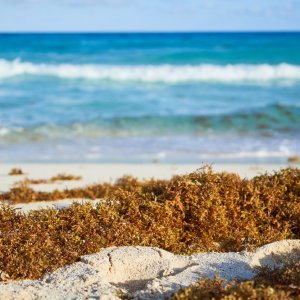
The Caribbean region and the Quintana Roo coastline are experiencing the largest sargassum landings in more than a decade, reaching 60,800t as of Friday, Aug. 8, according to official data from the Ministry of Navy. However, recent changes in ocean currents caused more than 90% of the sargassum heading toward Mexico’s coasts to deviate from its expected route.
This phenomenon benefited the central and southern areas of Quintana Roo, but arrivals have increased significantly in Cancun and Isla Mujeres. Amaro explained that sargassum is highly dynamic and tends to change course, influenced by ocean currents but especially by wind. He predicted this would be the last month of heavy arrivals, with improved beach conditions expected in September.
According to Amaro, global warming and excess nutrients in the sea caused by ocean pollution have transformed the “Sargasso Sea” into an algae belt stretching more than 26,000km across the Atlantic, leading to greater arrivals on Mexican coasts. He added that sargassum can double its biomass every 18 to 20 days, making it a constant challenge for authorities and the tourism sector.
Leticia Durand, Researcher, UNAM’s Regional Center for Multidisciplinary Research, estimated that cleaning just 1km of beach can cost over US$1 million a year. These expenses fall on local authorities and the hotel sector, which mobilize accumulated material manually or with heavy machinery. Beyond high costs and impacts on tourism, improperly disposed sargassum can leach contaminants into the Yucatan Peninsula’s porous limestone soils, polluting aquifers.
In response, academia, public institutions, and private companies have developed strategies to repurpose the algae within production chains. Sargassum is now a material of interest for industries such as agriculture, pharmaceuticals and cosmetics. However, Amaro stressed that the best solution is biogas production, considering the still-uncertain health risks of using it in personal care products.
Miguel Ángel Aké, Director, Nopalmex, a Mexican company pioneering gas and electricity generation from nopal biomass and other organic waste, highlighted that sargassum must be processed in large quantities to cease being a problem, which can be achieved by using it for biofuel production. His estimates suggest that processing between 2,500 and 3,000t of sargassum daily could yield visible results within a year.
“When processed, sargassum can produce 1m3 of biogas, equivalent to the energy from 1L of gasoline. Processing 500t of sargassum yields 20,000m3 of biogas. So, considering that a typical gas station in Mexico sells between 20,000 and 25,000L of fuel daily, we can conclude that 500t/d of sargassum could meet that demand,” he said.
Another potential use is in construction materials. Sargapanel is made from gypsum and about 5kg of dried sargassum, equivalent to 50kg of wet sargassum, per piece. It offers advantages over conventional panels, being about 33% more flexible, more impact-resistant and fire-retardant. No chemical additives are used in its production, making it recyclable. Once its lifecycle ends, it can be ground and reintegrated into production.
Sargapanel has already been installed in a home in Queretaro and proved effective. While the initiative is still artisanal, it only needs simple adaptations for industrial-scale production, and a company has already expressed interest in acquiring the technology. “We want companies to know our product so this does not stay on paper. We are already competitive, and once the panel hits the market, it will be a very good option,” said Rodrigo Esparza, member of the UNAM research team behind the project.
At the state level, the creation of the Comprehensive Sargassum Sanitation and Circular Economy Center was announced this year. Its main goals are to promote the use of sargassum for biogas production and organic fertilizers, and to generate carbon credits by preventing tons of the algae from decomposing in the open air and releasing carbon dioxide. These credits will be sold on voluntary or regulated markets, allowing companies and countries to offset greenhouse gas emissions.
Mara Lezama, Quintana Roo Governor, emphasized that this project will transform environmental liabilities into economic assets. She noted that the annual cost of managing sargassum currently represents 11% of the state’s GDP, or about US$2 billion. “This project will turn sargassum into an opportunity, fostering new sustainable industries, creating jobs and reducing its environmental impact,” she said.
You May Like





Most popular








