


Durango Discusses Investment Scope With Chinese Ambassador
 By Fernando Mares | Journalist & Industry Analyst -
Mon, 01/12/2026 - 13:32
By Fernando Mares | Journalist & Industry Analyst -
Mon, 01/12/2026 - 13:32
Amid the global reshuffling of supply chains, the government of Durango is making a decisive bid for Chinese investment. State officials, led by Foreign Investment Head Arturo Ortiz, met with China’s Ambassador to Mexico Chen Daojiang to showcase Durango’s potential as a strategic foothold in North America, aiming to secure new projects and deepen economic ties with one of Mexico’s principal trade partners.
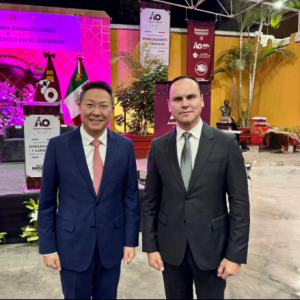
Ortiz reported that he met Ambassador Chen, with the objective of exploring the feasibility of establishing new productive projects within the state and to strengthen economic cooperation between the entity and the Asian nation. Dialogue took place within the framework of the Reception for Ambassadors and Consuls of Mexico Abroad. According to Ortiz, this initiative aligns with the strategy promoted by Governor Esteban Villegas to position Durango as a competitive destination for international capital, particularly as Asian companies seek new operational platforms in North America.
The meeting occurs amidst the ongoing trend of nearshoring, where companies are relocating factories and supply chains closer to the North American market. With China remaining one of Mexico's principal trade partners, Durango authorities aim to present the state as a viable alternative for Chinese capital looking to establish a regional foothold.
This encounter is not the first time Durango authorities have engaged with Chinese players seeking investments. Ortiz previously participated remotely in the Mexico-China Trade and Investment Forum organized by the Mexican Embassy in China, engaging with over 100 companies in person and another 350 connecting remotely. During that session, the state administration highlighted its competitive advantages in key sectors such as automotive, clean energy, and advanced manufacturing. This effort built upon a memorandum of understanding signed with the China Overseas Development Association (CODA) to drive concrete results. "We presented the competitive advantages of our state to confirm a visit from a delegation of Chinese companies, continuing to make things happen for Durango," Ortiz stated regarding the initiative.
Durango as an Investment Destination
Durango is located in northern Mexico , connecting the Pacific coast to the United States border via the Mazatlan-Matamoros highway axis. The state maintains a road network of 12,447km and seven main highway access points that link to ports and border crossings such as Ciudad Juarez, Chihuahua and Piedras Negras, Coahuila. Industrial infrastructure includes the Durango Logistics and Industrial Center (CLID) and parks in the Laguna Region, which provide access to natural gas, fiber optic telecommunications, and electrical substations. The state's workforce is supported by 161 higher education institutions and research centers offering 477 degree programs, according to the local government’s data.
The state’s industrial base includes forestry, mining, and advanced manufacturing. Durango ranks first in Mexico for timber production and forest reserves, with 2Mha under sustainable management. It is also the fourth-largest producer of metals and minerals in the country , hosting 23 mines that extract silver, gold, lead, and zinc. In manufacturing, the state hosts automotive suppliers such as Aptiv, Yazaki, and Daws, which produce harnesses and components. These operations utilize local resources, including non-metallic deposits like bentonite and marble.
Regarding international trade in 2024, the main sales were electrical wires and cables valued at US$493 million, followed by vehicle parts and accessories at US$327 million and vulcanized rubber articles at US$166 million. The United States served as the principal export destination with US$1.42 billion, while Canada and Honduras accounted for US$72.3 million and US$52.6 million, respectively. Conversely, international purchases were led by corn at US$261 million, soybean extraction residues at US$192 million, and vehicle parts at US$149 million. The primary origin of these imports was the United States with US$1.04 billion, followed by China with US$212 million and South Korea with US$172 million, according to the Ministry of Economy (SE).
You May Like




Most popular








