


Delta-Aeroméxico Pact Faces DOJ Push to End Immunity
 By Teresa De Alba | Jr Journalist & Industry Analyst -
Tue, 08/12/2025 - 13:36
By Teresa De Alba | Jr Journalist & Industry Analyst -
Tue, 08/12/2025 - 13:36
The US Department of Justice (DOJ) has formally supported termination antitrust immunity for the joint business agreement between Delta Air Lines and Aeroméxico. This move aligns with a preliminary decision by the US Department of Transportation (DOT) and could disrupt over 1.8 million seats annually on transborder flights between the United States and Mexico.
The DOJ stated, in a document reviewed by El Financiero, that it “supports the Department of Transportation’s preliminary decision not to renew antitrust immunity. Evidence suggests restrictive and potentially discriminatory practices by the Mexican government have limited the entry and expansion of certain airlines in the Mexican market and have therefore undermined competitive conditions and hindering open market access on US-Mexico routes.”
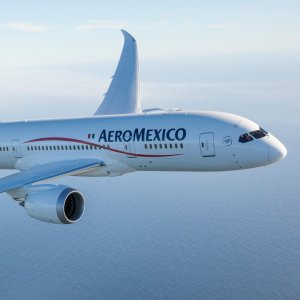
Aeroméxico operates about 30% of its flights under the agreement with Delta. The joint venture, which began in 2016 under antitrust immunity, allows the two carriers to jointly schedule, market, and share revenue on transborder routes. According to CAPA – Centre for Aviation, the JV accounts for 21.8% of two-way seats on US-Mexico routes, holding the largest market share ahead of American Airlines (19.8%) and United Airlines (15.2%).
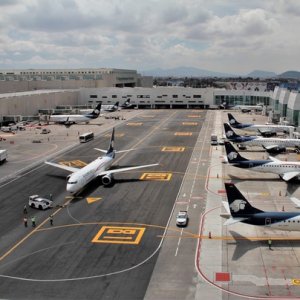
DOT Secretary Sean Duffy cited “blatant disregard” by the Mexican government for the US-Mexico Air Transport Agreement, including slot restrictions at Mexico City International Airport and a 2023 mandate forcing all-cargo carriers, including FedEx and UPS, to relocate from MEX to Felipe Ángeles International Airport (NLU), 30 miles away. Duffy labeled these measures “anti-competitive.”
The DOT’s July 19 filing stated: “Mexico has not taken any action to restore the operating rights of US all-cargo carriers guaranteed in the US-Mexico air transport agreement.” The government reduced MEX’s hourly aircraft movements from 61 to 52 for the 2022–23 winter season and to 43 for 2023–24. According to the DOT, these cuts were made “under the pretense of capacity constraints and operational limitations,” without corresponding infrastructure changes.
In response, the DOT has imposed three new orders: Mexican airlines must provide detailed operational data to determine the legality of US-bound flights; they must obtain prior approval before operating passenger or cargo charter flights to the United States; and the department reaffirmed its January 2024 “show cause” order, which tentatively recommended ending antitrust immunity for Delta and Aeroméxico.
Delta, which owns a 20% stake in Aeroméxico, requested in late July that the DOT delay its final ruling. According to a DOT memorandum dated Aug. 5, “Delta expressed support for the DOT’s actions to ensure Mexico’s compliance with the bilateral air services agreement, while emphasizing that antitrust immunity for its joint venture with Aeroméxico should continue.”
The Asociación Sindical de Pilotos Aviadores (ASPA), Mexico’s pilot union, warned of labor and business model consequences if immunity is revoked. “Aeroméxico’s business model will have to change,” said ASPA Secretary-General Jesús Ortíz Álvarez.
In an Aug. 8 letter to the DOT, ASPA wrote: “Without antitrust immunity, the structural reciprocity embedded in the agreement becomes hollow, replacing integration with fragmentation. Revoking immunity would nullify the conditions that make the Joint Cooperation Agreement effective in delivering benefits to workers and the traveling public.”
The Colegio de Pilotos Aviadores de México (CPAM) also defended the alliance. “We operate this agreement and understand the benefits it has brought to passengers and pilots alike. We have data showing how US companies have gained from the bilateral framework,” CPAM’s president told El Financiero.
The end of the agreement could also impact US aerospace manufacturer Boeing. The company reported in 2024 that demand for its aircraft was boosted by the Delta-Aeroméxico partnership. “Just as passenger traffic has increased in this market segment, the rise in demand for Boeing aircraft has also been a direct result of the synergy generated by the Delta-Aeroméxico agreement,” Boeing stated in a letter to the DOT.
Between 2021 and 2023, Aeroméxico received 46 new Boeing 737 MAX aircraft as part of the operational framework enabled by the alliance. This scale of acquisition reflects broader industrial implications of the potential dissolution.
The conflict partly stems from policies implemented during the Biden administration and the Andrés Manuel López Obrador administration in Mexico. Current DOT actions continue arguments raised in 2024 under former DOT Secretary Pete Buttigieg. However, US President Donald Trump and Secretary Duffy have criticized the Biden administration for not acting sooner.
You May Like






Most popular








