


Mexicana Marks Two Years: Targets 17 Routes, 450,000 Passengers
 By Óscar Goytia | Journalist & Industry Analyst -
Tue, 12/30/2025 - 13:56
By Óscar Goytia | Journalist & Industry Analyst -
Tue, 12/30/2025 - 13:56
Mexicana de Aviación marked its second year of operations on Dec. 26 with an expanded domestic network, a growing fleet of new aircraft, and a five-year institutional plan that outlines traffic growth and operational targets through 2030. The state-owned airline operates exclusively from the Felipe Ángeles International Airport (AIFA) and expects to close 2025 with an estimated 11% market share of passenger traffic handled at the airport, according to company executives.
Mexicana was relaunched in December 2023 as a parastatal airline after ceasing operations in 2010. Its first flight connected AIFA with Tulum International Airport using a Boeing 737-800. The inaugural operation was delayed due to fog, requiring a diversion to Mérida before arriving in Tulum two hours behind schedule. Despite that start, the airline has steadily expanded its operations over the past two years.
At launch, Mexicana operated nine domestic routes, all originating from AIFA, including Monterrey, Oaxaca, Puerto Vallarta, Villahermosa and Ixtapa-Zihuatanejo. As of December 2025, the airline serves 14 national destinations.
“In two years of operation, Mexicana has transported more than 800,000 passengers, which represents about 12% of the total passengers that have used AIFA in that period,” Leobardo Ávila, Director General, Mexicana de Aviación. He also said the company plans to add three additional routes in the second quarter of 2026, bringing the total to 17.
Passenger growth has accelerated during 2025. The airline expects to close the year with approximately 450,000 passengers, up from 350,000 in 2024, representing a 19% annual increase. Earlier in the year, company projections anticipated growth above 25% once the integration of new aircraft was fully reflected in operations. During the first half of 2025, Mexicana transported slightly more than 200,000 passengers, a 24% increase compared with the same period in 2024. Load factor reached 53%, up 15% year over year.
“This year we increased our efficiency per operation by 56%, which translates into more passengers per flight,” said Ávila. He added that the airline reported an on-time performance rate of 98.6% and a customer confidence level of 93.6%.
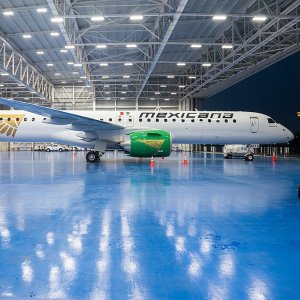
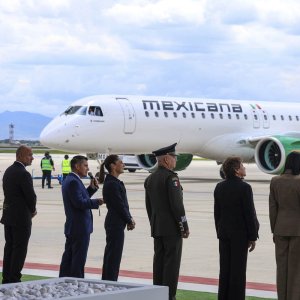
Fleet renewal has been a central component of Mexicana’s strategy. At the start of operations, the airline received three Boeing 737-800 aircraft on loan from the Mexican Air Force. In 2025, Mexicana began incorporating Embraer E195-E2 aircraft as part of a firm order for 20 planes, split evenly between E190-E2 and E195-E2 models. The airline has already received five E195-E2 aircraft.
“All current operations are now being carried out with Embraer E195-E2 aircraft, and preparations are underway to return the Boeing 737-800s to the Air Force,” Ávila said earlier this month.
Seven additional Embraer aircraft are scheduled for delivery in 2026, with the remaining eight expected in 2027, completing the fleet of 20. Each E195-E2 has a capacity of 108 passengers. According to the airline, the new aircraft allow flights that are up to 68% quieter, while also improving operational performance.
Beyond passenger services, Mexicana has developed a cargo segment focused on domestic logistics. Over the past two years, the airline has transported more than 700 metric tons of cargo, including postal materials, medicines and industrial components. Company officials said this activity supports national supply chains and aligns with federal government objectives.
To achieve these results, Mexicana has accumulated more than 17,000 flight hours and flown approximately 11.3 million kilometers, a distance equivalent to circling the globe 281 times.
You May Like




Most popular








