


Mexico’s Second Homegrown Nanosatellite Reaches ISS via Japan
 By Óscar Goytia | Journalist & Industry Analyst -
Fri, 10/31/2025 - 17:24
By Óscar Goytia | Journalist & Industry Analyst -
Fri, 10/31/2025 - 17:24
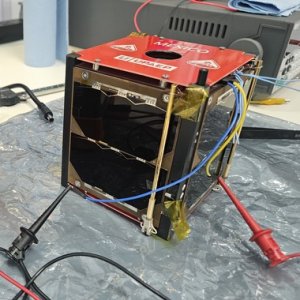
The Universidad Popular Autónoma del Estado de Puebla (UPAEP) reached a new milestone for Mexico’s aerospace sector with the launch of Gxiba-1, its second nanosatellite developed entirely in the country. The CubeSat was sent from Japan to the International Space Station (ISS) as part of a mission coordinated by the Japan Aerospace Exploration Agency (JAXA).
Conceived, designed, and assembled in UPAEP’s laboratories, the nanosatellite demonstrates the growing technical capabilities of Mexican academic institutions in space research. “Knowing that today a satellite made entirely in Mexico, by UPAEP talent, is taking off fills us with pride,” said Eugenio Urrutia, Director of Aerospace Projects, UPAEP. He noted that Gxiba-1 was developed without external technical collaboration, though JAXA reviewed its safety standards and provided the launch opportunity.
Unlike UPAEP’s first nanosatellite, AztechSat-1, which involved international collaboration, Gxiba-1 was produced fully in Mexico. “The first satellite gave us experience and paved the way. With Gxiba-1, we reaffirm that the university has the capacity to lead space projects to international standards,” Urrutia said.
Gxiba-1 is part of a cargo that includes CubeSats from Japan, Thailand, and Malaysia, as well as supplies for ISS astronauts. Its main mission is to monitor active volcanoes, providing data to support risk management and environmental studies. It will also feature an amateur radio function to transmit emergency messages via the Iridium satellite constellation, enabling immediate communication from orbit to Earth.
According to UPAEP, the project involved more than 25 students and six professors over three and a half years. It integrated multiple disciplines beyond engineering, including law, marketing, design, communication, and administration. “This project shows that students can contribute to space science and technology from Mexico,” said Lucio Ruiz, who worked on the ground station operations.



Most popular








