Mexico Advances Sargassum Governance
 By Eliza Galeana | Junior Journalist & Industry Analyst -
Mon, 11/10/2025 - 18:17
By Eliza Galeana | Junior Journalist & Industry Analyst -
Mon, 11/10/2025 - 18:17
The Mexican Institute for Research in Sustainable Fisheries and Aquaculture (IMIPAS), the Riviera Maya Hotel Association (AHRM), and The Seas We Love (TSWL) signed a collaboration agreement to implement containment, collection, and mitigation systems for sargassum in Quintana Roo.
IMIPAS will take the lead in developing a governance model for sargassum management and in building a value market around this biomass. The agreement defines key technical aspects such as optimal collection sites to maximize efficiency, innovation, and technology transfer through the development of sustainable fishing techniques and tools for sargassum harvesting, ideal collection periods, and the necessary conditions to provide certainty for industrial investments.
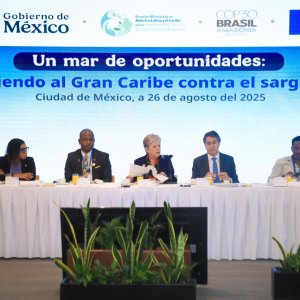
Víctor Manuel Vidal, Director General, IMIPAS, emphasized the importance of forming a common front among government, the private sector, and academia, and of promoting cooperation through science to address the social, environmental, and economic challenges caused by sargassum in the Mexican Caribbean. “Establishing this collaboration with the hotel industry and truly trying to put science at the service of solving problems is a great example,” he said.
Highlighting the region’s importance for the tourism industry, Vidal noted that seven out of every 10 tourism dollars entering Mexico come from Cancun. Likewise, Tony Chaves, President of the Riviera Maya Hotel Association, pointed out that Mexico receives around 45 million tourists every year, 22 million of whom visit Quintana Roo, where about 95% of the population depends directly or indirectly on tourism.
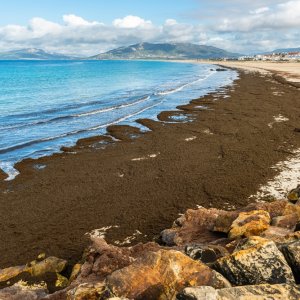
Chaves added that the hotel industry spends approximately US$150 million annually on sargassum collection and beach cleaning. According to José Antonio de la Torre, Director of Municipal Public Services, Cancun, the municipality will end the current collection season with over 16,500t of sargassum, compared to 3,000t in 2024, which represents a significant increase attributed to climate variability and changes in ocean currents.
Ignacio Muñoz, Director, The Seas We Love (TSWL), which is composed of AHRM members, expressed optimism that this natural resource can be transformed into an economic asset. Meanwhile, Edith Calixto, Director of Technological Development, Ministry of Science, Humanities, Technology and Innovation (SECIHTI), stated that at least 147 potential uses for sargassum have been identified. However, she emphasized the need to focus on scalable options that match the magnitude of the problem.
SECIHTI is currently working along four main lines: establishing a sargassum-based biorefinery, developing a comprehensive multiscale monitoring platform, studying health impacts, and strengthening basic science to better understand the causes of accelerated sargassum growth and its effects on ecosystems.
During the presentation of the short film, Mexico Changing the Tide: Sargassum Expedition, Vidal thanked the Inter-American Development Bank (IDB) and the Spanish Agency for International Development Cooperation (AECID) for their financial, technical, and operational support, noting that their assistance was essential for the research expeditions that underpin the scientific results obtained.
He acknowledged the work of more than 40 researchers from Mexico and abroad who participated in the campaign design, onboard operations of the Dr. Jorge Carranza Fraser Research Vessel, and data analysis. Vidal explained that the information gathered allows for a more accurate understanding of the phenomenon’s magnitude, its ecological implications, and its potential for sustainable use. He also noted that this data was key to including sargassum in Mexico’s National Fisheries Charter, an important milestone that establishes a regulatory framework for its sustainable management and marks a turning point in the country’s fisheries and environmental policy.
Ignacio Nicolau Ibarra, Representative, AECID, said that Spanish cooperation is financing a €400,000 (US$462,582) project to support research, governance, regulation, and engagement with coastal communities, as well as a €1 million (US$1.1) grant through the Inter-American Development Bank to promote circular economy initiatives and reuse sargassum as an economic asset and development opportunity.
Nicolau emphasized that the model being built in Mexico, integrating research, public policy, and circular economy principles, demonstrates regional leadership in addressing the sargassum challenge and could be replicated in other Caribbean countries, in line with the commitments of the Granada Declaration, which includes a goal to collect and process 500,000t of sargassum.
In this context, Muñoz noted that the Mexican model could be replicated in the Dominican Republic, Jamaica, and the Lesser Antilles, where the region produces nearly 40Mt of sargassum that could be controlled through this initiative. “Our goal is to safeguard the well-being and economic development of both residents and tourists,” he said.
You May Like


Most popular