

What Are Brands in Mexico Doing Despite Economic Uncertainty?




STORY INLINE POST



 By Mauricio Martínez | Managing Director -
Tue, 07/15/2025 - 11:30
By Mauricio Martínez | Managing Director -
Tue, 07/15/2025 - 11:30
Mexico is experiencing a period of marked economic uncertainty. During the first half of 2025, private consumption showed growth of just 0.7%, well below the 2.7% recorded the previous year. Added to this is a historic drop in remittances, with a 12% decrease in April, the most severe since 2012, and a further drop of almost 5% in May, which has reduced liquidity in many Mexican households.
Inflation, although generally contained at 3.59%, has had a greater impact on the consumption of basic products: mass consumer goods (FMCG) experienced inflation that more than doubled during the first quarter of the year. This increase in prices, combined with economic uncertainty, has weakened consumer confidence, which fell from 49.2 to 46.7 points between October 2024 and January 2025, according to the national indicator.
The Challenge for Brands
In this bleak outlook, many brands have seen their consumer base shrink, lost market share, or cut budgets. However, a select group of 25 brands in Mexico has managed not only to resist but also to grow, which raises a crucial question: What are these brands doing differently to continue thriving in such an adverse environment?
Attracting New Buyers
The main variable driving brand growth is market penetration. Among the 25 brands that grew the most, 24 achieved this primarily thanks to an increase in their customer base. On average, each of these brands gained 4.5 percentage points of penetration, equivalent to approximately 1 million new households.
This growth translates into a significant economic impact: each additional point of penetration generated MX$117 million (US$6 million) in incremental deflated revenue. This is undoubtedly a remarkable achievement for these leading brands.
But then, what are these brands doing — or not doing — to achieve this growth?
1. Marketing Investment
The brands that grew maintained their investment in marketing activities, despite the economic uncertainty. On average, the 25 brands observed maintained their Share of Voice at 18% between the two periods analyzed, which implies a commitment to their goals and the plans they have in place to achieve them.
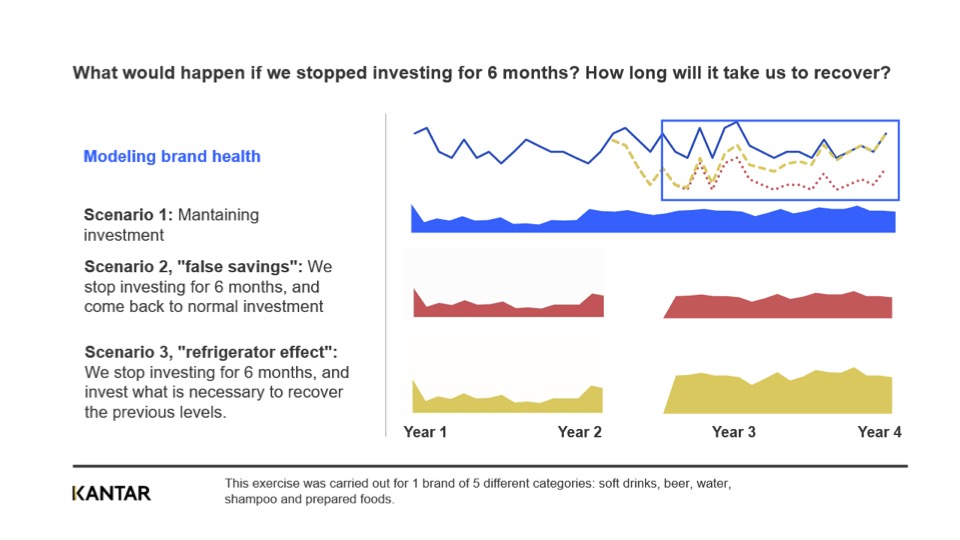
But in an environment like the one we are currently experiencing, it is common for advertising investments to be reduced or suspended, so we investigated whether this is a good idea. To answer this question, three investment scenarios were modeled to evaluate the impact of maintaining or reducing advertising investment:
a) Maintain investment.
b) Stop investing for six months and then return to the usual investment ("false savings").
c) Stop investing for six months and invest only what is necessary to recover to previous levels ("refrigerator effect").
The analysis showed that continued investment is essential to promote recovery and growth. In the scenarios where investment was suspended, a notable decline was identified in variables such as brand awareness, the key positioning attribute, and purchase consideration. The difference observed in the speed of recovery is particularly significant. In the second scenario, upon resuming regular investment starting in the seventh month, there was a 10% drop in awareness, -8.4% in positioning, and -9% in purchase consideration; furthermore, the gap with previous levels was not completely closed, even maintaining the same level of investment.
In the third scenario, the brand significantly increases its investment with the goal of recovering historical levels; however, this entails allocating an additional +26%, +13.5%, and +18.7% in investment to achieve advertising awareness, positioning, and purchase consideration prior to the cutback for 15 consecutive months. Thus, discontinuing the investment represents an unfavorable decision that entails either a sustained decline in brand metrics or the need for prolonged overinvestment, which is financially more costly and results in no real savings. (See Figure 1)
*Kantar Graphic 1 (file name attached)
2. Invest With Quality
Not only is continuing to invest key, but among growing brands, we noted a 41% perception of having great advertising, while the brands we monitor in Mexico only reach 26%. This requires a commitment to developing communication based on creativity and that adequately conveys the brands' key messages. This is corroborated when we see that 52% of growing brands do evaluate their copy with consumers through advertising pretests, compared to 25% of the rest of the brands in Mexico.
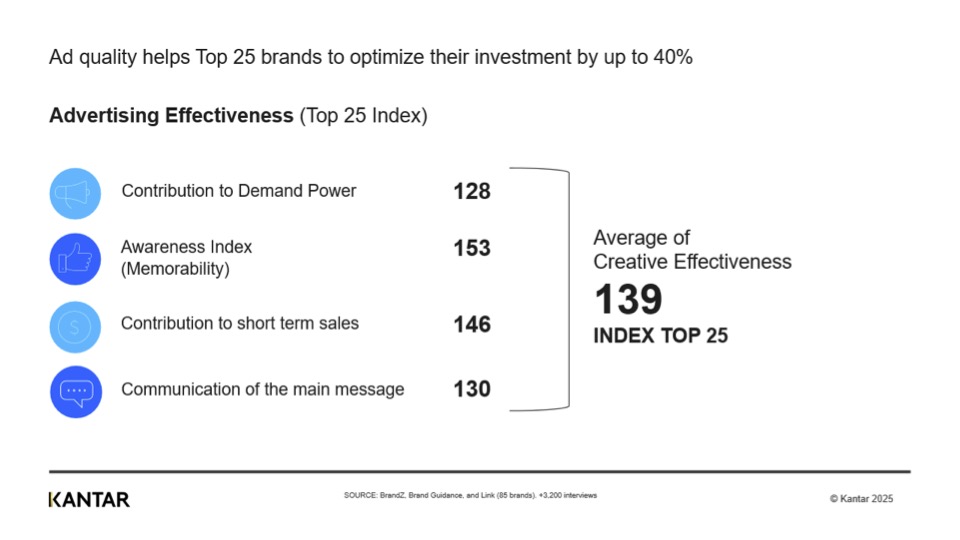
Ultimately, this creative vocation gives them an index of 128 for demand generation, 153 for brand memorability, 146 for short-term sales contribution, and 130 for conveying the core message. (See Figure 2)
*Kantar Graphic 2 (file name attached)
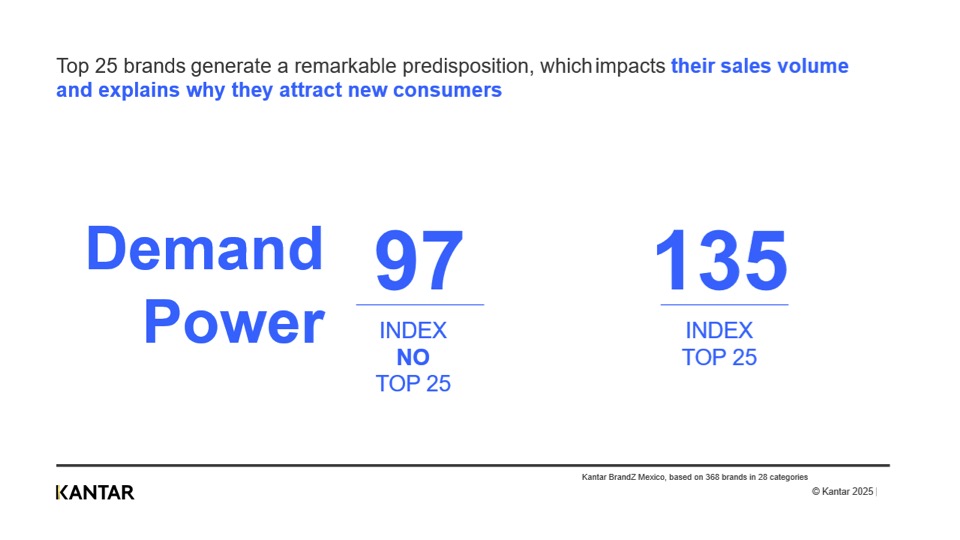
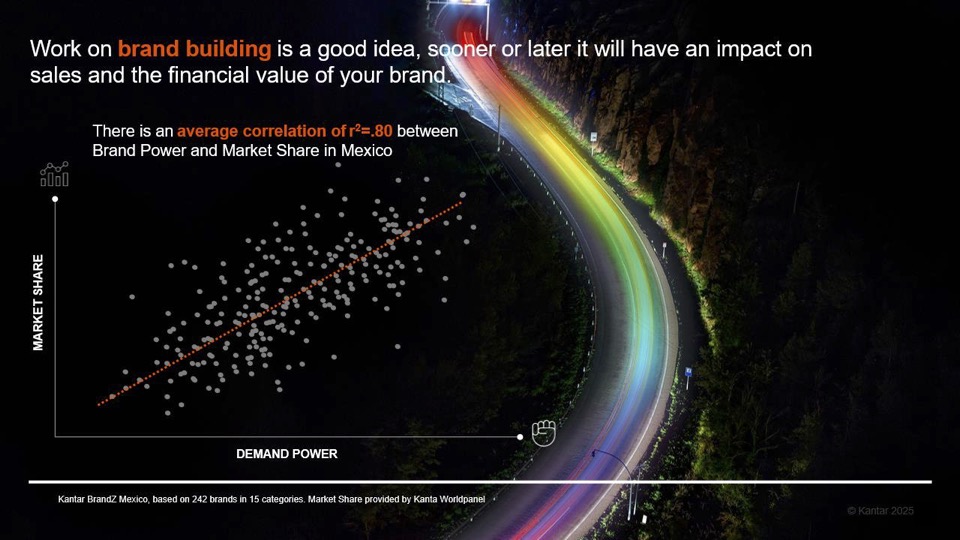
Investing more and better has a visible return. In addition to showing growth in market share and frequency, we also observed improved performance in Demand Power, with an index of 135 compared to 97 for the rest of the brands in Mexico (Figure 3). This is especially important because Demand Power, like no other metric, correlates strongly with market share, as shown in Figure 4.
*Kantar Graphic 3 (file name attached)
3. Smart Price Management
One of the most revealing findings of the analysis is the relationship between price perception and brands' ability to justify what they charge. In an environment where consumers are more sensitive than ever to the value they receive for their money, managing this equation becomes not only relevant, but crucial.
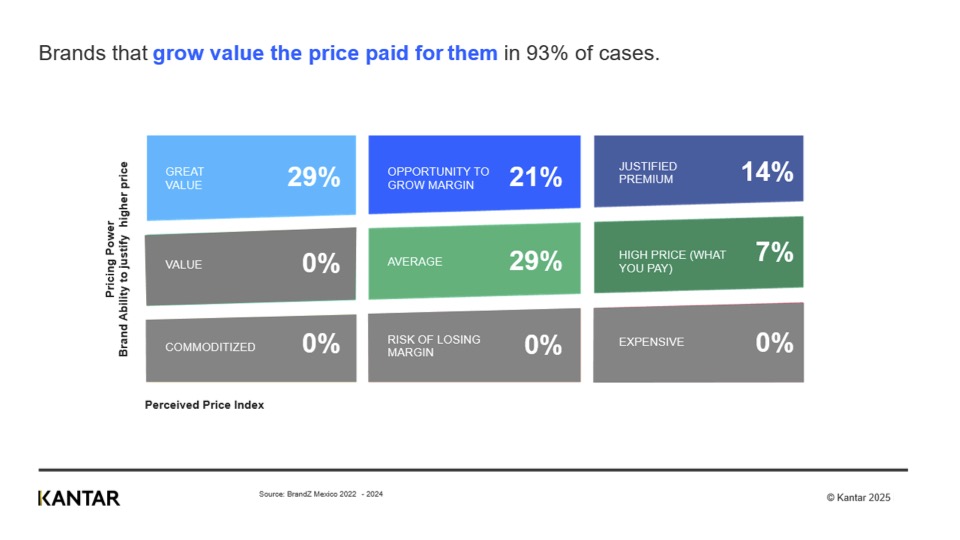
When we correlate price perception with brands' ability to justify a higher price, a clear pattern emerges: growing brands not only manage to justify the price they charge, but many of them even project a perception of value greater than their cost. In other words, consumers feel they are getting more than they pay for. This phenomenon is no small feat: 93% of brands that grew in the last year fall into this category (Figure 5).
*Kantar Graphic 5 (file name attached)
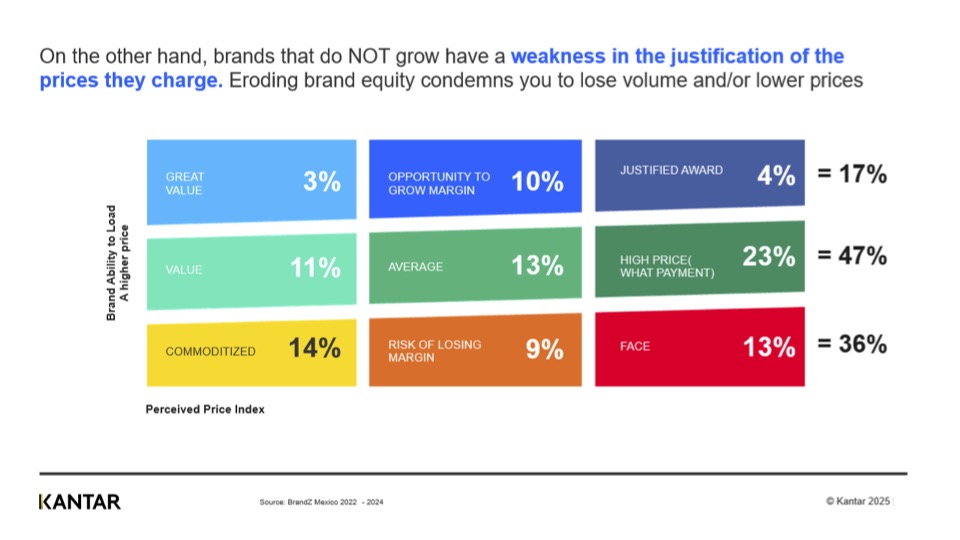
In contrast, brands that don't grow often have a structural weakness on this front: they fail to justify the price they charge. This erodes their brand equity, makes them more vulnerable to competition and forces them to compete on price, which in turn compromises their profitability and sustainability over time (Figure 6).
*Kantar Graphic 6 (file name attached)
4. Where You Win or Lose: The Point of Sale
In an environment where every point of growth counts, the point of sale becomes a strategic battlefield. And it is in the modern channel — supermarkets, hypermarkets, warehouses — where the most intense battle is being fought. But there is one player that is clearly standing out: hard discounters. This is where growth is occurring intensely, and where brands that aspire to grow must have a strong and precise presence.
The reality of the Mexican consumer today demands a multichannel strategy. More than 50% of households shop in eight or more different channels, which speaks volumes about the complexity of the environment and the importance of performing adequately in each of them. It's not enough to be there, you have to be good.
The brands that do this best — those that ensure availability, visibility, adequate assortment, and relevant formats — capture demand that other brands simply let slip by. Because when a brand is unavailable, not easy to find, or doesn't have the presentation the consumer was looking for, that consumer doesn't wait: they choose another option. And that seemingly small decision has a direct impact on volume
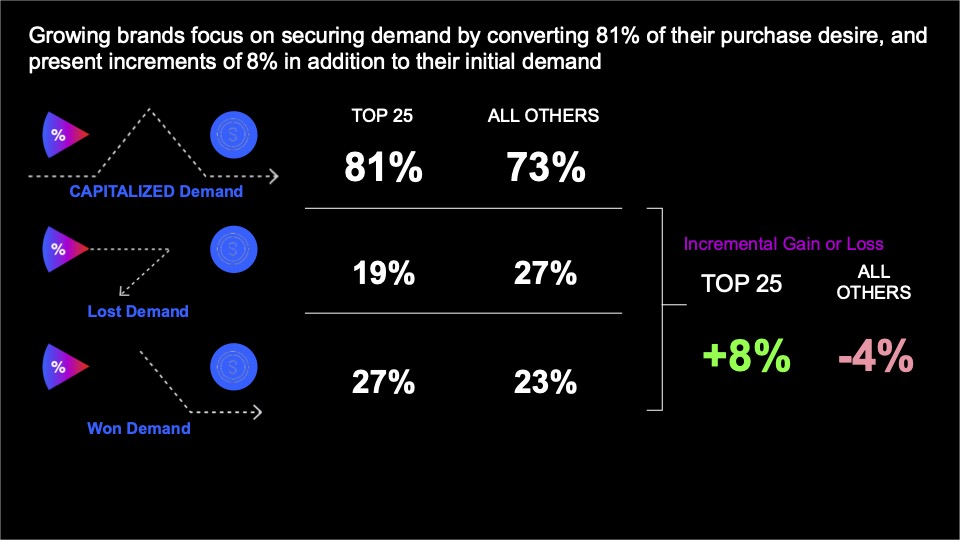
The data is overwhelming: growing brands capture up to 8 additional points of demand thanks to superior execution at the point of sale. In contrast, the rest of the brands in Mexico lose up to 4 points they had previously generated simply due to poor execution (see figure 7). In other words, it's not just about generating demand, but knowing how to capture it.
*Kantar Graphic 7 (file name attached)
5. Attack Areas Not Yet Mastered, Going Head to Head
Growing brands don't do so by accident, but because they choose precisely where to play. Instead of replicating generic strategies across all territories, they focus on specific regions, segments, or markets that have the potential to make significant contributions. There, where they haven't yet dominated, they deploy different, more aggressive, more tailored, and more ambitious strategies. This ability to identify opportunity spaces and treat them as true drivers of growth allows them not only to capture incremental volume but also to attack their competition head-on. In these markets, the strategy isn't defensive: it's offensive. And the results confirm this — brands that dare to play differently where there is room for growth win more.
6. Understand Innovation as a Driver of Growth
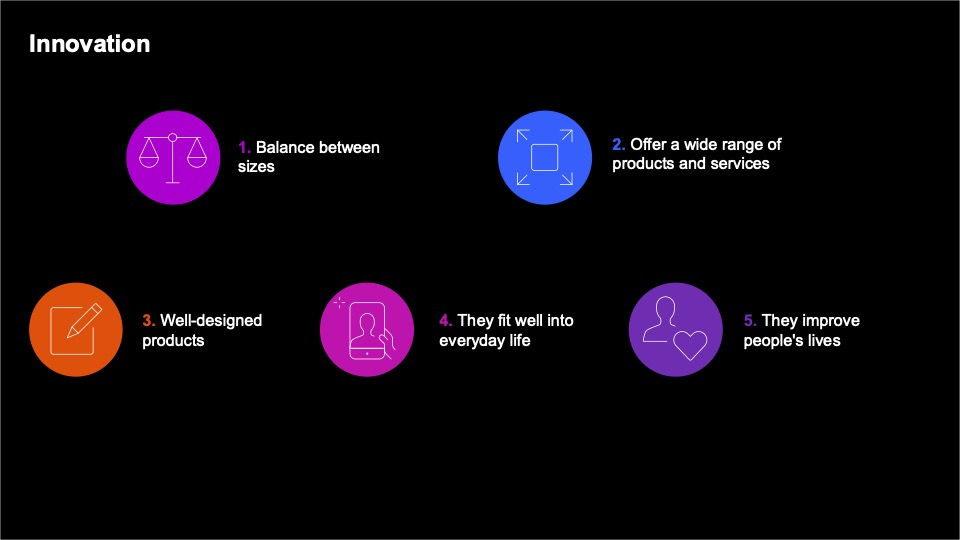
Innovation, for its part, is not a luxury, it is a growth tool. Growing brands understand this and apply it intentionally. They do so in five key dimensions: they offer products in the right sizes and presentations, precisely designed to fit into the consumer's daily life; they focus on convenience, facilitating use, access, and experience; and they provide a tangible superiority that allows them to establish a significant new differentiation from their competitors (see figure 8). This innovation is not just technical, it is strategic. It is how brands become relevant, desirable, and justify the price they charge. It is how they earn a place in the minds and shopping carts of consumers.
*Kantar Graphic 8 (file name attached)
In short, the brands that grow in Mexico do so because they have understood that, in times of uncertainty, it is not enough to simply resist: they must act with strategic intelligence. They continue to invest, even when the environment suggests otherwise. But it's not just about investing more, but about investing better: they do so with high-quality advertising pieces, evaluated, optimized, and designed to build their brand and generate results.
They manage their prices intelligently, not from a defensive perspective, but from a value perspective. They justify what they charge and, in many cases, make the consumer perceive that they are receiving more than they pay for. They execute impeccably at the point of sale, in each of the trenches where the purchasing decision is at stake. They attack untapped fronts, with strategies adapted to regions, channels, or segments that can bring them relevant contributions. And they understand innovation not as an isolated creative act, but as an engine of growth: they design products that fit into people's lives, that make their daily lives easier, and that offer a significant difference. Because brands that grow don't improvise, they execute with precision, bet with conviction, and build with vision.
You May Like


Most popular








