


The Future of Mexico's Energy Sector in the Upcoming Years
 By Fernando Mares | Journalist & Industry Analyst -
Thu, 11/30/2023 - 11:11
By Fernando Mares | Journalist & Industry Analyst -
Thu, 11/30/2023 - 11:11
The energy sector will undergo a series of changes, and technology is accelerating the process. Jorge Musalem, Strategic Projects Manager, CFE, mentioned that the main conditions contributing to these disruptions include the lower costs of new technologies, their accelerated adoption, new business models, and compatible technologies that amplify the impact of this new disruption.
SENER’s recently published National Electricity System Development Program (PRODESEN) sheds light on the nation's robust energy agenda for 2023-2037. To fortify the country's electric infrastructure, the program outlines plans for the operation of approximately 1,800km-c in transmission capacity at 400kV. This substantial milestone is attributed to two pivotal projects—incrementing transmission capacity from Northeast to Central Mexico and resolving congestion issues in the Northwest, Western, and Northern transmission links.
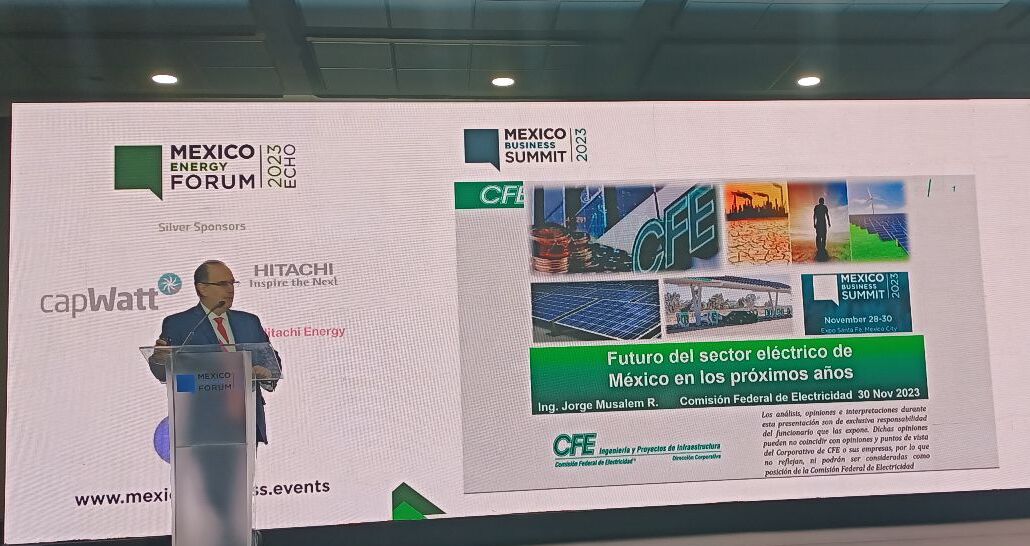
From the second half of 2023 to 2030, PRODESEN anticipates the commissioning of 289 projects sanctioned by SENER. Of these, 182 will fall under CFE Transmisión, covering 4,324.7km-c, with a focus on states such as Sinaloa, Hidalgo, State of Mexico, Guanajuato, Nayarit, and Quintana Roo. These projects aim to integrate the general distribution networks (RGD) of the Wholesale Electricity Market (MEM), incorporating 50.1 km-c of medium-voltage networks.
Sinaloa is poised to witness the largest transmission capacity operation, benefiting significantly from the "I20-SIN1 Solution to the Congestion Problem" project, contributing 612 km-c to reinforce the 400 kV trunk network.
The program also projects a considerable expansion in distributed solar generation, estimating a 186% increase in installed photovoltaic capacity by 2027 and a remarkable 543% surge by 2037. Musalem emphasized that photovoltaic energy has consistently reduced costs, transitioning from an expensive source priced at over US$5,000/kW to less than US$800/kW in 2023, and a prospected downward trend of 12% year-on-year until 2030. In 2022, the installed capacity for solar panels under 500kW reached 2,613MW, with projections indicating growth to 7,473MW in 2027 and 16,777MW by 2037. These projections, in a scenario of accelerated growth, surpass planning estimates by around 60%.
PRODESEN's forward-looking strategy not only addresses transmission challenges but also underscores Mexico's commitment to a diversified and sustainable energy future, incorporating both large-scale projects and the expansive growth of distributed solar generation.
The compatibility of different technologies like domestic distributed generation, batteries for energy storage, and electric cars, technologies that are becoming more accessible, are also accelerating the development of this disruption in the energy sector. “Climate change is boosting this transition, sooner or later using this technology will not be an option anymore,” he said.
Musalem stressed that Mexico sources over 57% of its energy from natural gas, followed by renewable energy with 28.7%, coal-fired with 4.11%, and other thermals at 9.66%. “Producing clean sources in Mexico is cheaper, for instance, a photovoltaic panel placed at 90° in Puebla produces more than the same panel placed at 0° in Berlin, Germany,” he added.
Acknowledging the rise in demand for clean energy and the threat of climate change, Musalem said it is important to promote clean energy projects. However, he warned that distributed generation, cannot happen to the detriment of CFE. He said that if CFE clients disconnect themselves from the grid, CFE will sell less energy at the same costs, which could lead to price increases that might incentivize more clients to disconnect, meaning more costs for CFE.
In this sense, Musalem outlined a series of business models that could fit CFE under this new reality or disruption in the market. These include exploring distributed generation and storage, adopting hourly tariffs based on consumption patterns, establishing a widespread EV charging network, implementing energy storage solutions, revising the fixed-price backup energy model, introducing regulatory measures for grid services, and considering the integration of green hydrogen. These adaptations aim to align CFE with evolving market dynamics.
You May Like





Most popular








