

Circular Economy Law: Science and Development for Mexico



STORY INLINE POST





 By Adrian Sanchez Roa | Senior Consultant in Circular Economy and Applied Sustainability -
Wed, 01/07/2026 - 06:30
By Adrian Sanchez Roa | Senior Consultant in Circular Economy and Applied Sustainability -
Wed, 01/07/2026 - 06:30
Mexico is undergoing a structural redefinition. The global narrative on development has shifted: it is no longer about how much can be extracted, but how much can be kept in circulation. With the recent approval and consolidation of the General Law of Circular Economy (LGEC), the country is not only updating its regulatory framework but also sending a powerful signal to international markets: Mexico has ceased viewing sustainability as an option and has turned it into its priority industrial strategy.
Technical Analysis: The Pillars of the New Law
Based on the rulings published in the Senate Gazette and the Official Journal of the Federation (DOF), we have broken down the strategic points that turn this law into an instrument of real economic transformation:
Extended Producer Responsibility (EPR): This is the financial heart of the law. It establishes that a brand's responsibility does not end at the point of sale but extends to post-consumption. This forces companies to internalize environmental costs, financially incentivizing the redesign of packaging to be truly recyclable.
Circular Economy Management Plans: The law is not punitive; it is programmatic. It requires regulated entities to submit management plans detailing progressive goals for reduction, recycling, and valorization. This provides legal certainty for investors, who now have a clear, long-term roadmap.
Integration of Grassroots Recyclers: A crucial and humanistic point of the legislation is the recognition of waste pickers and informal recyclers. The law seeks to formalize and integrate them into the value chain, acknowledging that without their labor, circularity in Mexico would be impossible.
By-Product Markets: The foundation is laid for residues from one industry to be legally and easily acquired as raw material by another, removing bureaucratic hurdles that previously forced valuable materials to be buried.
Mexico as a Beacon for Central and South America
The importance of this law transcends our borders. Due to its geopolitical weight and commercial integration with North America, Mexico is positioning itself as the "role model" for emerging economies.
This legal framework sets a historic precedent for replication in Central and South America. By demonstrating that a developing economy can implement world-class regulations without sacrificing growth, Mexico exports a model of environmental governance. We are creating a regional standard that will facilitate the trade of recycled materials and green technologies across the continent, harmonizing criteria that will allow companies to operate with similar standards from Tijuana to Patagonia.
A Tribute to Leadership and Persistence
At Lealtad Verde, we understand that laws are written by people with vision. Therefore, it is imperative to pause and extend a public and heartfelt congratulation to former Sen. Marcela Mora Arellano. Her work has been titanic, not only during her legislative term but also through her tireless post-legislative dedication. She understood that the circular economy has no partisan colors but is a national urgency, and her precise follow-up was decisive in ensuring this document did not get lost in the archives but instead came to life.
Likewise, we celebrate the current political moment. Having Dr. Claudia Sheinbaum in the presidency and MSc. Alicia Bárcena at the Ministry of Environment (SEMARNAT) is a historic alignment. Science has arrived in power. That the country's highest authorities have scientific backgrounds and expertise in sustainable development guarantees that the implementation of this law will be technical, precise, and evidence-based, rather than driven by political whims.
The Memory of Innovation: Our Machine in the Senate
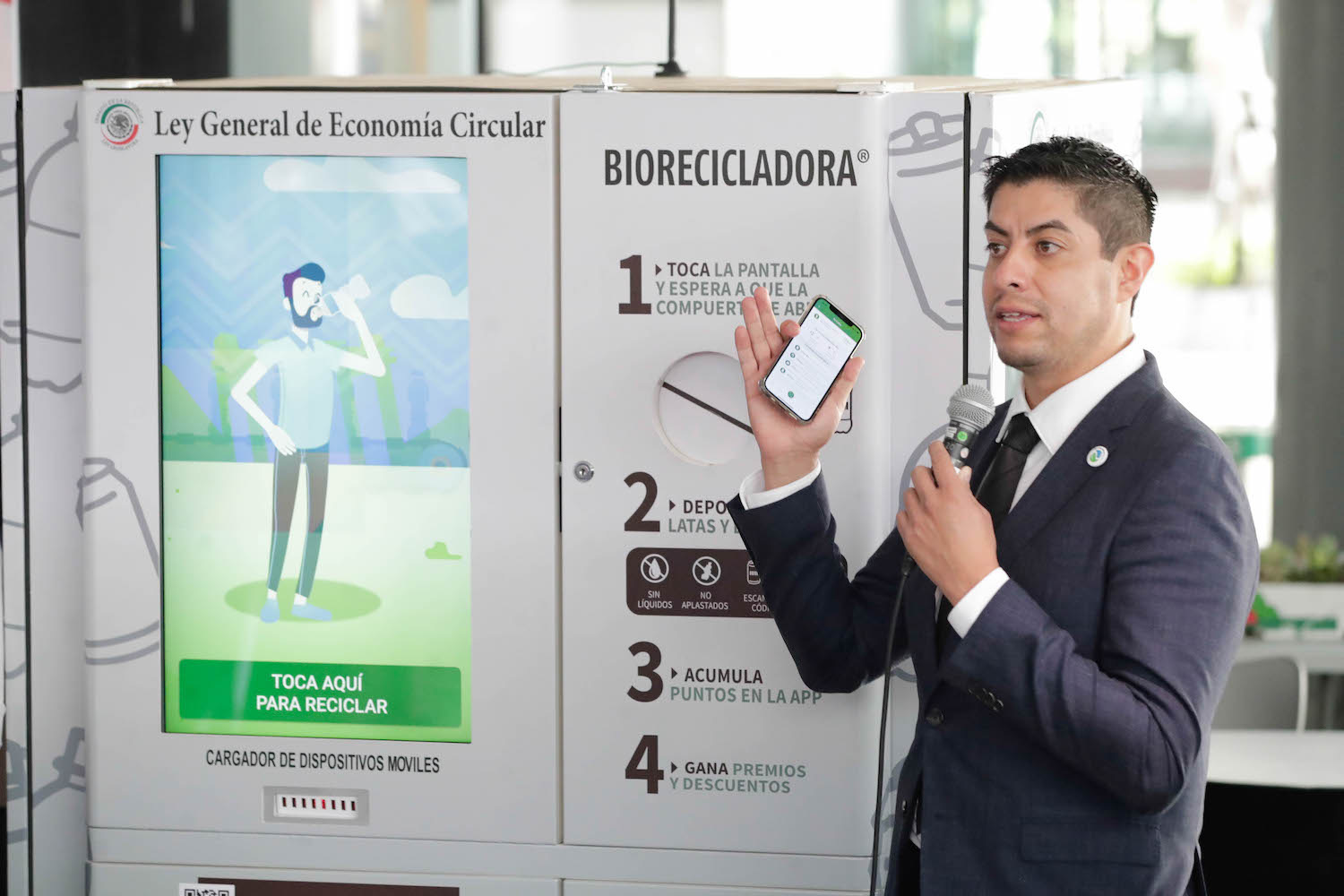
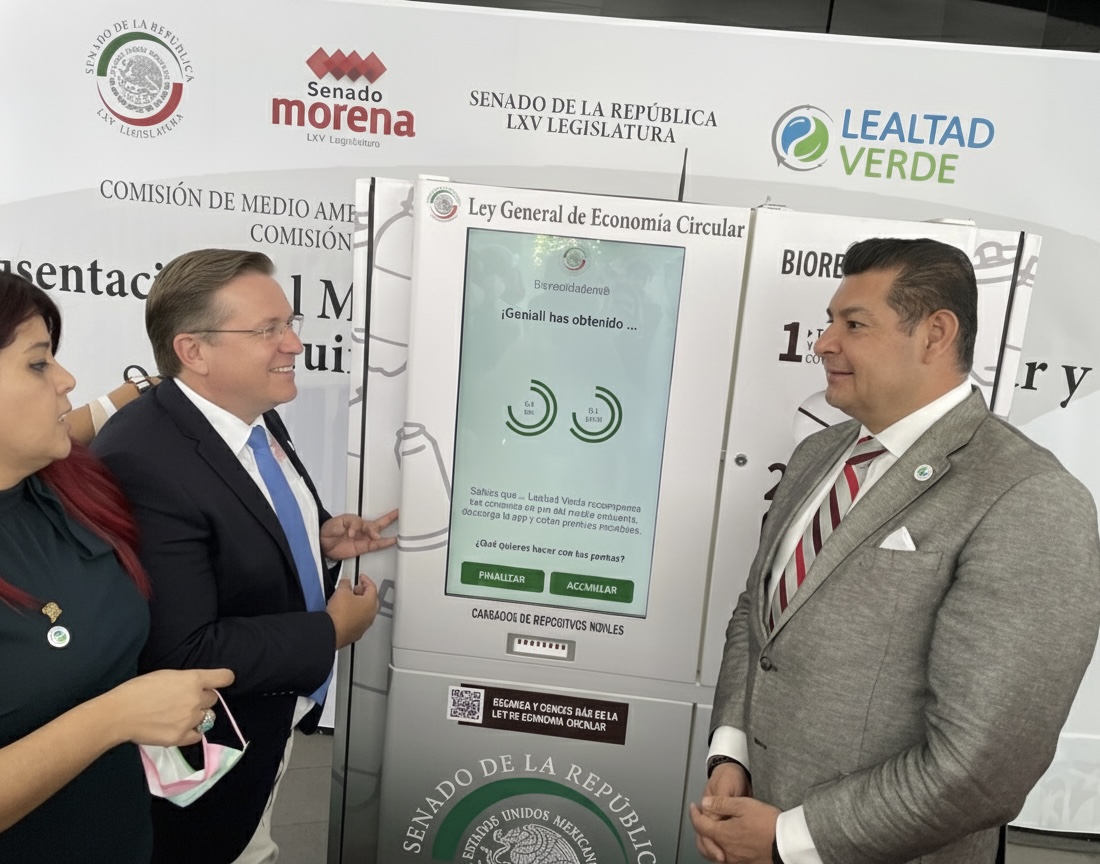
This legislative breakthrough touches a sensitive chord at Lealtad Verde. We remember with pride the day we broke protocol to bring innovation into the sacred hall of laws. We presented our biorecycling machine on the floor of the Senate of the Republic.
Why was this important? Because legislators needed to see it to believe it. By interacting with the Deposit Return System (DRS/SDDR) technology, we demonstrated that the theory of the law already had a practical solution in the real world. That machine did not just compact containers; it compacted the gap between the government and the citizenry. It was tangible proof that Mexican technology is ready to meet the challenge the law now imposes.

Science and Economy: An Indissoluble Alliance
Finally, we must be clear: this law is the perfect tool for integration between the government, users, brands, companies, and sanitation workers.
There is a false dilemma that opposes economic development with environmental care. The reality, backed by science, is that today there is no possible economic development without sustainability. Heeding science is not a sign of alarm or regression; it is the doorway to unprecedented development.
When science and economics join forces, disruptive models emerge, such as biorecyclers and SDDR systems. These technologies allow for:
- Total traceability of waste.
- Direct incentives for the user (rewards for recycling).
- Pure materials for the industry, reducing dependence on volatile virgin raw materials.
The General Law of Circular Economy is proportional to the care the Mexican territory deserves and the potential of its people. At Lealtad Verde, we are ready, proud, and committed to operating in this new Mexico, where recycling is synonymous with prospering.
You May Like







Most popular








