


APM Lazaro Cardenas to Run on 100% Renewables in 3Q26
 By Adriana Alarcón | Journalist & Industry Analyst -
Fri, 01/16/2026 - 11:05
By Adriana Alarcón | Journalist & Industry Analyst -
Fri, 01/16/2026 - 11:05
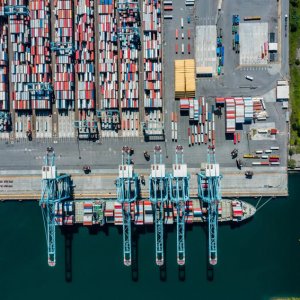
APM Terminals’ Lazaro Cardenas container terminal has signed a power-supply contract with Iberdrola México that will go live in the 3Q26, positioning the facility as the first terminal in Mexico to operate with electricity sourced entirely from renewables. Under the agreement, 95% of the terminal’s electricity consumption will be covered by Iberdrola’s renewable supply, while the remaining 5% will come from onsite solar panels expected to begin operating soon as part of APM Terminals’ global decarbonization strategy.
Beatriz Yera, Managing Director, APM Terminals Mexico, says the shift is especially significant because the terminal’s automated yard and some of its largest assets, including cranes, are already fully electric. In operational terms, that means the terminal is not only procuring renewable power on paper, but also increasingly running key cargo-handling processes on electricity rather than diesel, an important lever for emissions reduction in port operations.
A central element of the deal is the purchase of Guarantees of Origin (GDOs), which provide traceability and certification that the electricity supplied is tied to Iberdrola México’s renewable generation. With GDOs, APM Terminals can credibly document greenhouse gas reductions linked to its electricity consumption, an increasingly important requirement for shippers and ocean carriers seeking more transparent, lower-carbon supply chains.
APM Terminals estimates the renewable electricity supply for Lazaro Cardenas will avoid around 6,500 metric tons of carbon dioxide emissions per year, reinforcing the company’s broader goal of leading decarbonization in the terminal industry through accelerated electrification.
Record Throughput Underscores Modernization Momentum
The renewable-power transition lands as APM Terminals Lazaro Cardenas continues scaling throughput and equipment capabilities. In November 2025, the company reported it had moved one million TEUs before the end of 2025, a milestone it framed as a new efficiency record for the facility and a marker of its strategic role in Mexico’s international trade. The terminal has also been positioned by APM Terminals as Latin America’s first semi-automated container terminal.
APM Terminals attributed the performance to a sustained investment plan that expanded operating capacity at both the berth and yard, alongside initiatives to maximize crane productivity and optimize landside appointment scheduling to reduce waiting times and keep flows steady. The company also emphasized continued improvements in safety, performance, and customer experience supported by technology and close coordination with clients.
New Fully Electric STS Crane and Phase II Capacity Push
In parallel, APM Terminals has been upgrading its fleet with electric equipment designed to raise productivity while lowering emissions. The terminal received a new fully electric Super-Post-Panamax ship-to-shore crane, with a maximum lifting capacity of 100 metric tons. The company says the crane delivers performance comparable to existing equipment while improving energy efficiency and sustainability outcomes.
According to APM Terminals, the new STS crane should help reduce vessel time at berth and provide more flexibility to serve ships of different sizes, improvements that can translate into more reliable schedules for shipping lines and stronger service levels for cargo owners.
The crane will integrate into the Phase II expansion program, which also includes new automated rail-mounted gantry cranes (ARMGs). Once Phase II enters operations in 2026, APM Terminals expects annual capacity at Lazaro Cardenas to reach 2.2 million TEUs, supporting continued growth in one of Mexico’s most important Pacific gateways.
Broader Growth Across Mexico and Port-Wide Transformation in Lazaro Cardenas
A federal plan unveiled in July 2025 names Lazaro Cardenas as one of six priority ports targeted for logistics investment through a mix of public works and private terminal expansion. In that package, APM Terminals is explicitly cited as a major private-sector anchor at Lazaro Cardenas through a MX$2.87 billion (US$162.1 million) terminal expansion, reported as 50% complete, designed to scale capacity and reinforce the port’s multimodal profile alongside other terminal operators’ projects. The same plan links the port’s expansion to enabling infrastructure such as customs upgrades worth MX$363 million and congestion-relief works including a 7.6km city bypass valued at MX$325 million, plus complementary investments like the La Palma Island development, reported 50% complete with MX$4.89 billion in public investment.
The federal government has also framed Lazaro Cardenas as a central lever in Plan Michoacán, highlighting port modernization, coordinated with Mexican Navy (SEMAR), to strengthen exports, including cold-chain infrastructure and expanded container terminals. Within this narrative, the port’s modernization is described as evolving into a multimodal hub, explicitly integrating new terminal expansions by APM Terminals as part of the capacity buildout.
Puerto Progreso Investment
On the Gulf side, APM Terminals is pursuing a long-horizon modernization plan for its Puerto Progreso container terminal. The company has announced staged investments of about MX$3 billion over the next 19 years, aimed at upgrading infrastructure, renewing equipment, and introducing advanced technology to strengthen operational efficiency, safety, and reliability, while positioning Progreso as a benchmark hub for innovation and sustainability in southeastern Mexico.
This also aligns with the government’s broader port strategy. The state government has invested MX$1.5 billion to begin dredging the navigation channel. Once that is complete in January the federal government will invest an additional MX$9.2 billion. The project includes the creation of two 40ha platforms to increase port capacity for cargo, cruise ships, and fuel shipments. As the only port currently serving the Mexican Caribbean, Progreso is positioned to become the primary maritime gateway for the Yucatan Peninsula.
“We must be aware of the impact we leave on the country and local communities. When discussing infrastructure modernization, it is essential to integrate decarbonization into Mexico’s port operations. Moreover, ports should be viewed not only within Mexico’s domestic context but as part of a broader regional supply chain. Given its strategic geography on both the Pacific and Atlantic coasts, Mexico is ideally positioned to become a key regional logistics hub, strengthening its role in global trade,” said Beatriz Yera, Managing Director, APM Terminals, at Mexico Business Summit 2025.
You May Like





Most popular








