


ATA Backs US Crackdown as English Violations Surge Nationwide
 By Adriana Alarcón | Journalist & Industry Analyst -
Wed, 12/03/2025 - 14:15
By Adriana Alarcón | Journalist & Industry Analyst -
Wed, 12/03/2025 - 14:15
US federal regulators have removed nearly 3,000 commercial driver’s license (CDL) training providers from the FMCSA Training Provider Registry, and placed another 4,000 on notice for potential noncompliance, reports the American Trucking Associations (ATA)
Chris Spear, President and CEO, ATA, says the action sends a clear message that the federal government is prepared to eliminate “CDL mills” and strengthen industry standards. “Training someone to operate an 80,000-pound vehicle is not a weekend hobby. If you are running a CDL mill or issuing certificates to anyone who can fog a mirror, you are on notice,” he says.
The US Administration’s overhaul of the Electronic Logging Device (ELD) vetting process is also expected to prevent non-compliant devices from entering the FMCSA registry, says the ATA. The Administration’s regulatory shift extends beyond training and equipment. Following US President Donald Trump’s April 2025 executive order, the FMCSA reinstated strict English-language proficiency requirements for commercial drivers operating in US territory. The “Enforcing Commonsense Rules of the Road for America’s Truck Drivers” executive order mandates stronger enforcement of English proficiency requirements for commercial motor vehicle (CMV) drivers.
Effective June 25, 2025, English deficiencies were once again classified as Out-of-Service (OOS) violations, giving inspectors immediate authority to sideline drivers who cannot speak, read, or understand English sufficiently to perform safety-critical tasks or complete federal records.
New FMCSA data shows the impact of this policy has been immediate and significant, particularly among Mexico-domiciled drivers entering the United States. As of Sept. 26, Mexico-based carriers had accumulated 14,078 English-language violations and 46 OOS orders. Border-zone language proficiency failures (391.11B2Z) accounted for 11,960 of those violations, followed by 1,980 violations for inability to converse, read signage, or complete records (391.11B2Q).
By Oct. 31, total English-language violations for Mexico-domiciled drivers rose to 19,202 and OOS orders increased to 69. Border-zone violations climbed to 16,954, while failures to converse or read in English reached 2,105. In only five weeks, English violations for Mexican drivers increased by 36%, with OOS orders rising 50%.
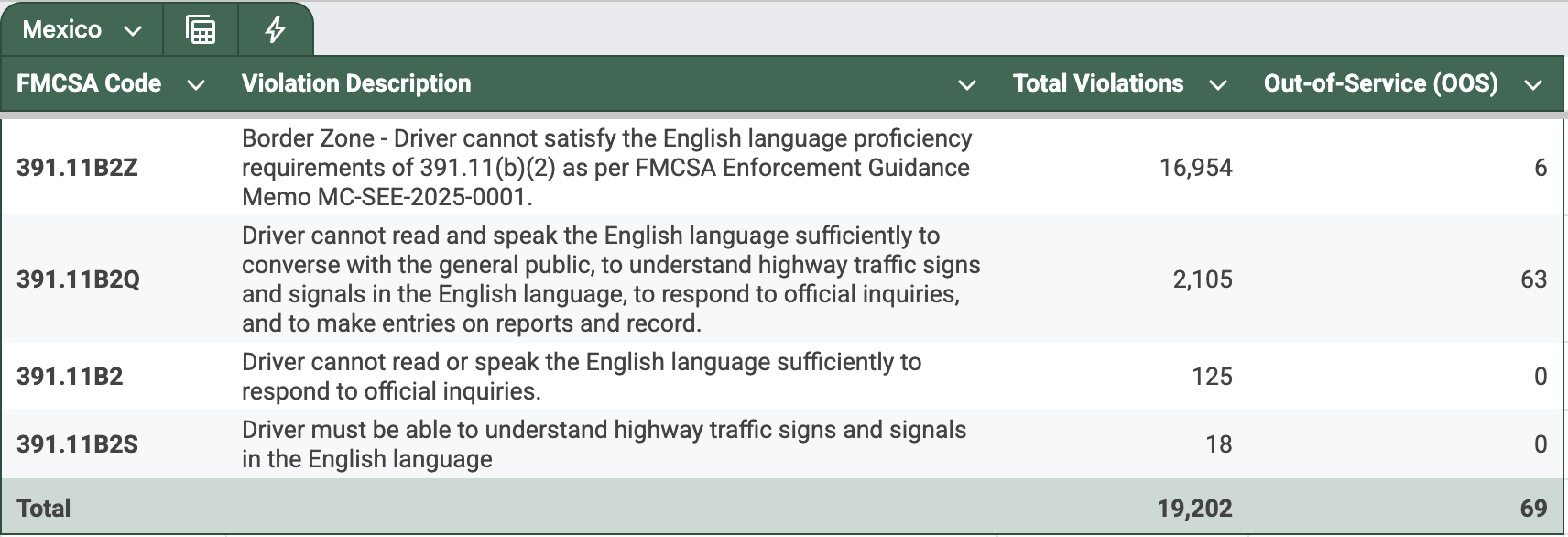
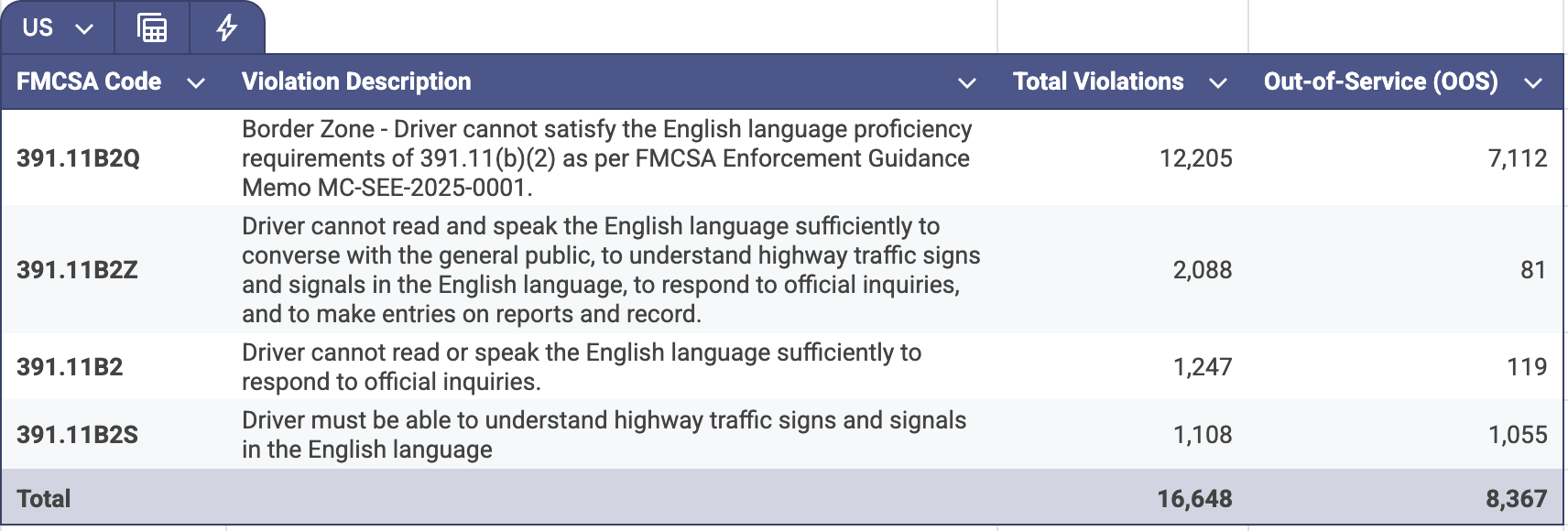
US-domiciled drivers also experienced a marked rise in enforcement. As of Sept. 26, they had recorded 13,795 English-language violations and 5,864 OOS orders. By Oct. 31, these figures rose to 16,648 violations and 8,367 OOS orders. Violations for inability to converse, read signs, or complete records in English (391.11B2Q) increased from 10,008 to 12,205 during this period, with corresponding OOS orders rising from 4,928 to 7,112. Violations for failure to understand English traffic signage (391.11B2S) increased from 800 to 1,108, and OOS outcomes under this category jumped from 755 to 1,055.
The surge in violations reflects a shift from conversational English enforcement toward operational English requirements directly tied to road safety. FMCSA inspectors are increasingly issuing citations for failures to understand traffic signs, respond to official inquiries, or complete federally required documentation in English. These tasks have been formally recognized as safety-critical under the 2025 enforcement guidance, enabling immediate OOS actions.
For Mexico-domiciled drivers, the enforcement increase has been most pronounced in the border zone, where inspection intensity and language checks have expanded significantly. For US-domiciled drivers, the main impact has been a sharp rise in OOS orders, which climbed more than 40% in just over a month.
You May Like








Most popular








