


SICT Introduces Vehicle Marking Regulation to Combat Cargo Theft
 By Adriana Alarcón | Journalist & Industry Analyst -
Fri, 01/10/2025 - 16:30
By Adriana Alarcón | Journalist & Industry Analyst -
Fri, 01/10/2025 - 16:30
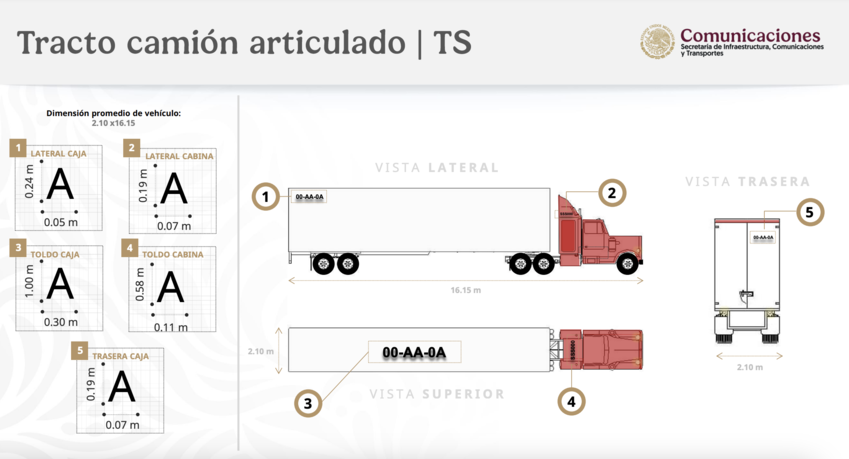
On Dec. 27, 2024, the Ministry of Infrastructure, Communications, and Transport (SICT) introduced the Annex Circular on Marking for Federal Transport Vehicles. This initiative seeks to improve the identification of vehicles traveling under federal jurisdiction by marking federal motor transport units in their various modes. These devices consist of stickers with reflective materials, improving visibility during the day and night.
Specifications for Vehicle Marking
The new marking guidelines, titled General Marking Specifications for Federal Transport Vehicles, outline the following:
-
Markings can be applied using stickers or paint.
-
Text must be in Arial font, with contrasting colors: white on dark backgrounds and black on light backgrounds.
-
Durable, reflective materials must be used to ensure long-term visibility.
-
Double-articulated configurations require markings on each trailer or semi-trailer.
-
For vehicles without roofs or covered containers (hoppers, tankers, flatbeds without cargo, vehicles not in operation, cages, containers, vehicles under lease, and/or vehicles in temporary importation from the United States to Mexico), a tarp with identification numbers must be used.
These measures are intended to make vehicles more visible, aiding authorities in identifying units more effectively in case of incidents or potential crimes. The notice is set to be published soon in the Official Federal Gazette (DOF), then the sector will have 90 calendar days to apply the new images to all vehicle units.

The Need of the Regulation
Road safety remains a critical concern for federal authorities. The new measures aim to: enhance the security of transport operators, cargo, and road users; facilitate the identification of vehicles involved in crimes; and reduce theft. In 2023, cargo theft cases grew by 3.9% compared to 2022, making it the highest number of cases since 2020, losses per cargo theft averaged MX$500,000 (US$24,411) but could exceed MX$7 million (US$341,766) for high-value goods, says Jorge Sánchez, Executive Director of Federal Transport Permits, SICT.
In a preliminary draft posted through the National Commission for Regulatory Improvement (CONAMER) on Jan. 8, Sánchez explained that the project provides greater benefits than costs for drivers, as it improves market competitiveness and efficiency by offering access to vehicle marking specifications, ensuring safer travel on federal roads.
Sánchez adds that the economic impact of theft extends beyond drivers, as it leads to delays in deliveries, production halts, and unmet contracts. Theft also increases insurance and security costs for companies, undermining their reputation and operations.
“This regulation will boost competitiveness and efficiency within transport markets. The regulation is expected to cost MX$158.3 million (US$7.7 million) to implement, affecting about 40% of the federal vehicle fleet. However, many companies already mark their fleets, reducing additional costs for compliance,” says Sánchez.
Sánchez says that the marking system offers several advantages, including:
-
Improved safety by reducing risks for operators, while preventing assaults, kidnappings, and fatalities.
-
Crime prevention by facilitating the faster identification of vehicles, assisting law enforcement in responding to crimes.
-
Economic protection by preventing losses of up to MX$4.6 billion (US$224.6) annually, based on average theft values and incident rates.
Call for Immediate Implementation
Alberto Montoya, National Commissioner for Regulatory Improvement, wrote a letter on Jan. 6, calling for expedited public consultation and immediate publication of the regulation. Montoya emphasizes that the measures are vital to safeguarding federal transport operators and mitigating economic losses caused by crime.
Industry Response
However, the new guidelines have not been welcomed by the entire industry. “This regulation by SICT, aimed at improving road safety, imposes new obligations on federal transport operators, specifically requiring their vehicles to be marked or labeled with an identification number (possibly the license plate number). This is intended to help authorities identify and locate vehicles involved in illicit activities more quickly, including through aerial means,” writes Román Mendoza, Advisor, CANACAR, on LinkedIn.
He adds that while such initiatives are well-intentioned, careful evaluation is needed to avoid imposing counterproductive obligations. “It is unclear if adding additional identifiers to vehicles is a viable solution to the complex security problems we face. This could result in unproductive costs for operators, especially if compliance becomes mandatory. Simply adding markings may not address the root causes of theft and security challenges, such as ineffective prosecution, limited road monitoring, social dynamics, and secondary markets,” writes Mendoza.
You May Like








Most popular








