


The Strategic Objectives of the Interoceanic Corridor
 By Adriana Alarcón | Journalist & Industry Analyst -
Thu, 03/27/2025 - 12:16
By Adriana Alarcón | Journalist & Industry Analyst -
Thu, 03/27/2025 - 12:16
The Interoceanic Corridor of the Isthmus of Tehuantepec (CIIT) is Mexico’s bet for a transformative infrastructure project designed to enhance economic and commercial development. CIIT aims to establish a comprehensive intermodal logistics platform, linking the Pacific and Atlantic oceans via an integrated transport network that involves railways, ports, and industrial parks. This project aims to play a key role in strengthening trade between Asia and the US East Coast while fostering regional development, according to the federal government.
"The Interoceanic Corridor, with its strategic development hubs and industrial parks, will drive trade and generate a greater economic impact once it reaches full operational capacity. Some lines are already in service, and Line K is expected to be inaugurated later this year or early next year," said Retired Vice Admiral Pascual Sepúlveda, Projects General Coordinator, INTEROCEANIC MEXICO.
CIIT involves the rehabilitation and construction of key infrastructure, including 1,200km of railway networks spread across three major rail lines and industrial parks strategically located to attract investment. The project will also upgrade port and airport facilities, modernize maritime trade capabilities, and enhance energy and telecommunications infrastructure, including a gas pipeline and an optic fiber network. The project impacts 79 municipalities, 33 in Veracruz and 46 in Oaxaca, and extends trade connections to Guatemala via the Ciudad Ixtepec-Ciudad Hidalgo railway (Line K).
Railway Network Development
The corridor includes multiple railway lines undergoing extensive rehabilitation:
-
Line “Z” (Coatzacoalcos-Salina Cruz), covering 307km. This line saw 210km rehabilitated, including 82 railway bridges and 290 drainage projects. It has been fully operational since Dec. 22, 2023, transporting over 63,000 passengers and 316,000mt of cargo.
-
Line “FA” (Coatzacoalcos-Palenque, Chiapas), spanning 310km. The line’s full rehabilitation included 91 railway bridges and 667 drainage works. Operational since Sep. 13, 2023, it has transported over 19,000 passengers and 29,000mt of cargo. Future development includes transshipment yards at Roberto Ayala (Huimanguillo) and Pakal-Na (Palenque).
-
Line “K” (Ixtepec, Oaxaca-Ciudad Hidalgo, Chiapas). This is the longest line, spanning 459km. It is undergoing staged rehabilitation, with Segment 1 (Ixtepec-Tonala) at 87% completion. The entire line is expected to be fully operational by 2Q25, with Segment 1 operational by July 2024. A major milestone is the elevated viaduct in Huixtla, reducing 14 level crossings.
Industrial Development and Economic Growth
CIIT features 12 Development Poles for Well-Being (PODEBIS), targeting industries such as electronics, semiconductors, automotive, auto parts and transportation equipment, medical devices, pharmaceutical, agroindustry, power generation and distribution equipment, machinery and equipment, metals, petrochemical, logistics. Some of these poles have already been awarded through international public bidding, while others are undergoing the bidding process. These are:
-
Coatzacoalcos I (257.70ha) and II (131.82ha), Salina Cruz (82.09ha): Awarded to Desarrolladora Multimodal del Istmo, Mota-Engil, Grupo INDI, Carso, and ICA.
-
Asuncion Ixtaltepec (Chivela) (234.12 ha): Managed by MARZAL.
-
Texistepec (467.85 ha), San Juan Evangelista (360.25 ha), Matias Romero (185 ha), Santa Maria Mixtequilla (502.42 ha): Concessioned to Proistmo.
-
Ciudad Ixtepec (412.54 ha): Awarded to Helax Istmo Holdco.
-
San Blas Atempa: With 331.53ha, its bidding process closed on Feb. 24, 2024.
-
Tapachula I (268.72 ha) and Tapachula II (149.71 ha): Upcoming bidding process.
-
Teapa, Tabasco (100 ha): Land donation process underway.
Tax Incentives and Economic Benefits
Companies established within PODEBIS and engaged in activities such as construction, logistics, administration, maintenance, and commercialization can access various tax incentives. At the federal level, they benefit from accelerated depreciation of fixed assets during the first six years of operation.
“They will also benefit from a 100% exemption of Income Tax (ISR) for the first three years, followed by progressive discounts ranging from 90% to 50% over the next three years. Transactions conducted within and between PODEBIS will be exempt from Value Added Tax (VAT) for six years,” said Sepúlveda.
At the state and municipal levels, additional benefits include discounts on payroll tax, property tax, and construction permits, facilitating investment and the establishment of new businesses in these areas.
These incentives aim to drive regional development by generating formal employment, improving wages, and increasing labor productivity. They also encourage the relocation of companies and their supply chains, with an expected creation of 500,000 formal jobs in the four entities within the influence area of the CIIT.
Additionally, efforts are focused on strengthening economies of scale, promoting local supply chains, and consolidating targeted public investment. All these factors contribute to an orderly industrialization process with more competitive and sustainable working conditions.
Port Expansion and Modernization
Salina Cruz is strengthening its port infrastructure by aligning and reinforcing the docks at its Multi-Purpose Terminal. The entrance is being expanded from 80m to 120m, and the construction of a 1,600m west breakwater is underway. Additionally, a specialized Container Terminal (TEC I) is planned, contingent on reaching an annual volume of 150,000 TEUs.
As a critical component of the CIIT, the Salina Cruz Port Breakwater strengthens connections between Mexico and markets in the United States, Asia, Central America, and South America. Domestically, it links the Pacific coast with the southern and southeastern regions of the country, facilitating trade flows to Veracruz, Chiapas, Puebla, Mexico City, Campeche, and Merida. The port aims to evolve into a major logistics and commercial hub, handling not only petrochemicals but also fertilizers, agricultural components, and equipment.
Aligned with CIIT’s sustainability vision, Salina Cruz is implementing environmental and biodiversity preservation measures. The port’s 14m-deep access channel is being modernized to expand its capacity. A specialized container terminal will complement another in Coatzacoalcos, enhancing interoceanic transport capacity to 1.4 million containers annually.
According to SEMAR, a new commercial port is under construction with a 300m-wide entrance and a 1,600m long west breakwater. This expansion is expected to accommodate large vessels and generate over 512 direct jobs and 2,560 indirect jobs.
Major expansion projects at Coatzacoalcos include extending the Pajaritos terminal dock from 270m to 400m and completing a 4km railway access. Segment 5 has been concessioned to Terminales del Istmo Salina Cruz-Coatzacoalcos (TISCC). Like Salina Cruz, a specialized Container Terminal (TEC) will be developed upon reaching 150,000 TEUs per year. The Port Mexico Chemical Terminal is nearing completion.
At Dos Bocas, the eastern breakwater is being extended from 1,640 to 2,140m (82% progress), while the western breakwater will be expanded from 780m to 1,360m. Additionally, a pier for PEMEX’s Mineral Bulk Terminal is under construction and expected to be completed by June 2025.
At the Port of Chiapas, maintenance dredging was completed on Nov. 29, 2024, removing 775,295m³ of material to maintain a depth of 11m. The maneuvering basin, with a 450m diameter, was also improved. Hydrodynamic and coastal studies by UNAM have been completed to prevent sediment accumulation in the navigation channel and interior port. A proposed hook-shaped breakwater extension is expected to reduce sediment inflow by 71%, ensuring long-term operational efficiency.
Strategic Alternative to the Panama Canal
The CIIT aims to become a viable alternative for cargo transport between Asia, the US Midwest, and the US East Coast, offering cost savings compared to California ports and shorter transit times than the Panama Canal. With a projected capacity of 13 million TEUs annually, the corridor will significantly enhance trade routes between Asia and the US Gulf Coast (USGC) and US East Coast (USEC).
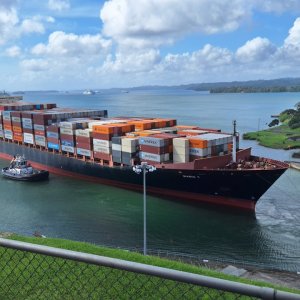
For nearly two years, the Panama Canal has faced operational setbacks due to severe droughts, leading to prolonged restrictions, vessel congestion, and major disruptions in maritime trade. This situation has opened a window of opportunity for Mexico to position the CIIT as a reliable and efficient alternative. The corridor will reduce transit times, lower dependency on the Panama Canal, and strengthen connectivity between the Pacific and Atlantic Oceans.
Mexico’s geostrategic position places it at the center of critical global trade routes, linking Asia, America, and the European Union. This prime location enhances Mexico’s potential to play a pivotal role in international logistics, with the CIIT strengthening its position within global supply chains.
"The Interoceanic Corridor will bridge regions, creating benefits not only for Mexico but for global trade. By leveraging access to both oceans, imports and exports stand to gain significantly. This project also offers two key advantages: lower costs compared to California ports and reduced transit times. Operations are already underway, and as port infrastructure improves, we will be able to handle even greater cargo volumes. We welcome all types of shipments. Our mission is to drive prosperity and development, ensuring this initiative delivers meaningful impact,” said Alfonso Dix, Business Development General Coordinator, INTEROCEANIC MEXICO.
You May Like




Most popular






