COP30: Critical Moment for Climate Diplomacy in Fragmented World




STORY INLINE POST




 By Adrian Sanchez Roa | Senior Consultant in Circular Economy and Applied Sustainability -
Fri, 11/14/2025 - 06:00
By Adrian Sanchez Roa | Senior Consultant in Circular Economy and Applied Sustainability -
Fri, 11/14/2025 - 06:00
The Conference of the Parties (COP30), taking place in November 2025 in Belém, Brazil, represents a milestone in the fight against climate change. For the first time in three decades of negotiations, the event is being held in the Amazon, symbolizing the urgency of preserving vital ecosystems while addressing growing geopolitical tensions.
However, the global landscape is challenging: The withdrawal of the United States from the Paris Agreement under the Trump administration has cast doubt on the participation of the largest historical emitter. Despite this, Brazil, as host, seeks to position COP30 as an "implementation forum," prioritizing concrete action over declarations. According to UN reports, 2025 is shaping up to be the second or third warmest year on record, with global temperatures exceeding 1.5°C for prolonged periods, accelerating the need for ambitious commitments.
The framework of the Paris Agreement, adopted in 2015, remains the pillar of international climate governance, but its effectiveness is questioned by the gap between promises and realities. The updated Nationally Determined Contributions (NDCs) for 2025, covering targets through 2035, show limited progress. Of the more than 60 nations that have submitted their plans as of September 2025, including Brazil, Canada, and the United Kingdom, only a handful align their objectives with the 1.5°C warming limit.
Countries like China and the European Union have not yet submitted their NDCs, increasing pressure for them to do so before COP30. Collectively, current policies and unconditional commitments would reduce emissions by only an additional 1.4 gigatons of CO2 equivalent (GtCO2e) by 2035, leaving a deficit of 29.9 GtCO2e to meet the Paris goal. This projects a warming of 2.5-2.9°C by 2100, according to the UN Emissions Gap Report, with devastating impacts on food security and migration.
Geopolitical Divergences: Clashing Development Models
Global climate policy finds itself on a multipolar chessboard, where national priorities clash with collective urgency.
United States
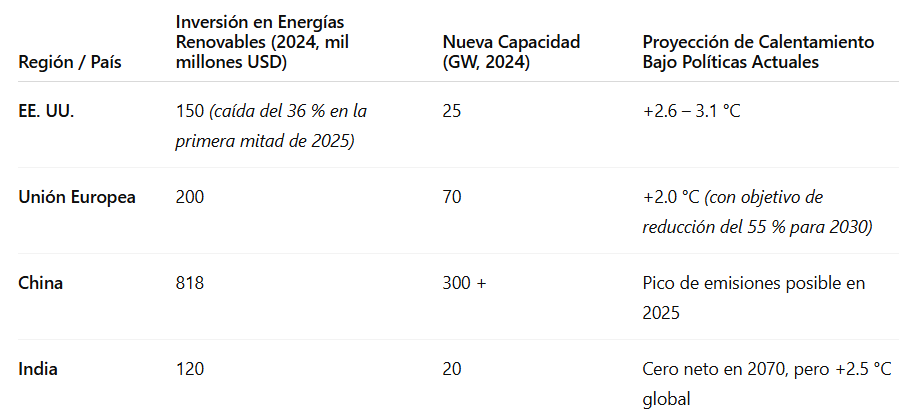
In the United States, the Trump administration has reversed key incentives for renewables, canceling over US$13 billion in funding for green projects and halting offshore wind initiatives under construction. In the first six months of 2025, renewable investments fell by 36%, according to energy experts, while promoting an "energy emergency" that prioritizes oil and gas, with projections of increased production until 2030. This not only erodes American leadership but also aggravates fragmentation, with the absence of high-level delegates in Belém.
European Union
In contrast, the European Union maintains its regulatory ambition, with over 70GW of new renewable capacity in 2024, driven by solar. However, it faces "climate fatigue:" Eurobarometer surveys show that although 80% of Europeans see climate change as a major threat, concerns about the cost of living and energy security are outpacing green priorities. The European Union's Social Climate Fund, designed to mitigate impacts on vulnerable households, faces criticism for its slow implementation, with national plans pending until June 2025.
China and India
China and India are emerging as engines of green industrialization, balancing energy security with growth. China invested US$818 billion in energy transition in 2024, accounting for 40% of global renewable capacity. Its emissions trading scheme expanded in 2025 to steel, cement, and aluminum, covering 60% of national emissions. India, meanwhile, reached 41% new energy vehicle sales in 2024. Both countries lead in cost reduction for clean technologies but prioritize economic development, with emissions that could peak in 2025 if electrification trends continue.
The Scientific Diagnosis: Approaching Critical Tipping Points
The climate science of 2025 paints an alarming picture: The planet has crossed its first tipping point, with the mass death of warm-water coral reefs, according to the 2025 Global Tipping Points Report. This marks a "new reality" where every additional tenth of a degree multiplies irreversible risks, such as the collapse of the Atlantic Meridional Overturning Circulation (AMOC) or the loss of ice in Greenland and West Antarctica.
In vulnerable regions like the Sahel and the Mediterranean, the impacts are systemic: prolonged droughts combined with water and food shortages threaten social stability. The UN Adaptation Gap Report estimates needs of US$310 billion annually by 2035 for developing countries, but only US$26 billion flowed in 2023, 12–14 times less than required.
The Financial Deficit: The Biggest Obstacle
Climate finance is the system's Achilles' heel. The promise of US$100 billion annually for the Global South was met for the first time in 2022 with US$115.9 billion, but with only 25% for adaptation and much of it as debt. In 2023, public adaptation flows fell to US$26 billion.
The investment gap is growing: developing countries need US$2.3–US$2.5 trillion annually by 2030, four times the current amount. The Loss and Damage Fund, operational since 2023, has only received initial commitments.
Integrity and Litigation: Combating Greenwashing
The rise of greenwashing erodes trust. Voluntary carbon markets (Article 6) face doubts about additionality and traceability. Meanwhile, global climate litigation reached 3,099 cases by June 2025, in 55 jurisdictions, with 20% against corporations. Landmark cases (like Milieudefensie v. Shell) and rulings from the International Court of Justice in July 2025 are turning the 1.5°C limit into a binding legal standard.
Toward Renewed Multilateralism: Alliances and Climate Clubs
Classical multilateralism is giving way to a mosaic of thematic alliances and "climate clubs" (like the G7's) that integrate environmental standards with geoeconomic power. In this context, influence is measured by execution: Brazil is proposing a Tropical Forests Forever Fund, and South-South alliances (G77 + China) are pressing for finance and technology.
From Diplomacy to Executory Social Action
COP30 in Belém is not just a summit; it is an ultimatum in a fragmented scenario. The success of this conference cannot be measured solely by the agreements signed in negotiation rooms. While analysis shows that three operational elements must be anchored for diplomacy to work, real change will depend on us moving beyond our role as spectators.
The three operational pillars for diplomatic success are:
Accounting Integrity. This is the cornerstone for the future of climate finance. It is fundamental for articulating and linking voluntary carbon markets (Article 6). The goal must be to generate a new generation of transparent and verifiable economic flows, providing accessibility for both companies and individuals to trade in them. This openness, understood as the monetization of the circular economy and mitigation action, will, to some extent, remove the social and financial stress currently paralyzing governments by opening new business avenues and channeling private capital toward action.
Accessible and Just Financing. The financial gap is abysmal. An inescapable commitment to the New Collective Quantified Goal (NCQG) is required, one that not only reaches the necessary figures (trillions, not billions) but also radically focuses on adaptation (reaching at least 50% of the total) and is delivered as grants, not as debt that perpetuates the crisis.
Recognition of Regional Realities. Climate action cannot be monolithic. It must prioritize resilience in global hotspots, such as the Sahel and the Mediterranean, where science indicates the impacts are already systemic and threaten social stability.
However, the analysis of a geopolitically fractured world, with "climate fatigue" in the European Union and regression in the United States, leads us to an inescapable reflection: We can no longer be spectators of a geopolitical climate mandate that advances with bureaucratic slowness while the planet crosses irreversible tipping points.
The true lever of change no longer resides in high-level diplomacy, but in the evolution of social conduct. Humans must evolve from passive consumers to "executor citizens." The era of waiting for governments and large corporations to lead us is over. Now, they must be pushed.
We become executors of change when our collective actions begin to actively press for model shifts. This translates into concrete actions:
Economic Pressure: Rejecting greenwashing and actively choosing companies with transparent and sustainable value chains, forcing markets to compete on integrity and not just on green narratives.
Legal and Civic Pressure: Using the tools the system itself provides, such as climate litigation, which is already turning 1.5°C into a legal standard, to demand direct accountability from corporations and governments for inaction.
Cultural Pressure: Normalizing sufficiency over excessive consumption and promoting community resilience as the new standard of security.
This grassroots social pressure is the only force capable of compelling both companies to redesign their business models to survive, and governments to implement the courageous regulations they otherwise avoid for fear of the political cost.
With the world on the brink of tipping points, the transition is not just environmental, but geopolitical and, above all, evolutionary. Innovative alliances can turn fragmentation into shared resilience, but only if civil society assumes its executory power. Failure is not an option; the cost of inaction — economic, social, and human — is incalculable.
You May Like




Most popular