


Mexico to Reveal New Climate Targets at COP30 with NDC 3.0
 By Duncan Randall | Journalist & Industry Analyst -
Fri, 11/07/2025 - 16:49
By Duncan Randall | Journalist & Industry Analyst -
Fri, 11/07/2025 - 16:49
Mexico will unveil its updated Nationally Determined Contribution (NDC 3.0) at COP30, set for Nov. 10–21 in Belem, Brazil, pledging to cut between 364 and 404 million metric tons of CO₂ equivalent (MtCO₂e) by 2035. While the plan signals a higher level of climate ambition, experts warn that Mexico’s fiscal and energy policies—still heavily weighted toward fossil fuels—could undermine its implementation.
According to Isabel Studer, president of Sostenibilidad Global, the Sheinbaum administration’s approach presents a “structural contradiction.” Under its first federal budget, PEMEX will receive US$28.2 billion in 2026, up 7.7% from 2025 and accounting for nearly 5% of total public spending. By contrast, the Environment Ministry (SEMARNAT) will operate with just US$103 million—a 4% real decline from 2025. Studer noted that while PEMEX has already received US$20.6 billion in financial support this year, SEMARNAT’s budget has been cut by nearly 40%.
A report by Mongabay in September found that the National Commission of Natural Protected Areas (CONANP)—responsible for managing 11% of Mexico’s territory—will see its budget fall to about US$52 million, its lowest in 21 years. The Federal Attorney for Environmental Protection (PROFEPA) faces a 3.3% reduction, leaving only US$1.5 million for operations. Similarly, Oceana Mexico reported that the National Commission for Aquaculture and Fisheries (CONAPESCA) and the Mexican Institute for Sustainable Fisheries and Aquaculture Research (IMIPAS) will face cuts of nearly 5.8%. IMIPAS conducts vital research on climate impacts on fisheries, a key sector for livelihoods and food security. “Mexico continues to spend more on preserving the past than building the future,” Studer said.
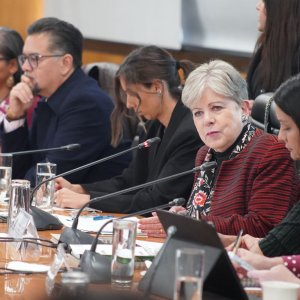
Approved unanimously by the Intersecretarial Commission on Climate Change, the NDC 3.0—led by Environment Secretary Alicia Bárcena—defines how Mexico plans to meet its emissions targets through five pillars: mitigation, adaptation, loss and damage, means of implementation, and cross-cutting themes. For the first time, it introduces a national security component, recognizing climate change as a potential driver of social and environmental conflict.
The plan sets a national emissions cap for 2035: between 364–404 MtCO₂e under the unconditional scenario and 332–363 MtCO₂e with international cooperation—both marking significant reductions from current levels of about 583 MtCO₂e. It also introduces a new loss and damage component focused on resilience and financial risk tools, such as parametric insurance, to protect vulnerable communities.
NDC 3.0 incorporates social inclusion as a key pillar of climate policy, addressing gender equality, human rights, and a just transition for workers in carbon-intensive sectors. It also prioritizes indigenous peoples, youth, and people with disabilities in shaping a fair and inclusive climate response.
Sostenibilidad Global argues that Mexico’s central challenge is not in setting ambitious goals, but in aligning public finance with climate priorities. Studer emphasized that a “just energy transition” requires redirecting subsidies and incentives toward clean energy, innovation, and industrial decarbonization. COP30, she said, will be a test of Mexico’s ability to “match its climate promises with its fiscal choices.”
Despite advances in governance, Mexico’s economy remains tied to oil revenues. PEMEX’s external debt exceeds US$97 billion, and ongoing subsidies restrict investment in renewable energy and clean technologies. Studer concluded that while “the NDC 3.0 marks progress,” a real transition demands “a government that stops shielding fossil monopolies and becomes a driver of innovation, equity, and collective prosperity.”
You May Like





Most popular








