Mexico Sets 50% Emissions Cut by 2035 in New COP30 Pledge
 By Duncan Randall | Journalist & Industry Analyst -
Mon, 11/10/2025 - 17:48
By Duncan Randall | Journalist & Industry Analyst -
Mon, 11/10/2025 - 17:48
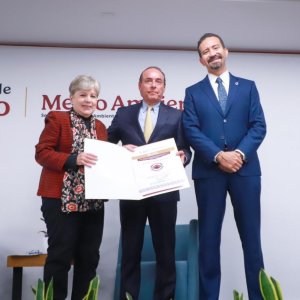
At the COP30 Leaders’ Climate Summit in Belem, Brazil, Alicia Bárcena, Mexico’s Minister of Environment and Natural Resources, presented the country’s updated Nationally Determined Contribution (NDC 3.0), outlining a path to cut national greenhouse gas emissions by up to 50% by 2035 and reaffirming Mexico’s long-term goal of net-zero emissions by mid-century.
Speaking on behalf of President Claudia Sheinbaum, Bárcena began by highlighting the human toll of climate impacts at home. “Devastating rains recently hit Mexico,” she said. “Five states were severely affected, about 90 municipalities were cut off, more than 100,000 homes were damaged, and 80 lives were lost. Climate change is no longer a warning—it is a reality that affects us all.”
Amid these crises, she urged world leaders to move beyond rhetoric toward decisive collective action, warning against “the paralysis of the world, the dilution of political will in polite but empty speeches, and the cowardice disguised as diplomacy.” She described the Belém summit as “the COP of truth, the COP of Latin America and the Caribbean, and the COP of hope.”
Bárcena emphasized that Mexico’s NDC 3.0 serves as a comprehensive roadmap to accelerate decarbonization while promoting inclusive and sustainable development. She said the plan was developed through a participatory process guided by the Escazú Agreement, drawing on the best available science. It is structured around five pillars: mitigation, adaptation, loss and damage, means of implementation, and enabling conditions and cross-cutting themes.
Under the mitigation component, Mexico commits to absolute emissions targets for the first time. By 2035, emissions will be capped between 364 and 404 million metric tons of CO₂ equivalent (MtCO₂e) in the unconditional scenario, financed with domestic resources. With international support, emissions would not exceed 332–363 MtCO₂e. This represents a reduction of more than 50% compared to current trajectories, positioning Mexico among the few developing nations to set fixed carbon ceilings within defined timeframes.
Bárcena noted that NDC 3.0 aligns with a new economic strategy, Plan México, which integrates climate goals into industrial policy across key sectors: transport, electricity generation, industry, agriculture and livestock, waste management, oil and gas, and construction. The initiative aims to drive technological innovation, promote circular economy principles, and curb methane emissions—one of the most potent greenhouse gases.
On adaptation, Bárcena announced that Mexico will publish its first National Adaptation Policy in 2026, focusing on food and energy security, biodiversity conservation, water management, and the protection of critical infrastructure. “We treat climate change as a matter of national security,” she said, underscoring the government’s commitment to integrate resilience planning into long-term policies.
Nature-based solutions are also central to Mexico’s strategy. Bárcena highlighted that Latin America and the Caribbean account for only 11% of global greenhouse gas emissions but remain among the most climate-vulnerable regions—home to the planet’s richest biodiversity. She noted that restoring just 10% of Mexico’s 1,450 square kilometers of mangroves could reduce nearly 19 million tons of CO₂ equivalent, or about 3% of national emissions in 2024.
She also announced Mexico’s participation in the Tropical Forests Forever Initiative (TFFF) and the launch of the Gran Selva Maya, a 5.7-million-hectare tropical forest corridor connecting Guatemala’s Petén region with Mexico and Belize’s Maya zone. “Fifteen percent of our territory is covered by tropical forests and mangroves,” Bárcena said. “These ecosystems are not only biodiversity hotspots—they are vital carbon sinks.”
The loss and damage component of NDC 3.0 strengthens Mexico’s financial and technical response to extreme weather events. Bárcena said the country will expand the use of parametric insurance and other risk transfer tools to protect vulnerable communities and sectors. The means of implementation section outlines commitments to mobilize resources, enhance technology transfer, and strengthen institutional capacity to achieve climate goals.
On cross-cutting themes, Bárcena underscored that Mexico’s updated NDC integrates gender equality, human rights, and intergenerational equity, recognizing Indigenous peoples, Afro-Mexican communities, women, and youth not only as disproportionately affected but as essential actors in driving transformation. “This is a roadmap for an entire nation toward the future we deserve,” she said.
Bárcena also called for stronger coordination among the Conventions on Climate Change, Biodiversity, and Desertification, urging the creation of shared methodologies and taxonomies to assess and value ecosystems as carbon sinks and sources of sustainable investment. “We must not measure separately under each convention,” she said. “We must advance harmonized methods that can internationalize carbon markets, which today operate only in limited or national contexts.”
She concluded her remarks with a reflection on the moral responsibility of the current generation, recalling former US President Barack Obama’s words at the signing of the Paris Agreement in 2015: “We are the first generation to feel the effects of climate change and the last that can do something about it.”
Looking ahead, Bárcena urged COP30 delegates to send a strong political signal of determination to correct “the development model and its trajectory.” Quoting Italian philosopher Antonio Gramsci, she closed: “It is time to let the old world die so that a new one can be born—a world where we live in harmony with nature, leaving no one behind.”
You May Like






Most popular