


Michoacan Cities Expand Public Transit With Cable Cars
 By Duncan Randall | Journalist & Industry Analyst -
Tue, 08/19/2025 - 13:05
By Duncan Randall | Journalist & Industry Analyst -
Tue, 08/19/2025 - 13:05
Morelia and Uruapan, the two largest cities in the state of Michoacan, are set to introduce cable car lines as part of their public transit networks. The Morelia line, which began construction on May 13, 2025, will comprise six stations, span 5.6 kilometers, and have a daily capacity of 22,000 commuters. The Uruapan line, which began construction in October 2023, will also consist of six stations, cover 8.4 kilometers, and transport over 19,000 passengers per day.
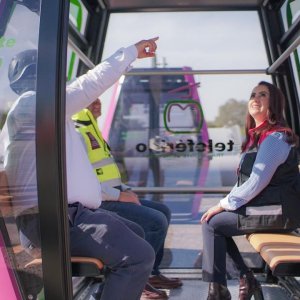
State officials reported progress on both lines during visits in recent weeks. Reviewing construction in the state capital on August 6, Governor Alfredo Ramirez Bedolla shared that the Morelia line is 27% complete. In late July, State Minister of Urban Development and Mobility Gladyz Butanda Macías revealed that the Uruapan line is 87% complete and set to begin trial runs in November. Authorities noted total public investments of over MX$5.1 billion (US$271.56 million), with the Morelia cable car costing MX$1.9 billion (US$101.22 million) and the Uruapan cable car exceeding MX$3.2 billion (US$170.41 million).
According to Ramirez, the investments signal Michoacan’s commitment to expanding mobility while safeguarding environmental welfare. “We are taking seriously the need to address decades of mobility gaps, reduce inequalities, and improve the population’s quality of life, while ensuring that we do this in a modern, safe, efficient, inclusive, accessible, and environmentally responsible manner,” said the governor. He explained that the cable cars will operate on 100% clean energy, producing zero greenhouse gas emissions. Butanda added that each line will be accompanied by related municipal projects, including new crosswalks, cultural spaces, and road improvements. Uruapan’s line will also include a skate park, a community dining hall, and a sports center.
Michoacan’s cable car lines follow examples set by Mexico City, which operates three “Cablebús” lines spanning a combined 24.75 kilometers. Part of the capital’s Integrated Mobility System (MI), these lines have a total daily capacity of over 200,000 passengers, with a fourth line—planned to be the longest—announced in June. These lines built on the success of the Mexicable system, a pair of cable bus lines in Ecatepec de Morelos constructed by the State of Mexico in 2017.
Both Ramirez and Butanda framed their efforts as part of President Claudia Sheinbaum’s national mobility policy. As mayor of Mexico City from 2018–2024, Sheinbaum was integral to the construction of Cablebús Lines 1, 2, and 3. As president, she has earmarked MX$4.5 billion (US$239.44 million) in federal funding for the upcoming Line 4. Although Michoacan’s cable car systems are being financed through state funds, Butanda emphasized Sheinbaum’s close involvement in the two projects. “We are working at full speed and in full coordination with the president and her team to ensure that our cable cars meet citizens’ needs safely and efficiently,” she said.
The Cablebús and Mexicable have also significantly reduced greenhouse gas emissions. According to a 2022 study by the National Institute of Ecology and Climate Change (INECC), Mexicable Line 1 alone saved 6,315 tons of CO2 emissions per year, driven by reductions from alternative modes of transport such as minibuses and taxis. Meanwhile, an ITDP Mexico study found that Cablebús Lines 1 and 2 were responsible for an 18,569 ton reduction in CO2 emissions between 2021 and 2023.
You May Like




Most popular








