

Algae Blooms: The Global Consequence of Human Activity

STORY INLINE POST
 By Julio César Trujillo Segura | Director General -
Mon, 08/18/2025 - 06:00
By Julio César Trujillo Segura | Director General -
Mon, 08/18/2025 - 06:00
To do my part, remain consistent, and lead by example through sustainable household practices, our home is equipped with a system for capturing and filtering greywater (from the kitchen, shower, and laundry) to reuse it for irrigation. One stage of the process involves channeling the water into a tank where it is filtered, then passing it through a bed of gravel and sand, before flowing into a pond with aquatic plants, fish, and other species, and finally into a cistern used to water the garden.
The system had worked flawlessly for several years. However, the other day I had the misfortune of witnessing an alarming outbreak of algae resembling tangles of “fine hair,” which reproduced at an unprecedented rate. The causes of this phenomenon can be summed up in two points.
The first, although unintentional, was that by introducing a new plant — a water lily — into the pond, I unknowingly brought in an invasive exotic alga. The second was that, after changing personal hygiene and cleaning products, nutrient levels increased, encouraging its proliferation.
We had to act quickly to prevent the pond from becoming eutrophic and to avoid a possible collapse of the aquatic environment. Fortunately, we succeeded in rebalancing the fragile ecosystem and controlling the algae’s spread.
While I was fighting this invasive species on a small scale, I was reminded that such imbalances occur on a massive scale in various parts of the Atlantic Ocean. This led me to reflect on the deteriorating health of our seas due to human activities, especially agriculture and the discharge of wastewater, which inevitably ends up in the ocean.
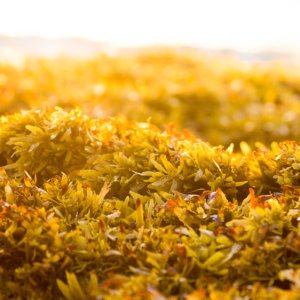
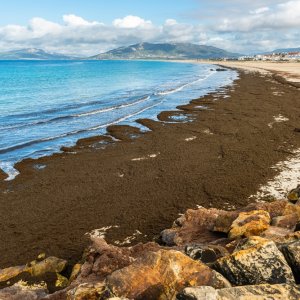
This vacation season, many people are complaining about the presence of a brown alga along the Riviera Maya and the Caribbean islands, which inconveniences tourists seeking “paradisiacal” beaches. It is not hard to guess that I am referring to sargassum, which has been plaguing our coasts for more than 15 years.
Before addressing that, however, I want to step back in time to the first major modern case of imbalance in an aquatic environment: the famous “dead zone” in the Mississippi Delta, in the Gulf of Mexico — not the “Gulf of America,” as a certain figure, whose name I prefer not to recall, once tried to rename it.
The Mississippi Delta Case
One of the earliest major examples of marine ecological imbalance is the hypoxic zone at the mouth of the Mississippi River, which extends into the Gulf of Mexico. It is one of the largest dead zones on the planet. The Mississippi and its tributary, the Missouri, form the most important watershed in North America, essential to the development of the United States.
This basin runs through much of what is known as the Midwest — the nation’s “breadbasket.” To increase agricultural productivity and prevent soil depletion, the use of agrochemicals rose sharply from the mid-20th century onward. Through natural runoff, these fertilizers make their way down the “Great River” to the sea. Today, the Mississippi Delta is widely known as the death zone.
Since the 1980s, nutrients from agriculture have been shown to cause massive blooms of marine algae that consume large amounts of oxygen, creating hypoxia and making it difficult for other species to survive. The size of this dead zone varies each season but has steadily grown over time. The record size exceeds 23,000km².
The consequences are not only environmental: they also harm fishing and aquaculture, especially shrimp production. Studies indicate that the main cause is high concentrations of nitrogen and phosphorus from crops such as genetically modified corn.
Brittany’s Green Algae
Another case of deadly algae, this time across the Atlantic, occurs on the coasts of Brittany, the “nose” of France. This region, known for its natural beauty, has since the 1980s adopted an agro-industrial model of intensive pig farming, abandoning traditional methods. Today, nearly 7 million pigs are raised on about 4,000 farms there, accounting for half of France’s pork production and making it one of the largest in the world.
In the early 2000s, green algae began appearing on Breton beaches. While harmless at sea, once stranded on the coast they decompose and release toxic gases.
The first incidents involved sudden deaths of dogs that sniffed the decaying algae. Then came the case of a horse. The greatest tragedy occurred in July 2009, when a runner (Thierry Morfoisse) suffered a cardiac arrest after tripping over an algal mat and inhaling the gases.
This case set a precedent: after years of litigation, the French judiciary recognized the state’s responsibility for failing to regulate pig waste discharges — rich in nitrates — that feed these algae. Coastal municipalities, unable to bear the cleaning costs, which are futile given the constant arrival of new algae, have in many cases opted to close beaches instead.
Caribbean Sargassum
Back on this side of the Atlantic, for the past 15 years we have faced a similar phenomenon: the massive arrival of sargassum on the shores of the Caribbean and the Riviera Maya. Although for the general public it is a recent problem, sargassum was known to 15th-century navigators. Christopher Columbus described it during his voyage that culminated in the “discovery” of a new world.
The “Sargasso Sea” lies in the North Atlantic subtropical region, covering more than 5.2 million km² and providing a habitat for countless marine species. Traditionally, this floating mass was contained by ocean currents, but since the beginning of this century, it has begun to overflow. In 2010, the first waves of sargassum reached Caribbean beaches.
The scientific community has yet to agree on the exact causes, but there are three main hypotheses:
Climate change: Warmer ocean waters favor algal expansion.
Altered ocean currents: Melting glaciers and ice caps have changed the circulation patterns that once contained sargassum, and a new sargassum belt has formed between the coasts of Brazil and Africa.
Nutrient influx: Major rivers such as the Mississippi, Amazon, Orinoco, Río de la Plata, and Congo discharge agrochemicals that stimulate algal growth, along with wastewater from Caribbean tourist centers.
Most likely, the reality is a combination of all three factors, all tied to human-driven anthropocentricity.
The most visible impact is on tourism: The algae soil beaches and, as they decompose, release foul-smelling gases that also corrode metals, such as copper. In Guadeloupe and Martinique, it has been observed that appliances near heavily affected areas last less than five years.
As in Brittany, efforts to remove sargassum are expensive and short-lived. All indications are that this will be a permanent battle, with volumes continuing to rise. While authorities focus on cleaning beaches to mitigate the economic effects, especially on the tourism sector, we must not forget that this is a clear symptom: our oceans are sick, and like any damaged system, they can collapse beyond repair, with unimaginable consequences for humanity and the planet.
You May Like

Most popular








