

Obtaining Mexican Mining Concessions

Obtaining Mexican Mining Concessions

STORY INLINE POST








Unlike the US and the Canadian legal systems, which are based in common law, the Mexican legal structure stems from civil law legislation. Because of the close economic ties between the three countries this is often forgotten and can be exaggerated by both Mexican lawyers and clients overseas. Structures, agreements, and procedures are often misconstrued as can be witnessed with the contrasts between the trust structures in both jurisdictions. The differences between these systems usually generate uncertainty and considerable misapprehensions on the part of those immersed in one system and doing business in another. These gaps in the understanding of how a particular legal system operates shape the perception many foreign nationals have of most procedural matters in Mexico and can contribute to making processes appear cumbersome. Furthermore, the general perception that the Mexican legal system is quite unique and corruption is rampant in all domains exacerbates the problem. Dissecting the legal process and offering simple explanations to apparently convoluted Mexican legal issues will always work for the benefit of all, whether that be authorities, clients, or counsel.
Unlike in almost all of the US and in many cases in Canada, where concessions are owned by the Crown and held by the federal and provincial governments, the ownership of Mexican natural resources is bestowed in the state and it is rooted in the Constitution. Article 27 sets forward, among other things, that all minerals belong to the state. Their use and/or exploitation may be carried out through a mining concession directly by nationals or through companies duly incorporated in Mexico. Article 10 of the Mexican Mining Law states that, “The exploration and mining of minerals or substances referred to in article 4, […] can only be carried out by individuals who have Mexican nationality […] and corporations incorporated according to Mexican Law, through mining concessions granted by the Ministry.” Thus, only Mexicans by birth or naturalization and Mexican entities are allowed to obtain mining concessions. However, the Mexican state grants the same right, in an indirect fashion to foreign nationals, provided that through their choice of legal vehicle they agree before Mexican authorities to be regarded and treated as Mexican citizens and they do not request the protection of their governments under penalty of losing their assets related to the dispute (in this case the mining concession) to the benefit of the United Mexican States (Mexico). This provision can be regarded as a waiver of the right to call for diplomatic protection. On top of all ancillary legal duties, entities incorporated or used for this purpose shall comply with a special registration obligation before the Ministry of Economy. This registration and its periodical update in the National Registry of Foreign Investment is compulsory and for statistical purposes only. Failure to comply with said responsibility will generate fines for the company in breach but will not affect the mining concession itself in any substantial manner.
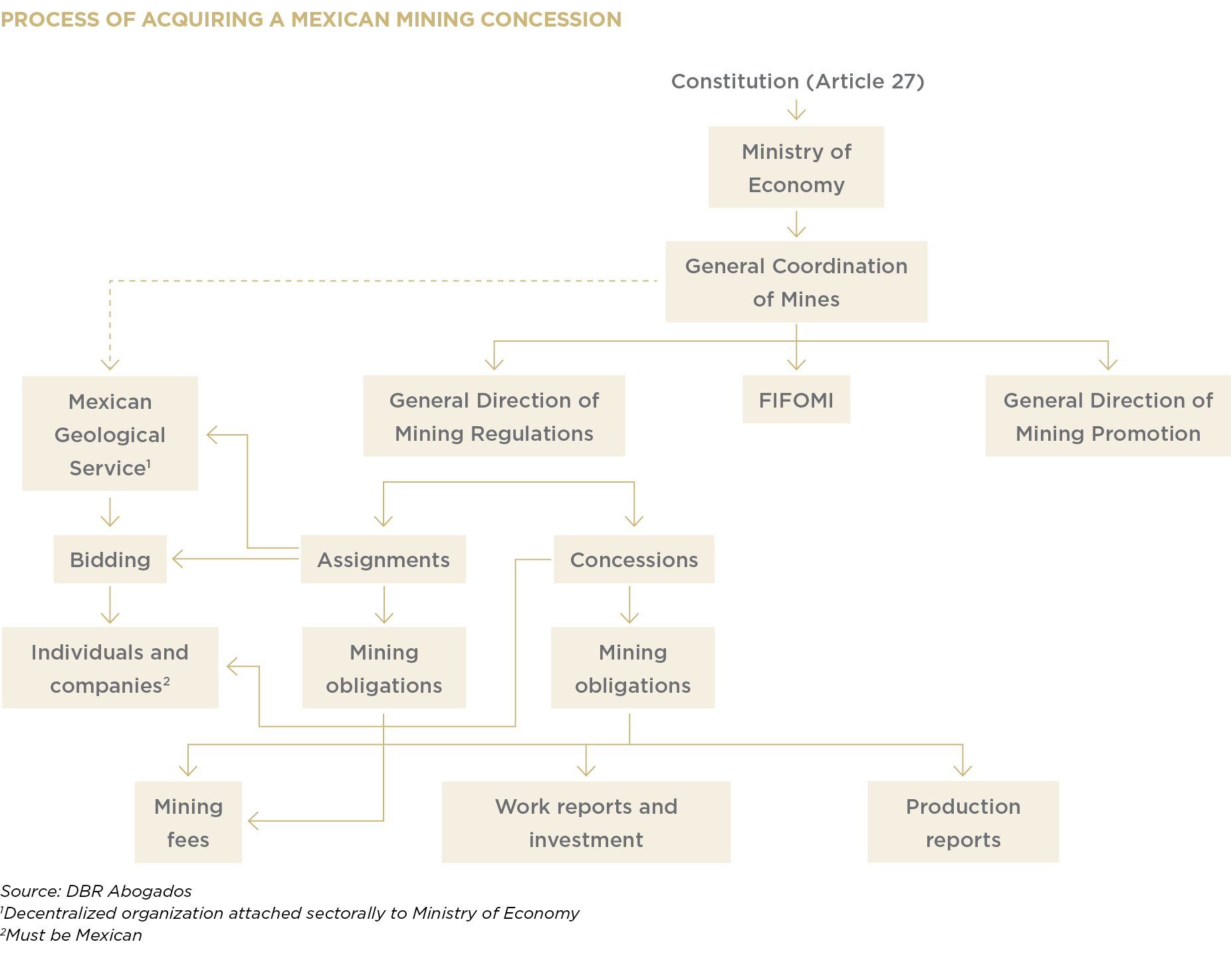
Concessions and assignments are granted by the Mexican State through the office of Mexico’s President who in turn delegates this duty to the Ministry of Economy. First, the Mexican government assigns mineral allotments to the Mexican Geological Service (SGM). All of those portions of land eligible for mining activity that have not been distributed to SGM are subject to a mining concession and could be granted to private parties who apply and fulfil certain requirements. If the Ministry of Economy, through SGM, decides that a specific assignment is of no further interest to the Mexican state for a particular reason, whether it be social, political, strategic, or economic, or SGM fails to produce a justification for maintaining said allotment, SGM will open that particular assignment to a bidding process and the Ministry of Economy will allocate said lot as a mining concession to the winning individual or entity, according to Article 10 of the Mexican Mining Law.
The Mexican Mining Bureau is the Ministry of Economy’s unit whose mandate is to apply all mining regulations. It is the Mexican Mining Bureau who will: (i) issue the concession titles; (ii) maintain the Public Mining Registry; and, (iii) handle requests for expropriation, temporary occupancy, or easements filed by the mining concession holders, in accordance with Article 7 section VI of the Mexican Mining Law. Article 46 dictates that mining concessions shall be recorded, kept and maintained in the Public Mining Registry. Aside from managing mining activities through the Public Mining Registry, Article 8 states that the Mexican Mining Bureau is responsible for overseeing and promoting the whole of the mining activity in Mexico.
A mining concession allows its holder to explore, exploit, and enjoy all of the minerals that are located in the subsoil of a particular mining concession, according to Article 19. If the mining concession’s surface rights belong to or are in possession of someone else other than the holder of the mining concession, an authorization from the owner or possessor and an Environmental Impact Study approved by the corresponding ministry are required to begin exploration works. Although the Ministry of Economy is generally in charge of most mining activities there are other government ministries or agencies that enforce provisions or grant permits that relate to mining. The Ministry of Labor, SEMARNAT, CONAGUA, and the Agrarian Registry are examples of authorities involved in the whole of the mining activity. Authorizations and authorities involved vary depending on the mining concession. Permits to store and use explosives, water concession, and/or permits for the discharge of water or a change of land use may or may not be required for specific mining concession.
Mining concessions are initially valid for 50 years provided the holder of the mining concession complies with all stipulated mining regulations, according to Article 15. The same Article states that validity of a mining concession may be extended, upon request of the holder, for additional periods of time. Holders of mining concessions are ordered to comply with several requirements in Article 27 of the Mexican Mining Law. The following are the three main duties mining concession holders have to comply with:
• Pay the corresponding fees, royalties and taxes
• Produce and file periodical reports
• Perform certain works in the mining concession
The breach of any of the responsibilities listed in the Mexican Mining Law will give the government sufficient grounds for the mining concession to be cancelled, as recorded in Articles 42 and 55 of the Mexican Mining Law.
Mining concessions are susceptible to being pledged or mortgaged as collateral for the financing of mining projects. However, to be valid in benefit of creditors, Articles 46 and 49 hold the requirement that all liens shall be registered in the Public Mining Registry. Some creditors request mining concessions pledged to be registered at the Ministry of Economy’s Registry of Movable Securities.
It is our opinion that understanding the general makeup and the granting of Mexican mining concessions is not complicated. There are just a few issues that one needs to know to have a fair awareness of them. The way the access and exploitation of minerals is regulated is quite similar to that in force in other jurisdictions and even more agile than in many.
You May Like






Most popular








