


Ballenas o Gas Front Protests Mexico Pacific LNG Project
 By Andrea Valeria Díaz Tolivia | Journalist & Industry Analyst -
Thu, 06/05/2025 - 07:40
By Andrea Valeria Díaz Tolivia | Journalist & Industry Analyst -
Thu, 06/05/2025 - 07:40
On the afternoon of May 29, chants of “Let them quiver, whales are not for sale” echoed through the steps of Mexico’s Ministry of Energy, where dozens were gathered, with some holding whale-shaped inflatables, demanding the halt of the construction of an LNG processing and export terminal in the Golf of California. Protesters argued that it could threaten the environment and local marine life. The protest was organized by Ballenas o Gas, a collective initiative working to stop the ongoing Saguaro Energía LNG project, owned by Mexico Pacific. The collective is supported by several environmental and social justice organizations, including Greenpeace and CEMDA.
As part of the demonstration, dozens of children laid out 1,500 drawings at the Ministry’s doorstep. The illustrations, featuring whales, sharks, and other marine species, symbolized the wildlife that activists say would be endangered by increased shipping traffic once the terminal begins operating.
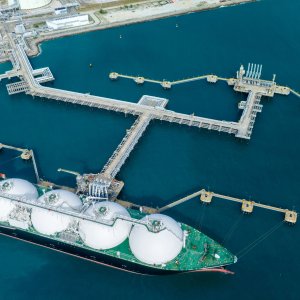
Located in Puerto Libertad, Sonora, the 1,500 acre Saguaro Energía facility is set to process and export LNG sourced from the Permian Basin, with a planned capacity of 15Mt/y. One of the main selling points of the project is its proximity to Asia. Its location would allow the shipping of LNG to East Asia without having to go through the Panama Canal, offering what Mexico Pacific claims is a 60% reduction in CO₂ emissions compared to routes from the US Gulf Coast terminals. That reduction is equivalent to about 105 million mt of CO₂, according to the company.
While LNG is often touted as a cleaner alternative to coal or oil, emitting around 40% less CO₂ than coal and 30% less than oil, the process of producing it remains controversial. It involves energy-intensive cooling and, often, fracking, both of which carry environmental and social concerns.
Despite the allegations of potential environmental damage, Mexico Pacific has provided all the documentation needed and has been approved by the federal, state, and municipal governments to continue with construction and future operations. As part of its environmental due diligence, Mexico Pacific conducted a Climate Change Risk Assessment aligned with international TCFD standards. The study evaluated both acute and chronic climate risks across three time horizons, short, medium, and long term, using multiple climate scenarios and models. Eleven potential climate hazards were assessed, and none were deemed significant or major to the project’s operations.
Potential Hazards
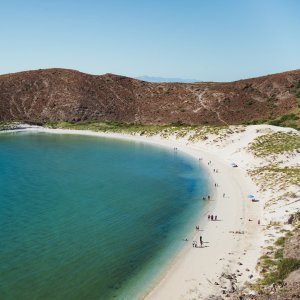
Often called “the world’s aquarium,” the Gulf of California spans 16 million ha and is home to more than one-third of the planet’s marine mammal species, over 900 species of fish, and 4,500 invertebrate species. It has been a UNESCO world heritage site since 2005 and holds several protected nature reserves.
Ballenas o Gas claims that the impact of the Saguaro LNG project would go beyond its emissions. The group warns that the LNG tankers, which can measure up to 300m in length, would navigate routes that intersect with marine priority conservation zones and pass near protected natural reserves. The traffic and noise generated by such large vessels has been linked to whale disorientation and even fatalities.
A 2024 study by researchers at the University of Washington and UC Santa Barbara, published in Science, found that ship collisions are now the leading cause of whale deaths worldwide, with thousands of whales being killed by ship strikes each year. Shipping traffic overlaps with 92% of whale ranges, but only 7% of high-risk collision zones have management strategies in place.
Lead author of the study Anna Nisi, University of Washington postdoctoral researcher, said the fact that most high-risk areas lie within exclusive economic zones is actually beneficial for the conservation of these species. “It means individual countries have the ability to protect the riskiest areas.”
Currently, most vessel management measures are concentrated along the Pacific coast of North America and in the Mediterranean Sea. Researchers estimate that extending similar measures to just 2.6% more of the ocean’s surface would cover all high-risk whale collision hotspots.
In Mexico, while there are some regulations in place to protect whales from smaller vessels, especially those used for tourism or whale watching, there are no specific policies addressing the risks large commercial tankers pose. Given the narrow shipping lanes within the Gulf of California, this scenario creates an opportunity for cooperation between the government and private companies to work on guidelines.
Noise pollution coming off from large tankers can also interfere with whale communication and navigation. Whales rely on echolocation to hunt, navigate, and even find mates, meaning an increase in underwater noise could disrupt not only their daily lives but also their chances of reproduction.
Beyond concerns over marine life, Ballenas o Gas also argues that constructing the equipment necessary for extracting and transporting the LNG would have its own set of environmental impacts. For example, the pipeline that would have to be built to connect the facility to its supply in the United States would serve as a physical barrier that could disrupt ecosystems and be a hazard due to potential leaks.
One of the main answers to this issue lies in technology. Tools are emerging that can help reduce the impacts tankers have on the ecosystem through better navigation. One of them, developed by the EU-funded Horizon Europe project OCEAN (Operator-Centered Enhancement of Awareness in Navigation), integrates hydrophone data, satellite imagery, and predictive models to give ship operators real-time environmental awareness. The system aims to reduce collision risks and help balance sustainability with operational efficiency. Additionally, technologies to reduce ship noise pollution, such as air lubrication systems and noise-reducing propellers, already exist and could be adopted by the shipping industry and factored into LNG exporters’ logistics planning.
You May Like




Most popular








