


Deadlock: Why AI Has Not Solved the Efficiency Crisis
 By Aura Moreno | Journalist & Industry Analyst -
Thu, 01/15/2026 - 08:54
By Aura Moreno | Journalist & Industry Analyst -
Thu, 01/15/2026 - 08:54
A new report from the International Labour Organization (ILO) reveals that the global productivity growth rate has stalled at 2.0%, despite the widespread integration of Generative AI. This "AI Purgatory" stems from a climate of elevated uncertainty, leading businesses to freeze hiring and reduce entry-level opportunities.
“Too many companies treat AI purely as a technology deployment rather than as a business transformation,” writes Jordi Cluró, Partner, Bain & Company, in MBN, summarizing a pattern observed across industrial sectors. This mindset, he argues, has left most organizations running pilot programs without measurable impact, even as institutional expectations for technology-driven efficiency continue to rise.
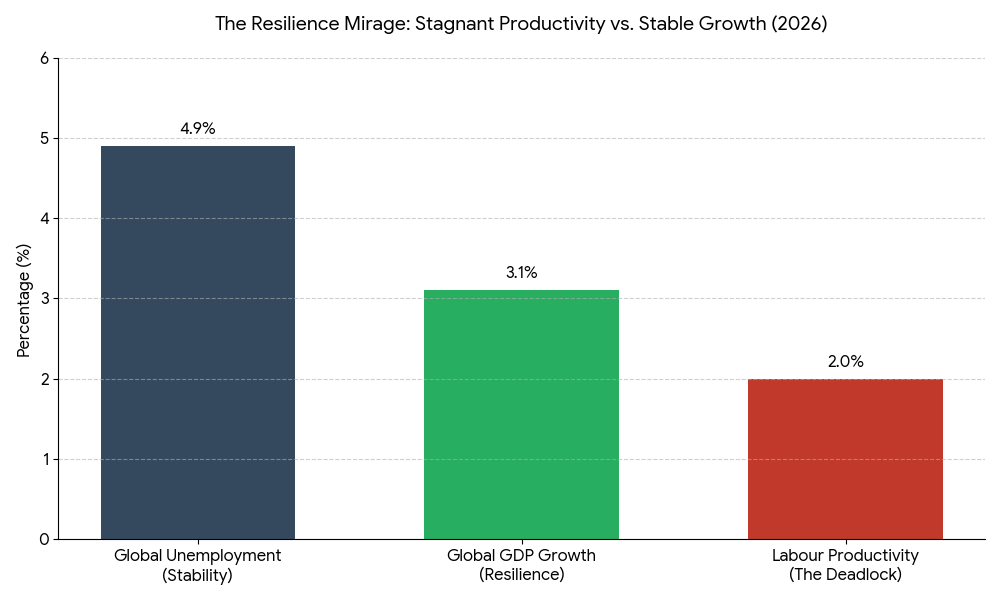
The central paradox of 2026 is the "Resilience Mirage." While the global unemployment rate remains at a historically stable 4.9%, the primary engine of long-term economic growth — productivity — is flatlining. According to the ILO Employment and Social Trends 2026 report, global labour productivity is projected to grow by only 2.0% this year. This is not merely a temporary statistical dip; it is a structural deadlock. Despite the trillions of dollars invested globally in Generative AI, the world economy is stuck in a productivity rut that mirrors the stagnant decade of 2010–2020. This disconnect is evident in global GDP figures, which remain resilient at a projected 3.1%, yet these gains are driven by capital and labor quantity rather than genuine efficiency.
The shift of workers from low-productivity sectors, such as informal agriculture, to high-productivity sectors has slowed by 50% compared to the previous decade. In Mexico, macroeconomic indicators reflect this trend. Alejandro Saldaña, Chief Economist, GFBX+, says that gross domestic product (GDP) remained largely stagnant through 2025, contracting 0.3% in the third quarter amid weak investment and subdued consumption. Formal employment growth through the Mexican Social Security Institute (IMSS) increased only 0.4% year-over-year in the same period, while total employment remained flat.
The report identifies "Elevated Uncertainty" as the primary friction point preventing a productivity breakout. Trade policy uncertainty and economic instability indices are at twice the historical average. This environment creates a "wait-and-see" hiring posture among corporate leaders. While organizations have not yet entered a full downturn, they remain hesitant to expand or restructure. This has led to an era of "Labour Hoarding," particularly in high-income countries facing aging populations. Companies are retaining existing staff to guard against labor shortages but are refusing to invest in the radical workflow redesigns required for AI to yield results. This "uncertainty freeze" is evidenced by business confidence levels sitting below the historical mean in 75% of surveyed countries — a level previously seen only during the 2008 financial crisis and the 2020 pandemic.
In Mexico, firms face additional structural pressures. Minimum wages more than doubled between 2018 and 2025, and employer contributions increased, while labor productivity declined between 4% and 6% compared to pre-2018 levels. Consequently, firms face higher labor costs and lower output per worker, reducing incentives to expand payrolls even as unemployment remains low due to declining labor force participation.
Complementary data indicates that the labor market implications of this uncertainty are visible across multiple dimensions, particularly regarding the readiness of the workforce. Hays’ Wage Analysis and Trends Report 2025 shows that while 56% of organizations in Latin America now recommend the use of AI technologies, 81% of employees report they receive no training or support to implement those tools.
This has created a widening gap between adoption in principle and effective use in practice. The result is what some analysts describe as "AI Purgatory," where tools are available but underutilized. This gap is further complicated by the "Junior Talent Trap," where AI disproportionately impacts entry-level positions. Global youth unemployment climbed to 12.4% in 2025, and nearly 260 million young people are now classified as Not in Employment, Education, or Training (NEET). In Mexico, about 20% of people aged 15 to 29 fall into this category, well above the OECD average. Because young workers often occupy "routine cognitive" roles that serve as foundational training, automating these tasks risks destroying the future leadership pipeline. Without a pool of juniors learning the basics today, there will be no senior strategists to manage the technology systems of 2030.
The stagnation is reinforced by a widening digital divide that prevents a synchronized global productivity breakout. In low-income countries, the NEET rate sits at 27.9%, and the lack of digital infrastructure prevents these regions from accessing the benefits of new technologies. While 88% of businesses in advanced economies are integrating AI into at least one function, the rest of the world is being left behind. Furthermore, many firms are experiencing the "J-Curve" effect, where initial productivity losses occur because AI is applied to legacy processes rather than used to redesign work entirely. In Mexico, Generative AI course enrollment quadrupled in 2024 to 68,000 registrations, positioning the country as the eighth-largest global market for such education. However, corporate training programs have not scaled at the same pace, leaving workers to seek out self-guided reskilling while firms remain hesitant to commit to long-term training strategies.
Analysis cited by Carlos Sánchez, CEO, Techshare, indicates that nearly a third of the skills required for an average job have changed in just three years. More than half of global job postings that mention AI are now outside traditional IT roles, spanning manufacturing, finance, marketing, and human resources. These functions are expanding in Mexico’s nearshoring corridors, from Nuevo Leon to the Bajio and the northern border, where foreign direct investment continues to grow. Nearshoring has raised expectations that Mexico can capture higher value in global supply chains, but Sánchez argues that without a coordinated skills strategy, the country risks becoming an execution hub rather than a design center. The critical investment is not only in hardware or software, but in "enduring skills," such as communication, leadership, data-driven critical thinking, and ethical judgment. Positions requiring these human-centric capabilities alongside AI proficiency currently carry salary premiums of roughly 28%.
To break the deadlock, the ILO suggests a shift from automation — replacing humans to save costs — to "augmentation," which uses technology to supercharge human output. The potential for AI to augment jobs is estimated to be six times greater than its potential to fully automate them — 13.0% versus 2.3% of global jobs. Corporate governance and public sector responses illustrate this shift; in late 2025, IMSS created an internal commission to govern AI use across the institution, focusing on data protection and alignment with institutional objectives to support clinical decision-making.
Moving out of "AI purgatory" will require organizations to reverse junior hiring freezes and invest in the redesign of work. Rather than waiting for macroeconomic clarity, experts argue that firms must actively redesign roles around human-AI collaboration. This includes allocating budget and time to skills development, particularly for early-career workers who will form the backbone of future operations.
|
Point of Deadlock |
Data/Metric |
Impact on Talent |
|
Productivity Gap |
2.0% growth vs 3.1% GDP |
Labor costs rising faster than output. |
|
Investment Fear |
1.3% FDI/GDP (20-year low) |
Stagnant digital transformation budgets. |
|
Youth Exclusion |
20.4% NEET rate (Projected) |
Future leadership pipeline is shrinking. |
|
Strategic Error |
Automation Focus |
Short-term savings at the cost of long-term innovation. |
Source: ILO.
The macroeconomic stakes of this transition are significant. A shrinking labor force and a stalled productivity rate constrain potential GDP growth, while higher labor costs without corresponding efficiency gains increase inflationary pressures. Public finances face additional strain as dependency ratios rise due to demographic aging. In this context, AI represents both a risk and an opportunity. Used narrowly as a tool for cost-cutting, it may reinforce existing inequalities and technical inefficiencies.
Deployed as part of a broader augmentation strategy, AI could help offset demographic headwinds and support more inclusive growth. For organizational leaders entering 2026, the implication is that the productivity crisis is not a failure of algorithms, but of coordination, confidence, and workforce strategy. Moving out of the deadlock will depend less on the next technological breakthrough and more on decisions made today regarding training, talent pipelines, and the structural redesign of daily work.
You May Like








Most popular








