


Viva Averaged 21 Grounded Jets Monthly Amid Pratt Engine Recalls
 By Teresa De Alba | Jr Journalist & Industry Analyst -
Fri, 11/28/2025 - 14:46
By Teresa De Alba | Jr Journalist & Industry Analyst -
Fri, 11/28/2025 - 14:46
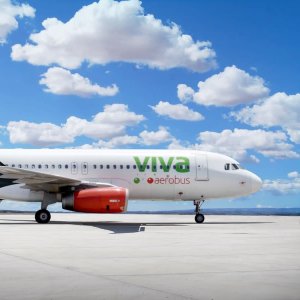
Viva averaged 21.3 grounded aircraft per month between September 2023 and October 2025 due to recalls of Pratt & Whitney PW1100G and PW1400G engines, according to a technical and financial analysis by aviation consultant Armando Sánchez Mata.
Over the 26-month period, the low-cost carrier had between three and 26 aircraft out of service each month as its fleet expanded from 78 to 119 units. The biggest impact occurred in August 2024, when 26 aircraft were grounded — 24.5% of the fleet. By model, the peak disruption was in May 2025, when 17 A320neo aircraft were inactive, representing 68% of that subfleet.
“The decline in flight hours throughout 2024 is directly linked to reduced aircraft availability,” Sánchez Mata said.
To mitigate the shortage, Viva implemented wet-lease agreements with Avion Express and SKY Airline starting in late 2023, bringing in additional A320ceo and A320neo capacity. The move drew criticism for involving foreign pilots, prompting the Colegio de Pilotos Aviadores (CPAM) and the Asociación Sindical de Pilotos Aviadores (ASPA) to raise concerns about labor impacts and the constitutional requirement that flight crews operating in Mexico be Mexican by birth.
The engine recall stems from defects in critical Life Limited Parts (LLP)—including discs, hubs, and seals in compressors and high-pressure turbines. Since 2023, the US Federal Aviation Administration (FAA) has issued several airworthiness directives mandating inspections and component replacements, affecting Viva, Volaris, and carriers abroad such as Spirit Airlines in the United States and ITA Airways in Italy.
Volaris has also faced disruptions due to Pratt & Whitney inspections and has extended its review program through 2028. Part of its fleet remains grounded, though the airline says it does not expect a significant operational impact and projects 6%-8% capacity growth next year. CEO Enrique Beltranena said the main effects should conclude in 2027, with limited delays extending into 2028. Volaris — one of more than 40 airlines affected by the accelerated inspections announced in 2023 — also reached a multi-year compensation agreement with the manufacturer. In 3Q25, an average of 36 Volaris aircraft were grounded, a figure the airline expects to narrow to 32–33 in 2026.
Viva has primarily stored grounded jets at the Roswell International Air Center in New Mexico, with additional aircraft parked in Monterrey, Mexico City, and Aguadilla, Puerto Rico. As of late October 2025, 26 aircraft — 17 A320neo and nine A321neo — were distributed across these facilities.
According to IATA, the global backlog of new aircraft orders has reached a record 17,000 units, while about 14% of the world’s fleet—roughly 5,000 of the 35,166 aircraft in service as of December 2024—remains parked for various reasons.
Sánchez Mata’s analysis drew on Airfleets and Flightradar24 data, cross-checked against official flight-hour records from the Agencia Federal de Aviación Civil (AFAC). Under the study’s methodology, an aircraft is classified as “grounded” when it has not operated a commercial flight for at least 70 days.
You May Like







Most popular








