

Solar Solutions Benefit Water-Scarce Regions



STORY INLINE POST




 By Sergio Taborga | Journalist & Industry Analyst -
Mon, 08/12/2024 - 11:15
By Sergio Taborga | Journalist & Industry Analyst -
Mon, 08/12/2024 - 11:15
Q: How has the evolution and growth of the distributed segment impacted your operations in Mexico?
A: Distributed generation remains our focus, but we also have a small utility-scale project in Mexico City’s Central de Abastos, a large food supply center that produces 8.6MW. It is a somewhat unusual project because almost all comparable activities have been canceled during this administration. This is a hybrid project, utility-scale but in an urban setting. Central de Abastos appears to have the largest roof in Mexico and possibly one of the largest in Latin America.
We are focusing on distributed generation and hybrid projects, which we have managed in many parts of the world. In India, for example, we are the leading supplier of solar panels. We do well in “dusty” high-soiling factor markets.
Q: How does a sales strategy based on volume help ZNSHINE Solar adapt to the lower prices of energy and solar panels?
A: The prices of solar panels have dropped significantly. China's production capacity continues to increase, causing an oversupply and, consequently, a decrease in the price of the panels and of distributed energy. The cost per watt of distributed energy has decreased by 30% to 40% and now stands below US$0.10/Wp FOBChina. The less expensive solar panels benefit consumers but those selling them had to increase their sales volume to maintain the same revenue. What is interesting is that the cost of maintenance has remained steady, requiring the allocation of a monthly budget for cleaning paid in Mexican pesos.
While the lower costs of solar panels benefit clients, these savings do not offset the costs of maintenance. Depending on the duration of the PPA contracts, the accumulated cost of future maintenance can approach the present value of the panel, standing now at about 60% of the panel’s cost, but if we consider the Net Present Value of future maintenance cost the offset clearly appears. Our panels offer long-term maintenance-cost advantages; this is our value proposition.
Q: How has Mexico’s water crisis affected ZNSHINE Solar’s solar operations?
A: The water crisis greatly affects solar operations, as it has a crucial role in maintenance. Clients mostly clean distributed energy installations every six months but some of them never do. The ideal cleaning frequency to maintain adequate efficiency is monthly. If not cleaned properly, the panel's generation capacity can decrease by 15, even 30%, leaving a significant amount of potential in distributed energy not being used due to negligence in maintenance. Imagine 30% of current 3.9GW of Mexican DG power resting under the dust, that is almost 1GW of “lazy” power. Addressing this issue is essential to optimize the performance and efficiency of installed solar systems.
Our patented graphene technology has been crucial for our development. Over the past three years, ZNSHINE Mexico has focused exclusively on selling double-glass and graphene solar panels. This strategy is part of our long-term approach to ensure that every installation delivers exceptional results. We combine product quality with impeccable service, which is essential to being a leading supplier in our key markets.
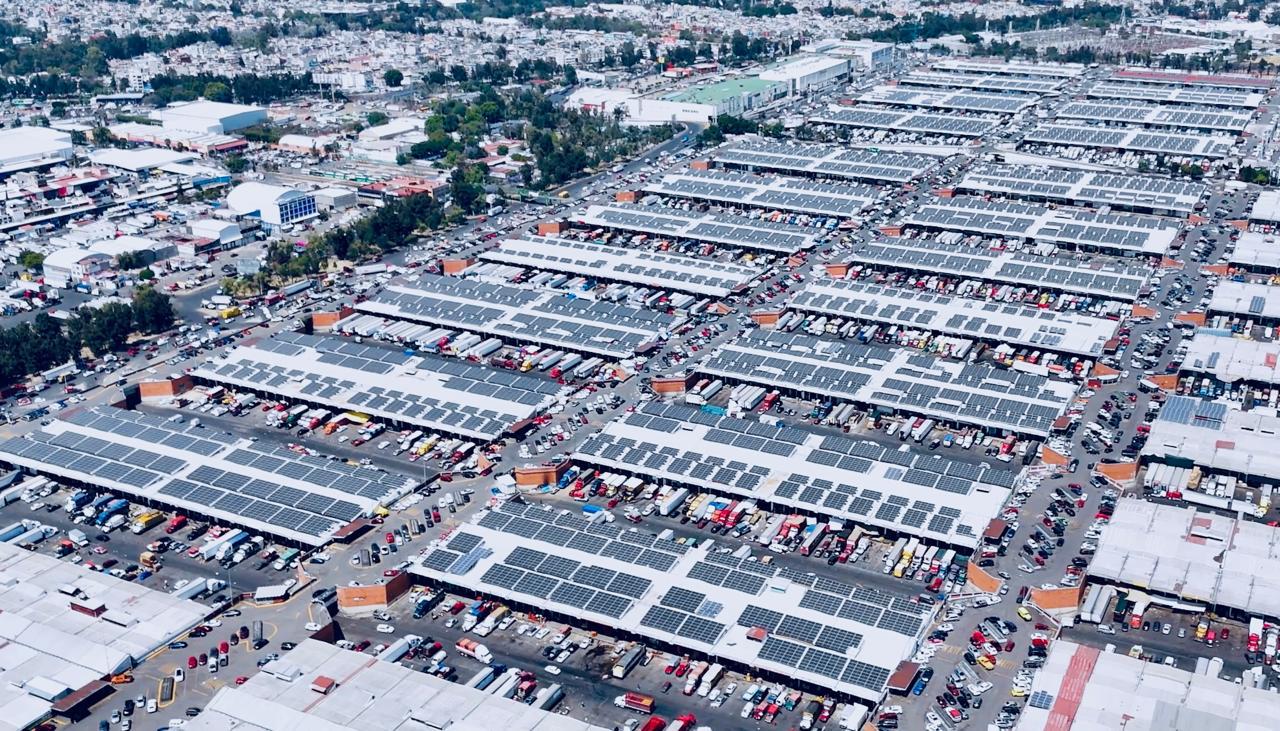
Central Fotovoltaica de la Central de Abastos (CEDA)
Q: What are the benefits of your double glass solutions?
A: We own the patents for our double-glass and graphene technologies, which we believe to be the best. Their technical characteristics are like those of a bifacial panel, but on a monofacial PERCor N-Type panel. We invested millions of dollars in their development and have already recovered that investment. We plan to use this technology to level the playing field.
With clear numbers and simulations, our offer stands out. We prefer to work with clients who understand our panels and can make the most of its physical characteristics. This allows us to guarantee quality installations, without cutting corners on inverters, structures, or engineering. When combined with graphene technology, these PV installations become an excellent solution to the Mexican context.
Q: What does nearshoring mean for your operations in Mexico and how is it affecting the country’s renewables sector?
A: Nearshoring has had a great impact on our operations because our main markets are the north, northeast, northwest, and Bajio regions, those dry regions with solid businesses with the United States. These are key areas for us due to soiling and water scarcity. The accumulation of dust and the scarcity of water significantly impact those regions, and they could greatly benefit from our solutions. These regions house production and manufacturing sites that are turning to renewable energy, and our solutions can help them manage soiling and water scarcity to make their installations more efficient. Currently we cannot sell our Graphene patent in the United States due to import restrictions, but we are working on new paths to bring these benefits to this huge market.
Q: What is the best path Mexico can take to achieve its sustainability goals?
A: Achieving these goals is difficult because the transmission issue has not been prioritized. By fixing the transmission problem, the country could deploy a bolder polycentric energy generation scheme. The private sector is ready to address this problem, the social sector must be kindly included. The United States, for example, made strong investments to develop both distributed energy channels and utility-scale projects in Mexico. The investment is available; the sector just needs to establish clear rules of the game. The groundwork was laid in this federal administration, and the next one will have to consolidate and join the efforts of various players, including communities that guard our culture and environment.
The next government administration will have to address transmission. It will likely facilitate continued investment in distributed generation, but for utility-scale generation, it needs to create much more specific rules. Although the industry has experienced a slowdown, this could be an opportunity to rethink social dynamics while conducting development with clearer guidelines. Once efficient transmission is achieved, authorities should also focus on creating new rules for fair energy generation, adapted to the vast social and ecological diversity and richness of Mexico.
Q: How is ZNSHINE Solar shaping the technological future of Mexico’s solar energy sector?
A: Other companies are starting to copy us, which speaks highly of what we are doing and how we lead with innovation. Other companies are introducing dust and water drainage systems into their panels, and double glass is increasingly being used.
Mexico is an interesting market, especially as it becomes more regulated. Mexico and other major markets like India and the United States are adopting more regulations. The Mexican market is growing. While the country is experiencing a private utility-scale projects ban, the intellectual and engineering capacity remains strong, resulting in a solid and resilient market in distributed generation. Solar energy allows for the generation and growth of polycentric systems, which are the most resilient in the natural world.
Q: What are ZNSHINE Solar’s objectives in the Mexican market for 2024 and 2025?
A: We would love to continue our entry into the utility-scale market in Mexico. Our self-cleaning panel works as well for utility-scale projects as it does for distributed generation. This is increasingly important considering the country’s water scarcity. Our panels have a hydrophilic surface, so a water drop spreads out flat, allowing water droplets to carry dust particles more efficiently. Our panel saves 30% in maintenance costs and 30% in water consumption, greatly reducing the environmental impact. Despite all changes that have taken place in the Mexican industry, it has evolved and become more resilient.
ZNSHINE Solar is one of the most experienced solar module suppliers and manufacturers in the PV industry. In addition to manufacturing high-performance PV modules, it provides leading engineering, procurement, and construction (EPC) services and provides a one-stop service for product application solutions.
You May Like








Most popular








