CONUEE Expands Industry Energy Efficiency with New Agreements
Mexico’s National Commission for the Efficient Use of Energy, (CONUEE) has formalized two new partnerships with key industry groups to accelerate energy efficiency and sustainability across industrial parks and manufacturing sectors with a significant economic footprint. Through separate letters of intent signed with the Mexican Association of Private Industrial Parks (AMPIP) and the National Chamber of the Cosmetic Products Industry (CANIPEC), CONUEE aims to promote best practices, strengthen technical capacities and encourage voluntary commitments to efficient energy use.
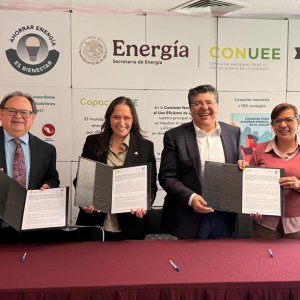
At the signing with AMPIP, CONUEE Director General Israel Jáuregui Nares said energy efficiency must be integrated across the full industrial cycle, from design and operation to final energy consumption. He said the agreement enables Conuee to extend its technical and operational capabilities to a sector with significant economic and territorial impact. “We are convinced that energy efficiency must always come first. This agreement is the start of work that will yield benefits for national development and for industrial parks themselves,” Jáuregui Nares said.
AMPIP Director General Claudia Esteves Cano said the association represents 95% of Mexico’s industrial parks, with operations in 28 states and more than 4,000 companies. AMPIP includes 477 industrial parks currently in operation and 103 under construction. She said the goal is for all affiliated parks to adopt energy efficiency measures and obtain a distinction reflecting a commitment to sustainability.
Esteves Cano added that AMPIP-affiliated parks concentrate 99% of foreign direct investment in manufacturing and 98% of national manufacturing GDP. Collaboration with CONUEE, she said, will support energy diagnostics, training programs and the dissemination of best practices to improve competitiveness and environmental performance.
CONUEE officials said the AMPIP agreement establishes four main lines of action: strengthening technical capabilities, creating collaboration networks, organizing joint training events and providing technical assistance to affiliated parks. The initiative is aligned with the National Energy Efficiency Agreement (ANEE), which targets large energy users and emerging industrial development hubs.
In a separate ceremony, CONUEE signed a letter of intent with CANIPEC to promote energy efficiency and sustainable practices in the personal care and household products industry. The agreement was led by Jáuregui Nares and CANIPEC Executive President Carlos Ramón Berzunza Sánchez.
Jáuregui Nares said cooperation with manufacturing sectors is essential to position energy efficiency as a core element of sustainability and competitiveness. Berzunza Sánchez highlighted the industry’s role in quality of life and said responsible energy use must be embedded throughout the value chain.
CANIPEC representatives said the chamber acts as a link between companies, authorities and consumers to promote environmental protection. Sustainability and circular economy initiatives already underway will be strengthened through collaboration with Conuee, including technical training, workshops and voluntary agreements under Mexico’s energy planning and transition framework.
Diana Verónica Noriega Navarrete, CONUEE’s director of large energy users, said the ANEE provides a platform for companies in both industrial parks and consumer goods manufacturing to adopt practices that improve energy performance and support decarbonization.
CONUEE: Advancing Energy Efficiency in Mexico
The AMPIP and CANIPEC agreements build on a series of similar memorandums signed by CONUEE and industry groups in late 2025. In September, the Commission signed a letter of intent with Mexican Institute of Chemical Engineers (IMIQ), laying the groundwork for joint energy efficiency initiatives through 2029. The signing was led by Jáuregui Nares and Víctor Martínez, National President, IMIQ.
Within the framework of Mexico’s National Energy Efficiency Agreement (ANEE), CONUEE outlined priority actions, including improving energy management among major users and driving efficiency gains across industrial processes. According to the Commission, the partnership is designed to facilitate technical information exchange and the development of collaborative projects, reinforcing both institutions’ roles as key players in advancing sustainable energy use. For its part, IMIQ highlighted the contribution of chemical engineers to improving processes, proposing innovative solutions, and creating networks of expertise to promote best practices.
That same month, CONUEE signed another letter of intent with National Institute of Electricity and Clean Energy (INEEL) at INEEL’s headquarters in Cuernavaca, Morelos, involving Jáuregui Nares and INEEL Director General Víctor Salcido. At the signing, both officials emphasized that the agreement formalizes joint efforts to develop strategic projects, training programs, and technical capacity-building initiatives that support the country’s energy transition.
Under the agreement, CONUEE and INEEL are set to establish joint working groups to design methodologies and technical tools, share information, and organize workshops, courses, and training events. The collaboration will also include the promotion of knowledge networks focused on efficient energy management in key sectors of the Mexican economy.
Officials highlighted that the partnership will allow INEEL to expand the services it provides to both public and private companies, while CONUEE will be able to access national and international programs supporting energy efficiency and sustainability. Together, the institutions said they aim to build synergies with academic, public, and private organizations to reinforce Mexico’s role in global clean energy efforts.
CONUEE has also sought to integrate state government agencies in its energy efficiency initiatives. In October 2025, the Commission signed an agreement with the Jalisco State Energy Agency (AEEJ) to promote energy efficiency across the state and strengthen the technical capacities of government personnel. The collaboration built on workshops held in August and September of that year, which trained state and municipal staff on energy efficiency in public buildings, street lighting, and water pumping systems. The sessions encouraged the adoption of measures aimed at reducing energy consumption and optimizing the operation of public services.
Meanwhile, in March 2025, CONUEE signed another letter of intent with Campeche’s Ministry of Environment, Biodiversity, Climate Change, and Energy (SEMABICCE), seeking to expand joint cooperation on energy efficiency initiatives in the state. The agreement followed an earlier collaboration launched in 2023 to promote energy-saving programs in public buildings across Campeche.
The initiative was initiated to bolster the technical capacity of municipal governments and support the implementation of best practices for energy efficiency in public facilities. It also included training, technical assistance, and project development guidance focused on improving public lighting and potable water pumping systems. These efforts were intended to equip municipalities with effective tools to lower operational costs associated with essential public services.
During the signing event, Jáuregui Nares highlighted the Commission’s readiness to continue working with Campeche’s government and to extend cooperation to the state’s industrial sector. SEMABICCE’s Director General of Sustainable Energy, Jorge Narro, noted progress in implementing energy efficiency programs in public buildings and emphasized the importance of interinstitutional collaboration to advance energy savings statewide.
You May Like


Most popular